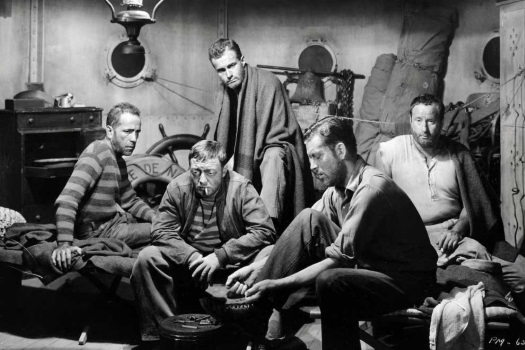
Passage to Marseille
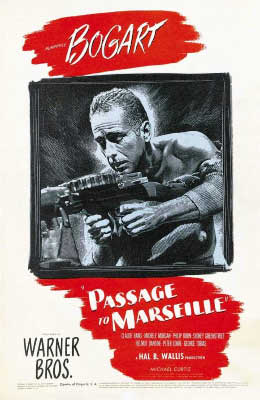
Director: Michael
Curtiz
Year:
1944
Rating: 6.0
Warner Brothers tried to recapture that
magic of Casablanca by bringing on the quartet of Bogart, Rains, Greenstreet
and Lorre as well as a few of the minor players under the direction of Michael
Curtiz. It too centers on the Free French and the Vichy government with multiple
Viva la Frances spoken throughout. But a mangled story that drowns in flashbacks
takes away from any sustained narrative suspense. It feels like there are
four movies on top of each other. Each one is fine on its own but they detract
from the others. I am not a fan of the flashback device in general - it was
so unnecessary in Casablanca - but here we get a flashback within a flashback
within a flashback.
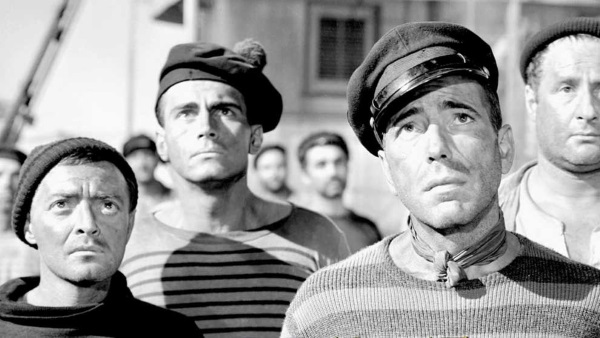
The main one is understandable with Rains
of the Free French airforce relating the story of Matrac (Bogart), one of
the flyers to a journalist. But along the way there are two other lengthy
flashbacks that go on for much too long. I just wanted to get back to the
main flashback and hurry these other ones along. Bogart really wanted this
role and Warners used that to force him to make a film (Conflict) that he
wanted no part of. They told him if he didn't make Conflict they would get
Jean Gabin to take his role in Passage. In a sense that might have been better
as the character is French and Gabin had in fact enlisted in the Free French
forces and been there when Paris was liberated. But Bogart was a draw at
the box office. Bogart finally gave in to make Conflict when he heard that
his friend Leslie Howard had been shot down and killed by the Germans. His
issues in the scheme of things didn't seem important any longer.
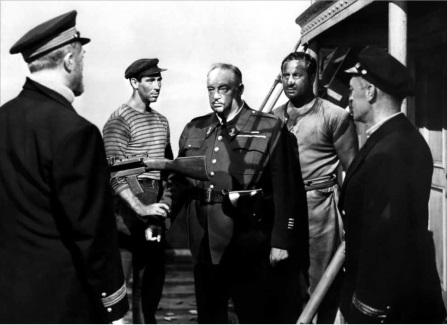
There are some very effective scenes and
a few that make you wince. Lets tell the story in chronological order - no
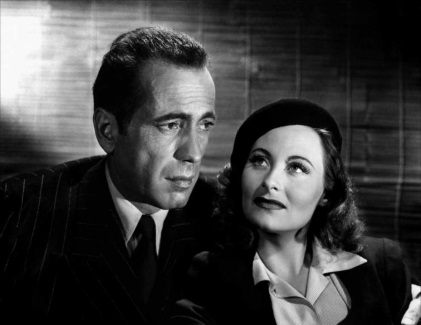
flashbacks. Bogart is an anti-fascist reporter in France in love with Michèle
Morgan, a French actress who had left after the German invasion. She never
quite made it in Hollywood (had been considered for Bergman's role in Casablanca)
but became a huge star in France after the war. She has a fascinating angular
face. Bogart gets framed for murder by the French fascists and sent to a
penal colony. There he escapes with four other men - Philip Dorn, Peter Lorre,
George Tobias and Helmut Dantine - who all want to get back to France to
fight the Nazis.
I could happily have done with much shorter
versions of both. Now we are back to the main and most interesting flashback.
They are picked up by a ship heading for Marseille where Rains is a passenger
along with Greenstreet. So Bogart, Lorre, Rains and Greenstreet all together.
Bogart, Lorre and Greenstreet are always linked together because of Maltese
Falcon and Casablanca. Bogart was to work with each in five films. Greenstreet
and Lorre were in nine films together. Greenstreet who acted in his first
film at 61 years old plays a Vichy officer who initially pompously swears
that the Maginot Line will stop the Germans and when it doesn't, he becomes
an adherent of the New Europe. Greenstreet really didn't want to play this
character but Warners forced him too. The scene of the German plane strafing
the boat with Bogart and Lorre each on a machine gun is great. When Bogart
guns down the unarmed pilots, it was controversial and had to be cut out
of overseas prints. The film is no Casablanca but it was a box office success,
has fine performances, Lorre is a good guy for a change and is a solid piece
of propaganda for the Free French.