Lajja (Shame)
Director: Raj Kumar Santoshi
Music: Anu Malik, Lyrics: Sameer
Year: 2001
Running Time: 3 hours 7 minutes
This effort from Santoshi is an extremely
interesting attempt at painfully exploring the position of women in India’s
society today through the experiences and eyes of one woman. In the end it
unfortunately seems to almost nervously back away from where it logically
was heading, but until then it was a powerful and emotional indictment of
the system that exists. This angry feminist perspective didn’t play well
at the box office and it is perhaps a film that might appeal more to audiences
in the West. My impression is (based on admittedly very few films and even
less knowledge) that a social agenda such as this is fairly rare in Bollywood
films.

What begins as a panicked flight for Manisha Koirala slowly turns into a
journey of self-discovery, self-esteem and feminist awareness on her part.
As Manisha travels across India in her attempt to stay out of harm’s way,
she begins to realize that more than her fate is involved – that what has
occurred to her is symptomatic of what is happening to Indian women at every
level of society. As this awareness grows she slowly transforms from a traditional
Indian wife to a feminist activist. Manisha plays the character well and
gives her enough depth to make this transformation seem fairly natural and
believable – from initially being only a reflection of her husband’s feeling
towards her to finally giving a fiery declaration of independence – and only
the script lets her down in the end. I should mention that the DVD has English
subtitles that come and go like the tide, but much of it was reasonably easy
to follow – but definitely there were bits that I missed.

Vaidehi (Manisha) lives an upper class existence in New York City with her
husband (Jackie Shroff). She is unable to adjust to or condone his playboy
swinging lifestyle and he finally loses patience with her attitude and orders
her back to India to live with her family. Her father is furious and humiliated
to find her on his doorstep and demands that she return to her rightful place
– by her husband’s side. When she receives a call from Shroff murmuring words
of love and loneliness, she happily prepares to return. Just as she is about
to board the plane though she learns from her doctor that she is pregnant
and that Jackie knows and plans on divorcing her after she gives birth and
keeping the child. She goes on the run with two of Jackie’s minions (Razzak
Khan and Johnny Lever) and seemingly much of the Indian police force in close
pursuit.

Sort of like a black cloud, Manisha meets and bonds with three other women
over the course of her journey and has to witness their degradation or destruction
at the hands of men. She first meets up with a kindly thief (Anil Kapoor)
and both end up sneaking into a wedding ceremony where Mahima Chaudhary is
about to be married. The groom’s family though is basically extorting Mahima’s
father for a larger dowry and he is unable to come up with the money. When
Mahima lifts the veil of silence and curses the family and their greed and
their weakling son, it will send chills down your spine.

Next Manisha travels to another town where she meets Madhuri Dixit, a member
of a theater troupe, who plays the heroines in the productions. She is a
completely free spirit, full of life – figuratively and literally – as she
is two months pregnant and unwed. The two of them become good friends and
she teaches Manisha to lighten up a bit – and even how to dance and how to
go the bathroom behind a rock. But her male lover deserts her and the crowds
turn against her in a fury when they learn she is “unchaste”.

In her final encounter Manisha meets Rekha who is sort of a mother figure
to a small village. Needless to say Manisha’s arrival foretells bad tidings
for Rekha. The final section simply goes terribly off track and largely negates
much of what went on before it. It is as if the director began to realize
that the film he was making lacked in commercial appeal and so he brings
in an Indiana Jones like hero (Ajay Devgan) that feels as if he fell in from
another film. The mood of the film had been fairly intimate and personal
and it quickly becomes a pointless action film that is nonsensical. Even
worse then this though is the very final act of contrition and forgiveness
that leaves a bad taste in your mouth. It is a shame that the director didn’t
stay the course with the themes that he was delivering.

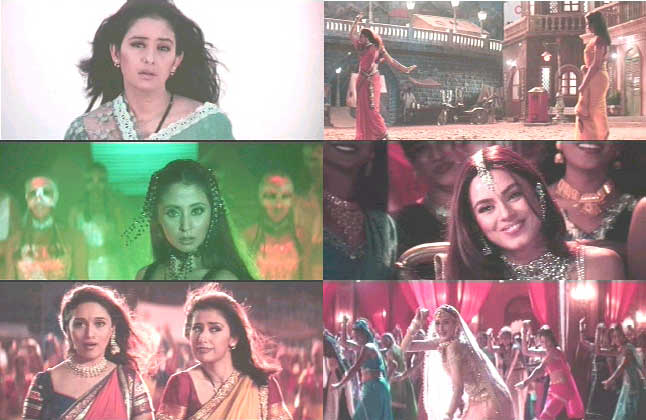
There are very few musical numbers in the film and this plays well with the
serious and intense social tone of the story – but the three main numbers
are all terrifically well done. In the first, Urmila makes a special appearance
and puts on sort of a Las Vegas snazzy floorshow. At the wedding Sonali Bendre
also makes a guest appearance to perform one song that is vivacious and very
catchy and she looks great. The best-choreographed number though is the one
that takes place with first Madhuri breaking into song and then Manisha tentatively
joining her in a joyous number.

Even with the ending, the film is still worthy and much of it is powerful
in a quiet disturbing way. Performances from the four main female actresses
are all absolutely terrific and natural and each of them is given a “get
on your acting chops” scene to emote to.
My rating for this film: 7.5