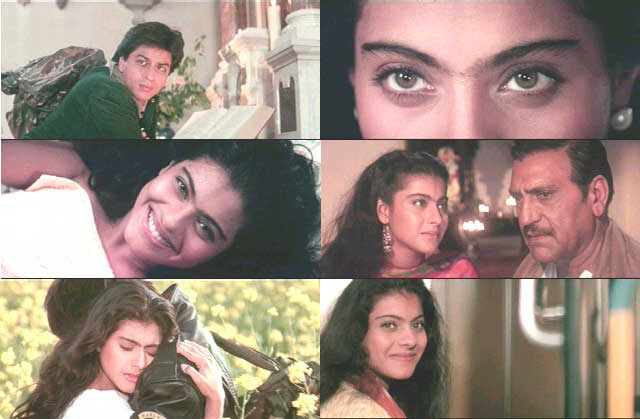
Dilwale Dulhania Le Jayenge
(The Lover Will Carry the Bride Away)
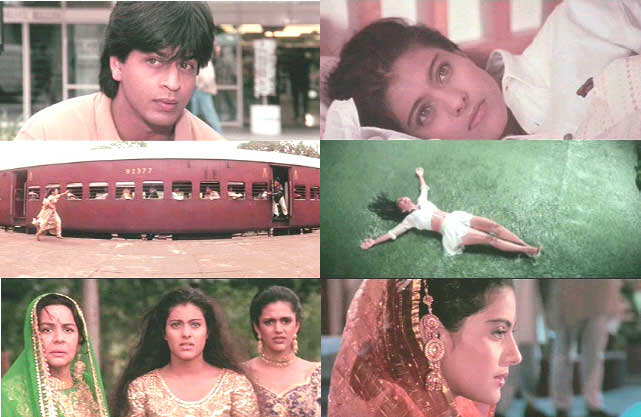
Director: Aditya Chopra
Music: Jatin Latin, Lyrics: Anand Bakshi
Year: 1995
Running Time: 3 hours 9 minutes
First time director Aditya Chopra (who comes
from a famous film family) struck both pure gold and pure hearts with this
simple but very affecting romance between two young lovers who have to overcome
the usual Bollywood parental roadblocks and hurdles to find happiness. The
film breaks no new ground in terms of plot but brings enormous heapings of
charm that it sprinkles like a fairytale snowfall throughout. The film was
huge – made its two main leads super stars – won a record number of awards
and apparently the film is still playing in theaters some six years after
its release - the longest running Indian film in history.
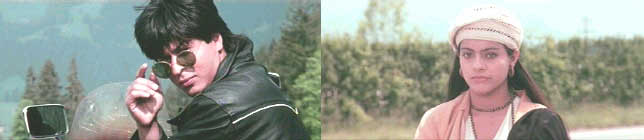
From a flint-eyed perspective, it is perhaps difficult to understand quite
why this film had the impact that it did because it certainly has its share
of faults. At times it feels slightly ragged, it drags in bits, is played
too broadly at times and the transitions from scene to scene occasionally
feel rough, but it somehow overcomes this lack of polish to pull the viewer
in like a slow moving gravitational vortex. Almost against your better judgment
you start to really care about this twosome and the seemingly insurmountable
odds against them. More than the script and more than the direction, this
has to primarily be attributed to the wonderful performances of Shahrukh
Khan and Kajol who lightly and lovingly tread on this old material and give
it a lovely freshness and spark that it almost doesn’t deserve. They are
by turns sweet, annoying, petulant, lovable, radiant, emotional and always
very real and natural.
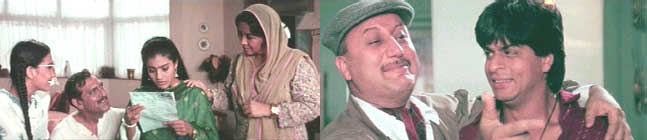
There are times during the film in which you want to smack Shahrukh for being
such an obnoxious smart aleck and for giving Kajol such a difficult time,
but as his feelings for her slowly change from a shallow flirtation to a
deep-rooted love, he takes on a surprising depth and strength. In a short
period of time love forces him into adulthood and his resolve to marry her
makes the best in him surface. Shahrukh is in near constant motion and oozes
silliness and sentiment in a manner that makes him very likable.

Though Shahrukh is initially a bit of a git, Kajol steals your affections
from the first frame as she stands at a window, her face being covered by
her wind blown hair, and parts it to reveal a face full of innocence, high
spirits and hope. Minutes later she is ecstatically dancing in the rain simply
at the thought of love even though no one has yet entered her life. Her character
is the most interesting and best developed in the film – Westernized but
still very traditional as she accepts her fathers wishes with a sense of
fatalism that is touching and yet tragic. When Shahrukh’s father (Anupam
Kher) meets her for the first time and says he now understands why his son
loves her so completely – so do we.
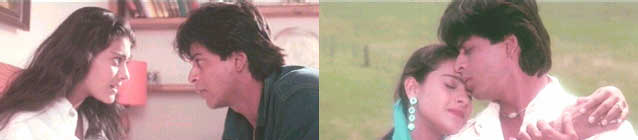
Kajol (Simran) has lived in London with her younger sister, her mother (Farida
Jalal) and her father (Amrish Puri) for all of her life – but conservative
Indian traditions are still a large part of the family’s life and her father
still feels that even after twenty two years his stay in London is only on
a temporary basis – faraway Punjab is still his true home. This theme of
Indians abroad longing for home – never feeling a part of the fabric of their
adopted country – plays out in a number of recent Indian films. In the book
Bollywood Cinema by Vijay Mishra he spends a good deal of time on this film
in his chapter on the Indian diaspora and its effect on Indian film. He writes
that DDLJ was the first film to fully approach this subject and play intentionally
to the overseas Indian population. But though the film seems to be full of
nostalgia for the customs of the home country it gives a conflicting message
at the same time as it is those traditions that cause the troubles and that
have to be changed for the film to come to a satisfactory ending. A streak
of nationalism pervades the film – such as Shahrukh telling Kajol when she
thinks her honor has been compromised “You think I am a wastrel. I’m not
scum. I’m Hindustani and I know what honor means for the Hindustani Woman”.
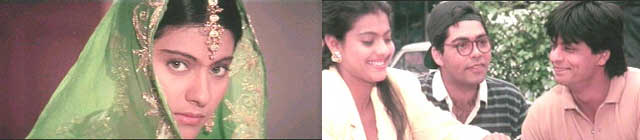
Kajol is hit with a body blow when she reads her father’s letter from an
old friend that announces that their pledge to marry their children to one
another is now ready to be acted upon. As Kajol tells her sympathetic mother
“I had forgotten I haven’t the right to dream”. She tells her father that
since she only has one last month to live her own life she wants to go to
Europe with some girlfriends. In an intimate and touching father/daughter
scene, he agrees. She soon runs into the fast talking Shahrukh (Raj) who
is also with two friends (one of whom is Karan Johar, the future director
of two of Shahrukhs and Kajols biggest hits – Kuch Kuch Hata Hoi and Khabie
Khushi Kabhie Gham) and the two of them want nothing to do with one another
– but when they miss a train they have to travel on their own together (and
Kajol produces the magic purse that seemingly holds multitudes of clothing
changes!) and though unable to admit it to one another – eventually fall
in love. Upon returning to London Kajol is whisked away to India for the
marriage – Shahrukh decides to follow and win not only her love but even
more importantly the consent of her father.
The film not only gets the two terrific
performances from Kajol and Shahrukh, but also very effective ones from the
supporting cast. Both fathers give distinct characterizations – Anupam’s
is comical and affectionate, Amrish’s stern, forbidding and yet he is a father
who clearly cherishes his daughters. In a smallish role, Mandira Bedi is
very sweet as the girl in India who falls for Shahrukh. But it’s Farida as
Kajol’s mother who gives an especially memorable turn here. In particular
she has two scenes that got her the Best Supporting Actress award – one in
which she tells Kajol to put her dreams away and accept the sad but unavoidable
fate of the Indian woman and then later when she pleads with Kajol to seize
her love and live her life on her terms.
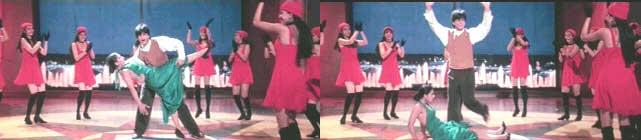
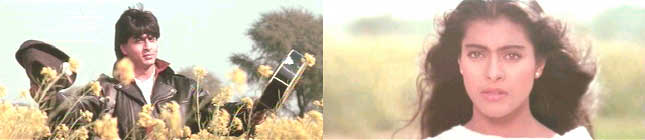
The music is uniformly wonderful with the centerpiece being Tujhe Dekha a
beautiful and haunting tune with a lovely mandolin refrain in which Kajol
and Shahrukh admit their feelings for one another. Other standouts are Mere
Khwabon Mein with Kajol practically exploding on screen in a scene of sexual
awakening as she dances coquettishly in a towel and then squirms provocatively
in the pouring rain. Much of the choreography though is surprisingly uninventive
and only the lively Mehndi Lagake really hits home with its call and response
scenario between the men and the women at the engagement party.
The DVD for this film was just released after being delayed for years due
to a legal issue about rights – but unfortunately the transfer is much less
than one might expect for such a high profile and treasured film. It shows
a fair amount of wear and the aspect ratio doesn’t look right. It does come
with loads of extras though and I particularly liked the interview with Kajol
in which the questioner asks her how is she able to be laughing around on
the set seconds before a dramatic scene and then go right into it with such
fervor – to which Kajol responds “because that’s what I get paid to do”.
My rating for this film: 8.5