Mast
Director: Ram Gopal Varma
Music: Sandeep Chowta; Lyrics: Nitin Raikwar
Year: 1999
Running Time: 2 hours 23 minutes
Since his first film, director Ram Gopal
Varma has created an image for himself as one of the mavericks of Bollywood
– willing to take chances, to be innovative and to introduce a sense of hard-edged
realism that many Bollywood films shy away from. Many of his films have eschewed
or minimized musical numbers because he felt they were simply a distraction
to the narrative and mood of the story he was unfolding. His first film in
1989, Siva, was a huge Telugu hit that forced the entire Telugu film industry
to change its style and take on less cartoonish aspects. He has ventured
into many genres – horror (Kaun and Raat), comedy (Kshana Kshanam and Anaga
Anaga Oka Roju), romance (Rangeela), but he is most identified with his crime
films. He has come under heavy criticism for his violent, but glamorized
portrayal of the underworld in his gangster films – Gaayan, Satya and Company
– but the last two have been among his most popular films and he has refused
to back down. Though these rough gangsters and their violent world seem to
have a fascination for him, he has on occasion gone into the complete opposite
direction with films that were as sweet and gentle as a spring rain.

He has said that he grew up loving and living films – his parents wanted
him to become an engineer and were very disappointed when he went into the
film business. As a student in college he would see eight to ten films a
week and just suck in their style – often seeing the same film a number of
times just to see a particular scene that impressed him. His cinematic style
clearly shows a love for American films and Mast appears to be an open heart
Valentine to the musicals and screwball comedies of the 1940s and 50s. There
isn’t a mean bone in this film – it’s just a big gushy frothy tribute to
the movies, to the fans and to the films he loved to watch. The film doesn’t
deliver a big emotional punch – and that perhaps is among the reasons it
did so poorly at the box office – but its good nature, sumptuous musical
set pieces that nearly swallow the film and portrayal of the film world and
their fans completely charmed me. Though the film is filled with various
characters, the director is really the star here and the actors are simply
pieces he moves around to lovely effect.

Aftab Shivdasani (in his debut after Varma saw him in a coke ad) plays a
film fan – in particular one totally obsessed with an actress portrayed by
Urmila Matondkar. One can’t really blame him. Urmila has become an icon in
Indian film over the past seven years. Very much like the Hong Kong director
Wong Jing and his discovery Chingmy Yau, Varma discovered Urmila in the early
90s and for a few years she appeared in his Telugu films playing fairly ordinary
characters, but with his first full fledged Bollywood (Hindi) film Rangeela
in 1995 he transformed Urmila into one of India’s biggest sex symbols and
her posters began adorning the walls of millions of adolescent boys all over
India. Aftab is one of these – though perhaps a bit older than most - and
his room is plastered with pictures of her. He daydreams of her constantly
– leading to some wonderful music numbers! – and he has hopes of meeting
her someday. His family and the girl who loves him (the sparkling Antara
Mali) thinks he is crazy but that he will grow out of this phase at some
point. Having seen a few of Varma’s edgier films, I was completely expecting
this film to suddenly change into an obsessed psycho film fan story – but
thankfully it never does but instead just gets more and more whimsical like
a Preston Sturges 1940s comedy.
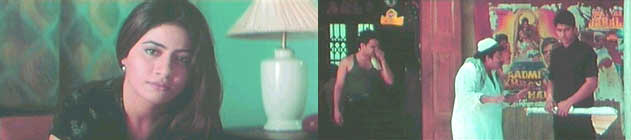
Finally his father (Dilip Tahil) tires of his son’s fantasies and poor grades
in college and tears down his posters of Urmila. This sends Aftab running
away from home – all the way to Mumbai – simply because he needs to catch
a glimpse of his love. He finds a sympathetic taxi driver who admits that
he came to Mumbai years before to see Sridevi but had his heart broken when
he saw her with Boney Kapoor but has stayed on since. Apparently, Varma was
a huge Sridevi fan in his younger days and had the opportunity to direct
her in Kshana Kshanam. The driver drops Aftab off in front of her home and
bids him good luck. Unable to get in, he begins working at a restaurant next
door with a bunch of happy go lucky characters with bad luck stories. Soon
he learns that Urmila is actually a lonely soul who is being exploited by
her evil uncle and aunt – and very much in need of a true-life hero. Well,
guess who is available?
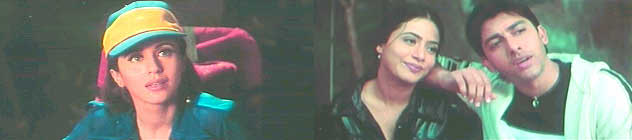
It took a while before the golly gee whiz innocence of Aftab grew on me,
but by the end he is nearly perfect for the role he plays – a simple man/boy
in love with a fantasy – that much to his own surprise leads him into some
unexpected situations. Urmila is more of an imaginary ideal here than anything
– Varma glamorizes her and almost fetishisizes her opulent figure in many
of the musical numbers – but then he pulls back the curtains to show what
an ordinary and simple person she really is. The other actress that very
much impressed me – though in a smallish role – was Antara Mali – who simply
takes over every scene she is in with her smile and enthusiasm – and she
has become a favorite of Varma’s with her being cast in much larger roles
in Company and Road.

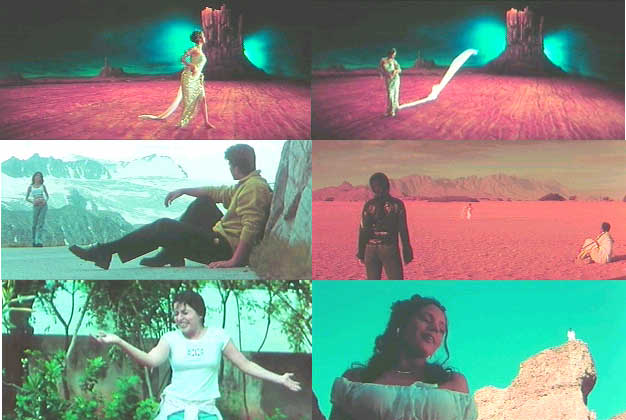
The music almost overwhelms the film – especially in the first section when
Aftab is constantly daydreaming about her. Much of the music also seems very
much a homage to the musicals of Hollywood and the movements, the color schemes
and the actor’s expressions in particular reminded me of some of films like
Singing in the Rain and An American in Paris – and I couldn’t help but wonder
what a young Gene Kelly could have done with Aftab’s role. Aftab even does
a few trademark Kelly moves – the swing around the light pole and the step
on to a falling chair move. The early fantasy numbers seemed influenced by
the fantasy numbers in An American in Paris. There are eight songs in total
and all of them are treats (oddly some have subs and some don’t) and go from
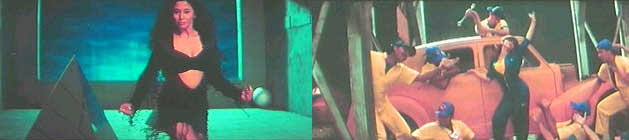
the very lavish to the very simple. A few standouts are Mere Hero in which
Urmila sings “Not Govinda, not Shahrukh” to the tune of “Hey, Big Spender”
and Aftab fancies himself a film hero and is rooted on by cheerleaders. Rama
Krishna is pure Hollywood and delightful and allows Urmila to really show
her splendid dancing ability. Another delightful musical number is Pucho
Na Yaar when Aftab comes back from delivering pizza to Urmila's house and
ever so slightly exaggerates the encounter to his awestruck co-workers.
Its simply delicious and in some ways unexpected. The ending actually surprises
me – because I thought it still had a ways to go – but apparently Varma decided
to surprise everyone by simply saying “it’s over” but it’s a lovely little
ride while it lasts.
My rating for this film: 8.0