Hare Rama Hare Krishna (Praise
Rama Praise Krishna
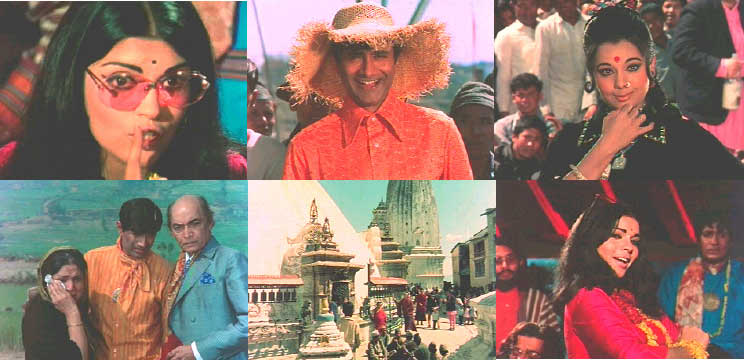
Director: Dev Anand
Music: R.D. Burman; Lyrics: Anand Bakshi
Year: 1971
Running Time: 2 hours 22 minutes
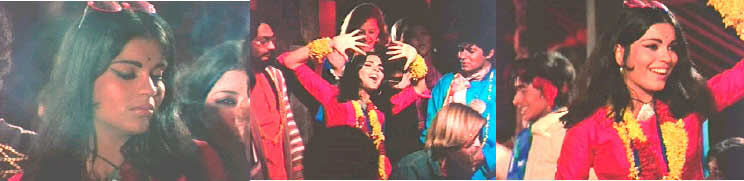
Hashish smoke slowly wafts through the air
as a raggedy bunch of youths take long hits from their pipes when suddenly
a “shush” breaks through the chatter and sharp guitar notes start up and a
fuzzy bass line follows like an avenging shadow. Chills ran up my body as
Zeenat Aman (well, Asha Bhosle really) hypnotically intones “Dum Maro Dum”
(take another puff) and stands up and begins to dance with a look of ecstasy
on her face – partly fuelled by the intake of drugs and partly by the bass
beat driving through her head. In the short two minute running time a legend
was born and a song was burnt into the collective memory of a nation. Strongly
resembling a young more voluptuous Ali McGraw, Zeenie Baby (as she was to
be called) broke down all preconceptions of an Indian heroine as well as
managing to break the hearts of the movie going audience with her portrayal
of a drug addicted lost soul looking for some meaning in life.
Dev Anand had been one of the major directors/actors of the 1950’s and 60’s
and as he moved into the new decade of the 70’s he was looking to do something
new – to keep pushing the boundaries of Indian film a bit. In this one he
took on the subject of drug use and the lifestyle of this new phenomenon
called hippies. By this time the subject had certainly been covered in Hollywood,
but it was still fertile territory in Bollywood. Very few films that explored
the drug culture in that period have escaped the test of time as they now
feel a bit creaky and at times laughable – and this is certainly true to
some extent with this film. Anand is clearly attempting to paint a negative
portrait of these hippies and to differentiate between them and good Indian
values (his character in the film) and much of this social chastising feels
outdated and patronizing now. Strangely, even though the hippies appear to
be Anand’s target in the film – it is really the conventional figures that
come off worse – cruel parents, corrupt businessmen, gullible towns people
– as the hippies really harm no one but themselves. The film does still hold
up as enjoyable entertainment even if the message does not – the tragic arc
of the story, the beatific and beautiful Zeenat, the classic score from R.D.
Burman, the playful smile of Mumtaz and the exotic setting makes for a strange
and loopy trip. It is really only Anand himself and his heavy-handed acting
that weighs down the film at times.
It begins with an Indian family in Montreal that falls far outside the typical
portrayal of a warm Bollywood family. The parents can’t stand each other
and the father wanders off into an affair. This leads to a divorce in which
the two children – a boy and a girl – are split up – the boy returns to India
with the mother and his sister remains in Montreal with dear old dad. Dad
wins the Father of the Year Award by telling his daughter that both her bother
and mother are dead and then marries his paramour. This plays havoc with
the psyche of the girl and as we jump sixteen years into the future she is
clearly a messed up kid – but has at least turned into the sumptuous Zeenat
as she sways to the music in a trance. She skips off to Katmandu in Nepal
where she joins a hippie commune and keeps her pipe at close quarters. Her
brother (Dev Anand) learns of this and makes it his mission to go there and
reunite the two of them.
This is a bit of a chronological disaster though because Dev was in his late
forties at the time (and looks it) and one has to wonder how the boy aged
forty years and the girl about the correct sixteen. This bugs me throughout
the entire movie perhaps more than it should have because this is fairly
common in Bollywood films. Popular male actors tend to have long shelf lives
in India and its not uncommon to have actors clearly in their thirties or
forties playing college boys – its just one of those things you have to accept.
Not only does Dev look much too old for his character, but this actor who
had been compared in looks to Gregory Peck earlier on, had begun to develop
his “dirty old man smile”. I came across this smile in full regalia in his
2002 film Love In Time Square and it was rather scary especially as he was
surrounded by some fairly young voluptuous women – one being his supposed
daughter that he spent a lot of time rubbing up against in a “fatherly” way.
It hadn’t quite reached that “hide your daughter” stage in Hare Rama, but
one can see it developing.
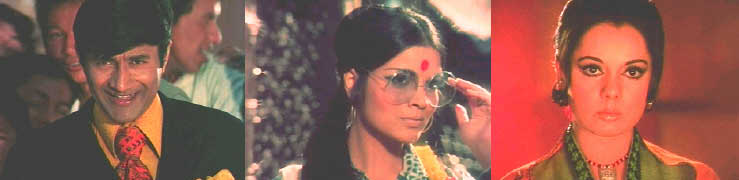
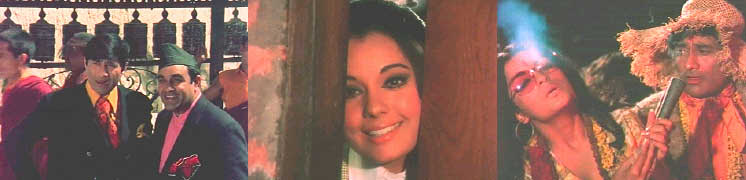
Dev wanders the streets of Katmandu looking for his wayward sister and thinks
that Zeenat must be her – but she has changed her name and refuses to admit
who she is – of course she thinks her brother is long dead. In fact, she
thinks he is a voyeuristic creep and gets some of her free love boyfriends
to give him a beating. In his search Dev still finds time for love when he
comes across local lovely Mumtaz dancing in the town square and he puts his
smile to work and she is soon swooning – I guess anything to get out of Katmandu.
There is a local thug (Prem Chopra) who has his beady eyes on Mumtaz and
he has his boys also give Dev a thrashing. Looking a lot worse for wear,
Dev is next framed for a theft of a holy relic and has the entire town wanting
to beat him up – by this time I would be booking a ticket home but not our
hero. The film doesn’t necessarily go where one might imagine and Anand as
director makes an interesting choice in the end.
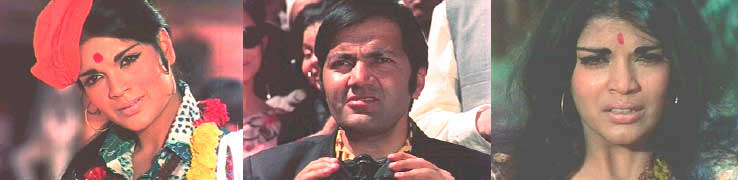
Mumtaz – who was a star in her own right
– is the theoretical heroine of this film but Zeenat – who was Anand’s choice
only after two other actresses turned him down – was the one everyone was
talking about afterwards. Stunning westernised looks, a flair for style, ample
cleavage (displayed more in future films than here) and a willingness to
take on controversial roles made a statement of a different kind of Indian
actress. She wasn’t the typical vamp but she certainly wasn’t a traditional
heroine – instead she successfully treads on the edges of both and created
an entirely new kind of character in Bollywood cinema – a tough independent
woman with the eyes and heart of a femme fatale – someone you want to sleep
with and then take home to mom.
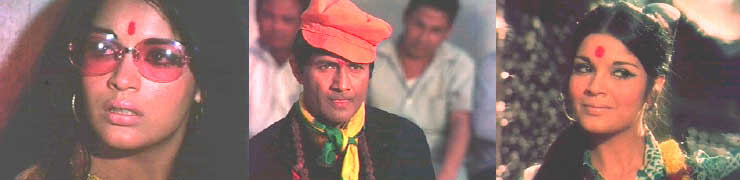
The score from the legendary R.D. Burman is considered one of his best. It
has two classic songs – both picturized by Zeenat – the aforementioned Dum
Maro Dum and the equally drug induced Pyaar Kushi Ka Ghaam (with the English
line “Can we go a little faster man"). In total there are six songs – all
strong and the final tune – Phoolon Ka Taron Ki – is a lovely ballad that
Dev sings and that Zeenat recognizes from childhood through her daze as a
song her brother use to sing to her – it makes for a touching and sad scene.
As a point of perhaps little interest -
Zeenat once again sings and dances to Dum Maro Dum in the 2003 film Boom.
My rating for this film: 7.5