Vaastav
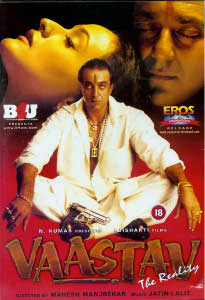
Director: Mahesh Manjrekar
Music: Jatin-Lalit
Year: 1999
Running Time: 145 Minutes
Sanjay Dutt has always struck me as one
of the more unusual looking heroes of Bollywood. With an oversized head,
large square jaw, a forehead you could park your car on, a sharp hatchet
nose that could chop wood and deep-set hooded eyes he looks more like a crumpled
pillow that Picasso painted on a bad day than a film hero. If Bollywood ever
did their version of "Mice and Men", Dutt would have to be cast as Lenny.
With these looks, one has to wonder what his chances of breaking into the
film industry would have been if he didn't have the star Bollywood parentage
(Sunil Dutt and Nargis) in his background. Not only though was he able to
break in, but he has also become over the years a major Bollywood star primarily
in action films but in comedies and romances as well on occasion. That he
is the reciprocate of romance often makes me uneasy as he more resembles
a bull tramping on fine china and I worry for the safety of his dainty female
co-stars.
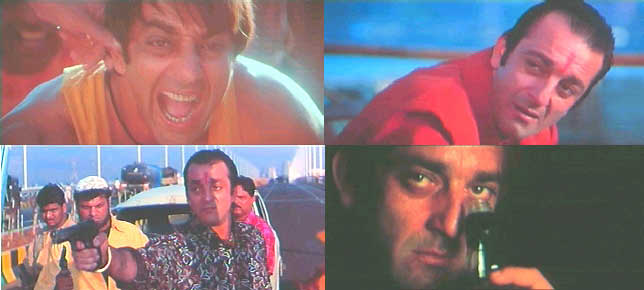
If his looks are not of the classic hero variety though, what he does have
to compensate for this is a seething sense of masculine power and menace
that nearly explodes on the screen. This palpable aura of menace that surrounds
him is only reinforced by his off screen life - such as getting jail time
for gun smuggling and an association with Hindi religious terrorists. This
is not a guy you want to beat to the last parking spot. This of course makes
him just right for Vaastav.
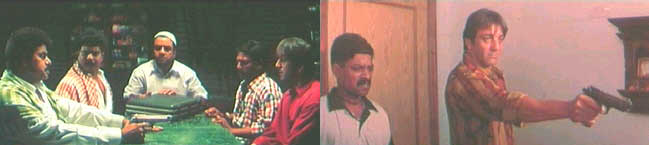
Vaastav is pure anti-hero stuff - a ruffian, a killer without conscience
or hesitation - and yet you still find yourself pulling for him to the end.
That’s because deep down he is a mama's boy and this is like Cagney's "White
Heat" on steroids - "Made it Ma! Top of the world”. As long as you love and
honor your parents (Shivaji Satam and Reema Lagoo) you can't be all bad can
you - in Vastav, Dutt comes pretty damn close. Still underneath the cocaine
glazed dead eyes, there is a touch of humanity that is looking for a way
to crawl out - but in the Mumbai underworld there is little room for kindness
and no time for sentiment.
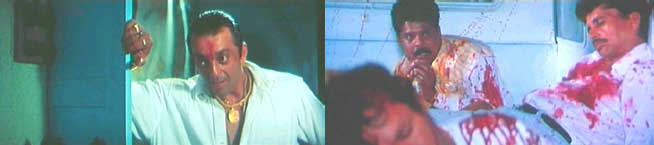
Dutt's character (Raghu) begins as a bit of a lovable lunkhead - a playful
rowdy troublemaker with his friends in his poor tenement neighborhood - but
no signs of any real malice in his heart. He lives with his parents and his
brother (Mohnish Behl) and he hopes only to own a fast food vending cart
someday. His father finances it and in no time Raghu is a successful small
time entrepreneur as he serves his delicious looking food - bhajis, puris
and pilaf to appreciative customers. Trouble comes looking for him though
when a couple of gangsters expect to get the food for free and abuse Raghu's
friend and helper, Shorty (Sanjay Narvekar ) as well. When things go overboard
Raghu has to step in to protect Shorty and in the ensuing fight he kills
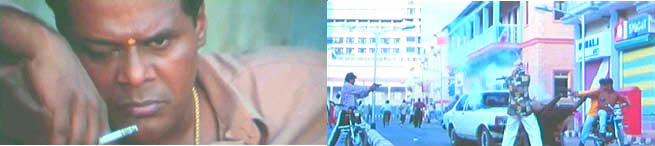
the brother of Mumbai's biggest mobster - Bandya. With the police in Bandya's
pocket, Raghu and Shorty have to turn to Bandya's prime rival ("One-Eyed
Vitthal") for protection - and he is only to glad to help - for one small
favor - the two friends have to become his in-house killers.
Fueled by alcohol and cocaine, they take to this new profession with a vengeance
and with the sponsorship of a major politician they soon have the town at
their feet in fear. As the body count rises along with Ragu's intake of drugs,
it seems only a matter of time before he will have to be brought down like
the wounded animal he has become. Of course mom and dad aren't especially
happy with their son's newfound line of work, but Sanjay finds comfort in
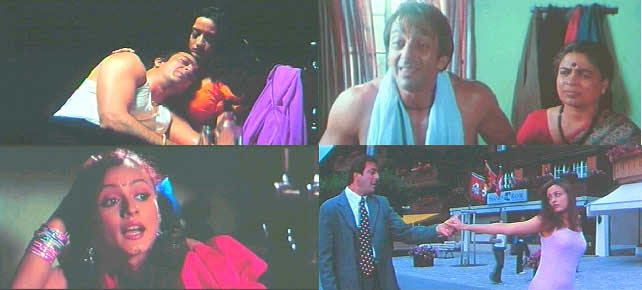
the arms of the beautiful Sonu (Namrata Shirodkar) a prostitute from the
local brothel. They even have time to go to Switzerland for a song!
And speaking of such, the songs in this film are unexpectedly good for such
a rough and tumble film. The first song Chota Kad is a clever piece as it
mixes in the sounds of sizzling cooking and banging utensils with music to
announce Raghu acquiring the food stall. This is followed almost immediately
with Har Taraf Hai - a religious celebration that interestingly had an interesting
parallel with the Chinese Lion Dance in that two competing teams build human
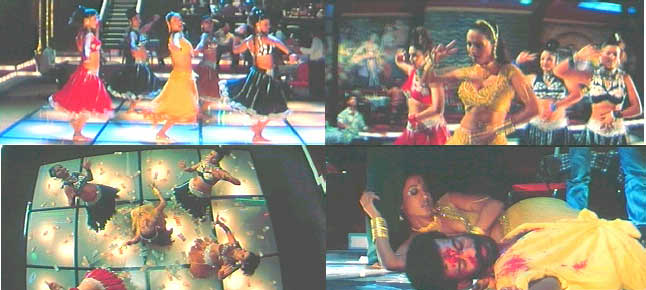
pyramids to reach an elevated target that they smash. The third song is a
snappy nightclub number with the usual beautiful women tearing it up on the
stage, but framed nicely with impending violence forming on the sidelines.
The final song is the trip to the Alps with no songs making an appearance
for the final third of the film.
It is a solid film with few compromises made in terms of Raghu's character
- he does some really bad things here that are hard to forgive him for. At
the same time films relating the rise of a gangster and the inevitable fall
have been around for decades and so little really feels new here other than
the setting. Raghu's conversion to violence also feels very abrupt and one
never quite understands how or why he becomes the man he does.
My rating for this film: 6.5