Kaakha Kaakha
Reviewed by Simon Booth
Director: Gautham Menon
Music: Harris Jayaraj; Lyrics: Thamarai
Year: 2003
Running Time: 2 hours 33 minutes
To most people, Indian cinema is equated
with "Bollywood", the film industry based in Mumbai that produced predominantly
Hindi language cinema. However, there are 3 distinct movie industries in the
country, with the Hindi industry being the biggest and most commercially successful,
and the Tamil and Telegu film industries generally perceived to offer lower
budget and "artier" fair. One fairly odd phenomenon is that Tamil movies
that are successful are often remade in Hindi, often by the same director
these days but usually with a different cast. Some recent films have
even been made in Tamil and Hindi in parallel, with one film reportedly having
the same scenes shot twice with two different casts :p
Anyway, my exposure to Indian film has mostly been through Hindi cinema,
and the two Tamil films I had previously seen (Santoshi Sivan's "The Terrorist"
and Mani Ratnam's "A Peck On The Cheek" seemed to confirm the notion that
the films were more low-key artistic creations. I picked up another
Tamil film, Kaakha Khaaka, thinking that it was the original film from which
the 2004 Hindi blockbuster Khakee originated. As it turns out, they are actually
two quite different films, though there are more similarities than the name
(derived from the Khaki uniforms of the Indian police, I believe).
Kaakha Kaakha scotches the notion that Tamil films are all artsy and low
budget though, being a full-blown blockbuster with plentiful action and song
and dance scenes that would fit quite neatly into any Bollywood affair.
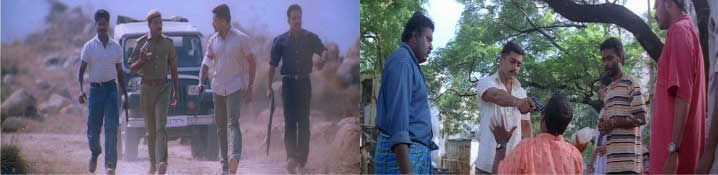
I am pretty sure Khakee was influenced by Kaakha Kaakha, even though the
stories are essentially quite different. Both are cops and criminals
cat-and-mouse affairs filmed in a modern, "edgy" style with plenty of testosterone
and quite a dark tone. The influence of Ram Gopal Varma feels strong
in them both, and the influence of Hollywood too it must be admitted.
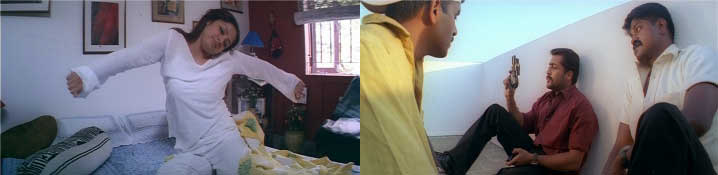
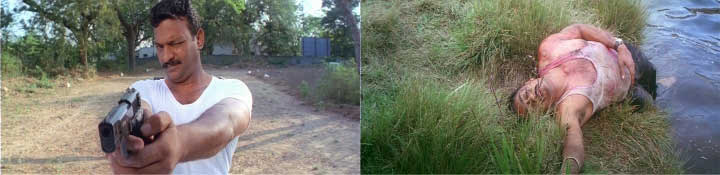
Kaakha Kaakha starts with a man crashing out of a lakeside house into the
water, covered in blood, where he sinks to the bottom and has a musical dream
about a beautiful girl. Upon the song's conclusion he regains consciousness
and struggles out of the lake, and informs the viewer that despite being
full of bullets he has to pull himself together and go rescue that girl.
The film then goes into flashback mode to fill in the story of who this man
is and how he came to this situation. It's fully 2 hours before we
return to this point in time, by which time we understand a lot more and
have a lot more motivation to want him to pull himself together.
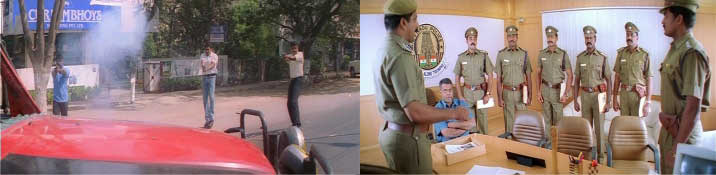
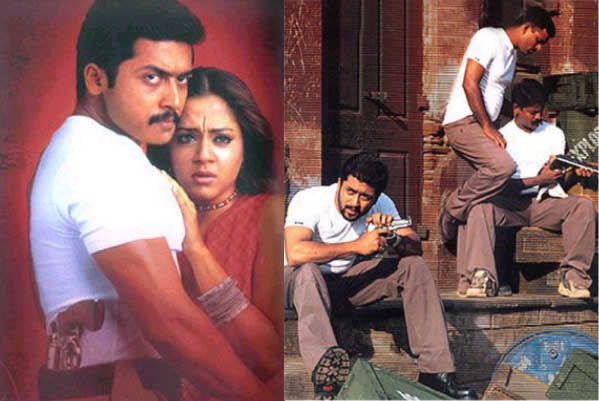
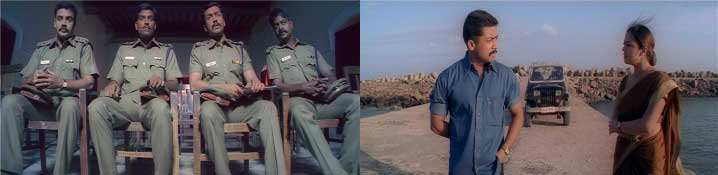
The man is DCP Anbuselvan (Surya) and he is a cop. He rose up the ranks
of the Madras police force and together with a group of his colleagues became
somewhat notorious for his tough methods in bringing down criminals.
Why go to all the cost of a court trial when a bullet can bring justice a
lot quicker? The girl in his musical daydream is Maya (Jyotica), the
woman who managed to get inside his stony heart. Obviously in
2 hours they go into quite a bit more detail than that, but I will leave
that for the interested viewer to discover for his or her self ;)
Kaakha Kaakha serves up both a solid love story and a solid crime story,
with the former dominating at first but giving way to the latter as time
goes by. One of the nice things about the typically long running times
of Indian films is that they can develop characters and plots in a lot more
detail than the average 100 minute action film could dream of, and in 2.5
hours we get a good development of both these strands in Anbuselvan's life.
The ultimate collision of these two threads makes both all the more powerful.
There definitely seems to be a move towards darker, grittier and more violent
films in India in recent years, and Kaakha Kaakha continues this trend, taking
the film to some pretty nasty places. This will undoubtedly upset some
viewers, but it's all good with me. If you like your films to be feel-good
and life-affirming, you probably don't need to read any more of this review
'cause you should know by now that this isn't a film for you.

Another factor that may turn off some viewers is that the film does seem
to condone police violence (well, murder to be blunt) as a means of fighting
crime. I was hoping that the film would explore the ethics of this
viewpoint, and it seemed in many places that it was about to do so but then
it never quite did. I ended up sampling some bits of the director's
commentary to see what he had to say on the matter, but it seems that he
has no particular disagreement with the idea that killing criminals is a
generally good approach to fighting crime. The film does seem like it provides
some food for thought on the subject whether the director intended it or
not though, as one can't help thinking that things might have gone better
all round if the cops had actually arrested some of the people they "economically"
dispatched.

Apart from this, the script for the film is generally very good - quite tight
and logical, and full of nice bits of dialogue and detail that flesh out
the principle characters well. Another benefit of the long length of
Indian films is that they often give the villains more depth and development
than the average Hollywood or Hong Kong crime film, making them equally important
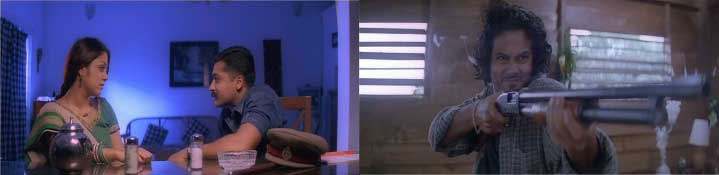
characters. Kaakha Kaakha has a really great main villain, played with
great charisma by young actor Jeevan. He's a really *bad* bad guy,
but it's hard not to like him because he's so charming, and his lack of moral
compass seems to be due to bad upbringing rather than a malevolent nature.
More amoral than immoral.
The film features impressive production values for the most part, with very
high technical skill. However, the direction is a little self-indulgent.
The film features the sort of "edgy" jump-cuts and roving cameras of Ram
Gopal Varma's COMPANY, but here they seem to be applied without particular
reason in many cases, drawing too much attention to themselves and detracting
from what they are meant to be showing rather than enhancing it. Too
much style for style's sake, I guess (and I normally *like* that in a film).
The camera's excesses are amplified by the soundtrack, which is occasionally
great but in too many cases is just too bombastic for the scene it belongs
too. A little more subtlety in the visuals and sound could have made
the film a lot better. When it works, it works really well though.
For most of its running time the film is
very tight, with no down-spots and confident direction. It engages
the attention effortlessly, and I found myself very involved in the storyline.
Unfortunately, the film flounders a bit at the end, with a climactic scene
that doesn't really fit or offer a neat resolution (not the very last scene,
which is good, but the final showdown scene). On the commentary track
the director admits that he isn't happy with the scene either, but they ran
out of time and money and couldn't shoot the scene he had planned. Well,
maybe he will get chance when he helms the Hindi remake :)

Final thoughts - if you like gritty, dark crime films with a well developed
love story then Kaakha Kaakha ought to please :) It has a few flaws, but
they're easily forgiven considering all the things the film does right -
and it's certainly an entertaining ride.
Rating for the film: 8.0