Hum Aapke Hain Koun (Who
Am I to You?)
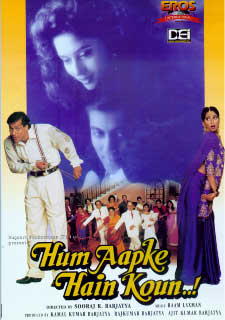
Reviewed by Anabela Voi You
Director: Sooraj R. Barjatya
Music: Raam Laxman; Lyrics: Ravinder Rawal, Dev Kohli
Year: 1994
Running Time: 3 hrs 24 minutes (some DVD versions have been cut)
Hum Aapke Hain Koun is a typical Bollywood
romantic comedy, and it is considered a classic as the highest-grossing movie
ever in India; I’ve seen other statistics on how HAHK is the second highest-grossing
movie on some Bollywood film lists due to the inflation of ticket prices,
but I am sure the economics of HAHK is not your main interest. Madhuri Dixit
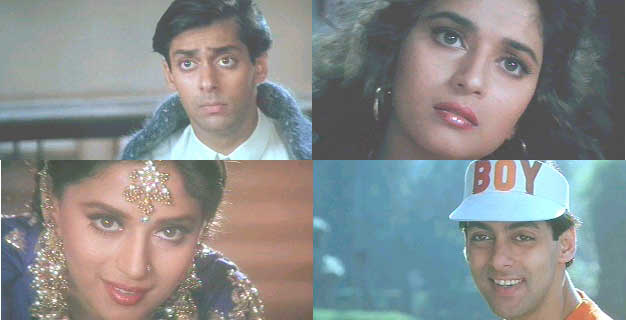
as Nisha and Salman Khan as Prem were adorable. I’ve read about accusations
of Salman Khan for manslaughter, physical abuse of Aishwarya Rai and other
girlfriends, and how he’s got a problem with anger management in general.
But despite all those preconceived prejudices, Salman came across as very
lovable and child-like in HAHK. After reading so much vicious gossip about
Bollywood actors, I am quite impressed with the discrepancy between the charming
characters they portray on screen and the personalities/reputations off-screen
- even if it is gossip. I suppose that speaks for their ability as chameleon
actors.
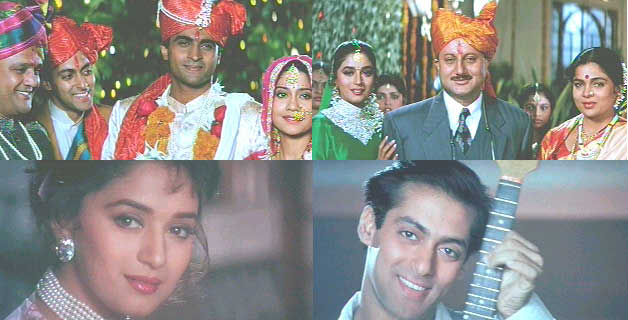
Although 1994 is the year HAHK was released it feels like it was filmed 10
years earlier with Madhuri’s big hair and Salman’s gigantic shoulder pads,
and indeed it just might have started filming in 1984 because it seemed to
take me about 10 years to get through it. HAHK was rather laborious for me
to go through, because there was virtually no intriguing plot for some 2
hours or so. Pooja, Nisha’s older sister, and Rajesh, Prem’s older brother,
meet, fall in love, and get married. At big family gatherings Nisha and Prem
meet often and try to outdo each other in silly pranks. Eventually, they
too fall in love and want to get married. However, that is not so easy. I
will not disclose what the obstacle is, as I think it is the only somewhat
redeeming feature of the movie since it made me semi-curious about the fate
of the characters. The real twist of the film doesn’t come until two-thirds
of the way into film. Until then, it’s just a cacophony of dancing and singing,
an engagement and wedding scene, and some minor tug-of-war rifts between
Madhuri and Salman.
HAHK challenged my Bollywood viewing stamina because it passed the 3-hour
mark at some 3 hours and 24 minutes. In fact I could only watch it in more
than two sittings because I found the plot pointless and trivial. The set
was full of pretty but archaic things to look at. The dancing choreography
was minimal, and the music was just too folkloric/culturally specific for
a dumb foreigner like me and became even monotonous to me – nothing avant-garde
or innovative like the music and dancing in Dil Se. I think they even used
a synthesizer as an instrument, the horror, the horror. It just seemed like
a mass-produced Bollywood flick of questionable technical and artistic quality
that is a mere vehicle for the heartthrob and sweetheart to get together.
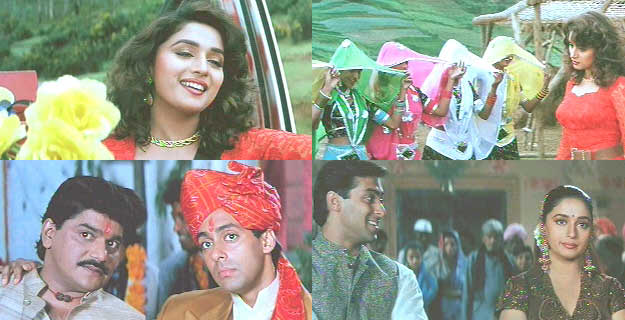
Some of the lyrics were rather banal – in one Madhuri sang about chocolate
and limejuice and it somehow had something to do with how she’s a grown,
nubile woman now. Madhuri’s performance was absolutely lovely and adorable,
but she didn’t have much of a chance to showcase her dancing abilities. Her
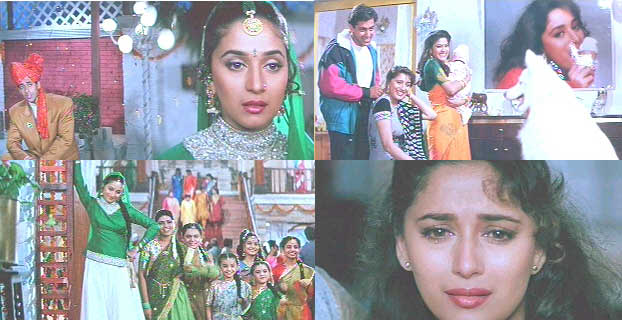
performance towards the end was moving when it showed Nisha’s transition
from a carefree girl to a traditional woman fulfilling her family’s duties.
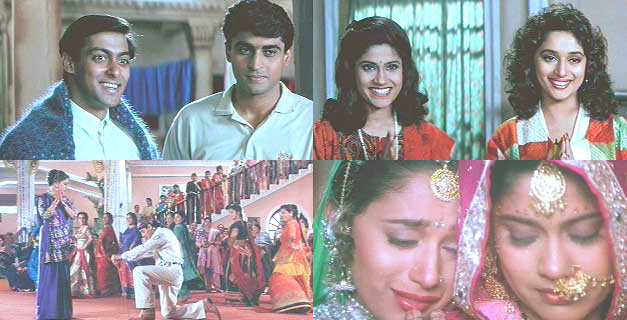
The dance choreography was generally very simple and abbreviated (arms akimbo,
hipshake, step-step, hipshake). The whole movie looked like blurred Technicolor
to me where everyone seemed out of focus. The subtitles of my DVD version
often confusingly appeared at the wrong times, i.e. before or after someone
or a group of people said something. I consider HAHK a movie with a moral
about how one’s love of the family supercedes personal desire for romantic
love and how one feels compelled to sacrifice one’s happiness precisely because
of one’s love for the family. Conversely, the family’s genuine love for their
children encourages their children to pursue true happiness and overlook
the principles of sacrifice. The exchanges towards the end are a melodramatic
reciprocation of love and honor in the family.
I guess that’s why HAHK has been so popular, because the concept and melodrama
of sacrifice evoked many deep-rooted feelings and glorified family principles
to its target audience. I wouldn’t classify HAHK as a great Bollywood film
in the ranks of Devdas or Dilwale Dulhania Le Jayenge, and it might appear
too archaic and cheesy for the jaded viewer with high cinematic expectations.
The whole set screamed of “studio suffocation” – everything felt contrived
and enclosed with fake lights while they tried to cram in as many extras
as possible. HAKH has the plotline and characterizations as preposterous
as any Hollywood movie, but the moral of the story is at least deeper.
Rating: 6.5/7.0 (As kind as I would like
to be to this classic)
Reviewed by Brian
It is hard to argue with the fact that this
film has very little on the surface in terms of plot or tension for most of
its lengthy running time – it is like spending an afternoon at a petting zoo
only to have a lamb bite you just as you are ready to leave – but I find
this to be an exuberantly moving film that has some scenes that are nearly
sublime. There is the art of “cool” – this isn’t it – this is the art of
“nice” in which there are no villains – only really nice people without a
hint of darkness in their souls who spend much of the film smiling at each
other as if their teeth are in a museum display. If I smiled that much my
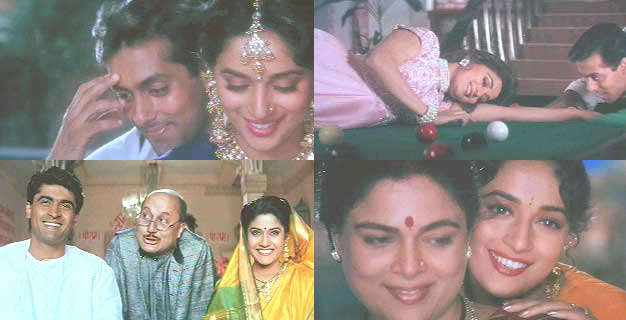
jaw would hurt. Both of the major actresses are in fact well-known for their
radiant smiles – Madhuri has been known to level small villages with one
of her landmark smiles and just about any article on Renuka Shahane begins
with a comment on her pearly whites.
The two actors who portray the father figures in the film – Alok Nath and
Anupam Kher – have become the go to guys when you want a nice father type
in films – Alok in “Taal” and "Kabhi Khushi Kabhie Gham" among others and
Kher in “Dilwale Dulhania Le Jayenge” and recently in “Bend it with Beckham”
and “Bride and Prejudice”. The one actor in the film of course who’s name
is rarely mentioned in the same sentence as “nice” is Salman Khan, but this
was before all of his personal problems and in fact his career at this time
was mired after having gotten off to a bang with “Maine Pyar Kiya” from the
same director in 1989 (he was also called Prem in that one as he was to be
in Barjatya’s 1999 “Hum Saath-Saath Hain”). Salman has become an enormously
irritating actor to watch since fame hit him – full of prefabricated charm
that is smarmy and makes you check to see if he stole your toilet paper –
but he is quite the sweet playful virgin verging on love here.
To a large degree this movie began the big happy Hindi family syndrome –
or what I believe is more often termed the “Hindi Family Values” genre in
which all family members love and respect one another, follow traditions
and the wishes of their parents and are all overjoyed to be living in very
close proximity to one another. This explains part of the enormous popularity
of this film both in India and among Indians living abroad - in a period
of social upheaval this was a nostalgic return to Indian roots and culture
– yet a very comfortable one. No one here has to share their bedroom or sacrifice
a meal – the families in these films tended to be wealthy enough to have
all the amenities of modern life and with ample room to lodge a pro football
team – so it’s the best of both the old and new worlds and this was very
appealing to audiences. Even if more fantasy than reality, I find this extended
family interaction to be a fascinating aspect about this film. It is a rare
moment when anyone is alone here – it is always filled with family – nuclear
and extended – and friends and solitude, loneliness, introspection and privacy
are almost taboo within this social context. The thought of this might drive
many Westerners crazy with anxiety – myself included – but at the same time
this family was so adorable that I wanted to be a part of it.
What I like most about this film though is the simplicity of it – in a sense
it celebrates the cycle of life and all the rituals that accompany it – represented
in this film by a year or two in the lives of two families who become joined
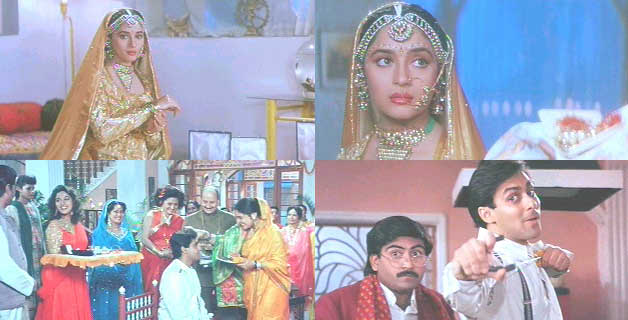
through marriage – from the initial introduction of the prospective couple,
their engagement, the marriage, the poignancy of the bride leaving her family
to join another, the joyful discovery of pregnancy, the birth of a child
and sadly death enters the scene – and then the cycle begins again. For the
most part the film simply skips by the parts in between and focuses on these
highlights of life like a photo album – and it may seem like little else
with the romance of Salman and Madhuri playing around the edges of all of
these events – but these all blend together to build a moving tapestry of
family life and the touch points as we move along the road of life. It almost
seems a shame that tragedy is introduced to the film – it adds a level of
melodrama that wasn’t really needed – the small moments of life and memory
are drama enough.
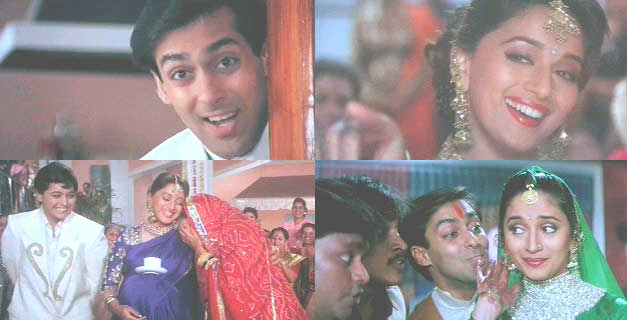
Much of the story comes out of the musical numbers – a gigantic awe inspiring
fourteen of them that at times practically collide with one another like
bumper cars. The film really brought music back to Bollywood – in the seventies
and eighties the number of songs per film had diminished over time to often
four or five maximum and the huge popularity of not only this film but the
soundtrack made music an essential part of Bollywood films again in a big
way. Music is pervasive here – every ritual from cricket to a baby shower
is adorned with song – but these are not strictly songs for song sake – out
of them springs emotion, the passing of time, family relations and love.
There are a few numbers that have much going on under the surface – and they
come about in intriguing ways that not only showcase the music but also the
tender feelings among this very extended family.
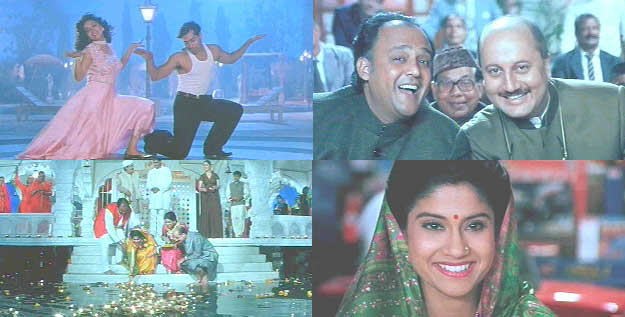
For example in one instance, Alok is egged on by others to sing a song to
the mother of his new daughter in law and within this song and the looks
that pass between them is a glimpse of what might have been had life taken
another turn far back – but there is no bitterness – only perhaps a small
regret from Alok and a question in the mind of the mother. It’s a beautifully
tender song about how lucky Anupam is to have such a wife. Another time the
two families are sitting around and they play the pillow game – sort of like
our musical chairs – except whoever has the pillow when the music stops has
to give a small performance – a poem, a bit of film dialogue or a song –
after Satish Shah sings a refrain from the film “Bobby” to his wife it is
Nisha's turn and she sings to her mother of her love for her but also makes
clear that she is now ready for marriage though her love for Prem is left
unstated. And strangely in the chaotic turmoil of festivities this love is
noticed by no one (other than the loyal servant) though it feels like it
is written in lights for all to see.
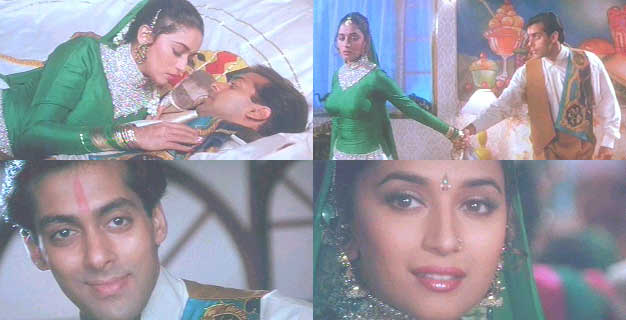
Finally there is the astonishing “Joote De Do Paise Le Lo” or as I think
of it the “find the shoes” song. In this ritual/game the bride’s side tries
to steal the shoes of the groom and his side tries to hide them. The song
and actions begin very lightly – Nisha trying to discover the whereabouts
of the shoes and Prem trying to keep them from her – much flirting, joking
and teasing taking place in the dance steps and gestures – finally Nisha
gets hold of the shoes and flies up the staircase with Prem behind her in
close pursuit. He ends up chasing her into her bedroom where they accidentally
crash into one another and fall onto the bed – whereupon the mood of the
song suddenly shifts to the stuff romance is made of – for only an instant
they lie there but an inadvertent instinctive caress takes place and Nisha
wakes up from this sudden moment of reverie and grabs the shoes to leave
– Prem holds her wrists for a moment not allowing her to leave and finally
lets go. When she realizes that he is allowing her to win it is a kick in
the heart as they both realize that there is something very special beginning
here. The look she gives him as these newfound feelings sear through her
body is ravaging. Anabela mentioned in her “Devdas” review the moment when
she became a Madhuri Dixit fan – this was mine - I was bewitched. It
was also Salman’s finest moment that nearly redeems all of his acting sins
since this film.
The film at the same time can be very goofy
– almost childish in the manner people behave with one another or contains
abject silliness such as having a dog as an umpire or the “hero” of the film
– and this can make you nearly cringe in pain at times – but it is so unapologetically
wholesome that it is like having cookies and milk by your bedside or chocolate
and lime juice for that matter. For three hours suspend your well-earned
cynicism and simply mop it up.
My rating for this film: 8.0