Bride and Prejudice (Balle
Balle Amritsar to L.A.)
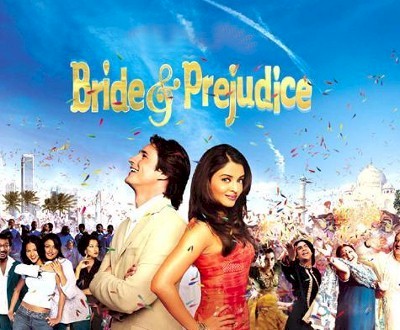
Reviewed by Anabela Voi You
Director: Gurinder Chadha
Music: Anu Malik; Lyrics: Various
Year: 2004
Running Time: 111 minutes (122 Hindi version)
I first saw Bride and Prejudice on a San
Francisco-London flight, long after the UK had already seen and reviewed
it. This colorful musical was my initiation into Bollywood and I was quickly
addicted to the charisma and musical splendor of the world’s largest film
industry. It reminded me how starved I was for simple movies that are both
an awe-inspiring sight to behold and a celebration of life. For those of
us who are from more “stiff” and reserved cultures, the thought of “I wish
my culture had rhythm like them!” might have crossed our minds during the
viewing of B&P. Critics have dissenting opinions of whether B&P is
a pure Bollywood film or a Hollywood one; director Gurinder Chadha claims
B&P is both but to me it leans towards the Bollywood side with the only
exception being that it is an English-language film with a Hollywood-esque
length. Xenophiles and Anti-Americans should overlook the storyline, as neither
party will find the ideological aspects of the film to be consumptive – this
will later be discussed.

I was impressed with how Gurinder Chadha threw in a Gospel choir on a beach
where Aishwarya and Martin Henderson were romancing. I liked this scene most
because then I knew I was watching something wonderful and eclectic, a masala,
a smorgasbord, or a melting pot of all musical genres that ranged from folk
to pop. There is definitely some fantastic music in B&P that should not
be missed and the energy and charisma in the film is unrivalled. In an interview
director Gurinder Chadha mentioned that she was impassioned to introduce
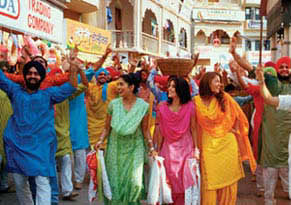
the Bollywood elements of vibrant colors, bombastic music, gorgeous people,
dance and larger-than-life themes to a wider international public. Indeed,
watching certain Bollywood films can be an antidote to languishing imagination
and diminishing appreciation towards life, and B&P was a superb visual
celebration of just that. I have heard complaints about how English lyrics
were used instead of Hindi but I didn’t find the language usage unnatural
or odd at all.
Some people seem to forget that classic American musicals in which Frank
Sinatra broke into song and dance in a sailor suit (or when Gene Kelly performed
under fake rain) were once the norm – and it was all done in English and
done very well indeed. Why all the sniffing giggles regarding Bollywood,
I wonder? I don’t see many differences between an American musical produced
in the 1940s and 50s versus a contemporary Bollywood film; the “Western”
film industry has undergone a cinematic evolution of experimental film-making
much more deeply than Bollywood has and admittedly Bollywood generally needs
to develop some of its elements with more sophistication, i.e. plot and character
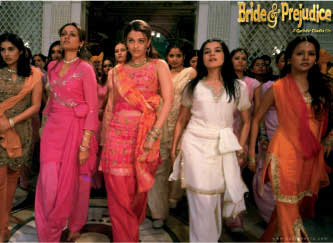
developments. B&P’s choreographer was Devdas’ Saroj Khan, and the cinematographer
was Asoka’s Santosh Sivan, and these credentials alone speak for the visual
quality of B&P.
I don’t quite understand critics’ dissatisfaction with the fusion of Jane
Austen’s novel and a Bollywood representation. I can’t think of a more perfect
fit of transplanting the story into class-conscious and marriage-obsessed
modern-day India. Standard adaptations of Pride and Prejudice have been done
to death and a new style of narrative isn’t a bad idea at all. In my opinion
it is due. Austen’s themes have a universality that are cross-cultural, and
in fact the Bennett girls’ issues are the exact same ones that plague the
Bakshi girls – class distinctions, the conflict of love and money, defensiveness
of one’s social and financial standing, and parental obsessions on their
children’s marriages. On the surface the characterizations were faithful
to Austen’s novel: Lalita like Elizabeth is proud, cerebral and headstrong.
Elder sister Jaya is conventional, beautiful, and uncomplicated. The mother
is a chatterbox obsessed with marriage and money. The father is silent but
wise and always carrying an amused smile. And Darcy appears to be arrogant
and class-conscious but is just misunderstood.
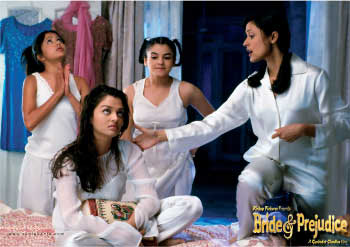
Critics complain about Aishwarya but I must come to her defense: she isn’t
an incompetent actress nor is she extraordinary, which doesn’t mean she can’t
act. Ash brought a bit of feistiness and spark to Lalita that I don’t think
I’ve seen from her in any other role. I think Ash looks even more beautiful
here than she was in Devdas, which sounds impossible, but B&P proves
it to be possible. Deliberately gaining 20 lbs. was an advantageous move
for Ash, and she dispels the theory that women must be under a certain weight
to look good (completely unrelated to this review and a bit of trivia, in
her 60 Minutes interview Ash made known her enormous appetite which is amazing
considering how thin she has been all these years). Moving on, I rarely feel
Ash has any chemistry with her fellow romantic co-stars (even with the infinitely
charismatic Shah Rukh Khan), and she doesn’t have much sizzle with Henderson
either. I think the whole point in the movie was just to use a wedding as
an excuse to put Aishwarya in a gorgeous fuchsia-pink sari and buckets of
jewelry for the sake of Indian pageantry. Indians love their women, especially
their very own Marianne of India, in sumptuous saris and would definitely
flock to see B&P just for that spectacle.
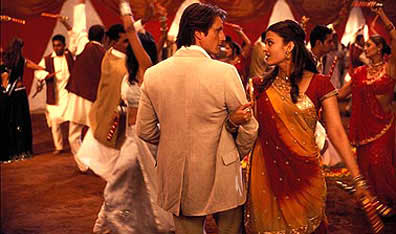
Martin Henderson’s performance as Darcy is rather problematic in my opinion
because his portrayal does not have a well-rounded personality. Austen’s
Darcy initially came across as stuffy, arrogant, and bordering on annoying,
but Henderson’s Darcy unfortunately just says the wrong thing at the wrong
time (i.e. my hotel had electrical problems), which renders him hapless in
the eyes of the pissed off Lalita (Aishwarya) because she’s so politically
correct and anal. Lalita comes across as an intellectual with a mood swing
who seems to be hypersensitive and defensive rather than having a genuine
beef to be incensed at Darcy for. It annoyed me that Lalita felt like she
was the defiant speakerphone for her country and parroted many social, political,
and economic issues about why she doesn’t like Darcy or elements he represents
such as American imperialism, economic hegemony, cultural ignorance, etc.
But then she falls for him – for no particularly strong reason. He’s a “nice”
guy she later on discovers. When was “niceness” the only thing that made
people fall in love?
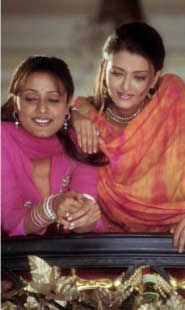
I think Gurinder Chadha made Lalita irritating and attempted to portray her
“intelligence” by making her politically sensitive and reactive to just about
every detail in her environment. How and why Lalita finally relented to Darcy
and married him is still a question mark in my mind. What made Austen’s Elizabeth
and Darcy so engaging is that these two souls have underlying tension, chemistry,
and rapid-fire witty banter – Ash and Henderson have almost nil chemistry.
My interpretation of Elizabeth and Darcy is two people destined to be together
but who are simply indulging in “foreplay” of verbal bickering and superficial
warfare; Darcy and Lalita didn’t convey that energy to me at all. I think
what annoyed many people about B&P is its superficial political and cultural
concerns but at the same time endorsing the relationship between Darcy and
Lalita who represent two completely different backgrounds, philosophies,
and motivations. These characters were completely antithetical to each other
and yet they married on grounds that are far more superficial than the reasons
for why they hated each other – or rather, why Lalita hated Darcy!
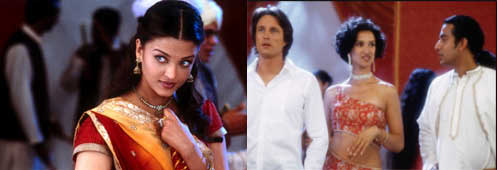
Gurinder tries to be faithful to Austen’s Darcy and Elizabeth, and they are
supposed to be different and yet attracted to each other due to irresistible
magnetic chemistry. Without this chemistry, the union of Lalita and Darcy
is not convincing. I haven’t seen every Pride and Prejudice interpretation
that exists out there, but one of the best portrayals of Darcy is that of
Colin Firth – stuffy, arrogant, sophisticated, verbally economical yet meaningful,
misunderstood, but still radiating a sexual and mental tension underneath
all that stuffiness. Henderson’s Darcy has none of that. He just appears
to be a pretty boy who is unlucky enough to get verbally hammered by Lalita
and has no mental capability to defend himself effectively. Henderson’s Darcy
doesn’t resemble the rich hotelier that he is supposed to be – he is more
like a disheveled graduate student backpacking with his buddies in India.
The tension between Elizabeth and Darcy is the reason why so many are drawn
to this timeless story and why particularly women are fascinated by the character
of Darcy - so much so that other films these days, i.e. Bridget Jones, love
to stick Darcy anywhere even without much of an Austenian storyline. I think
B&P failed to capture this synergy between the main characters.
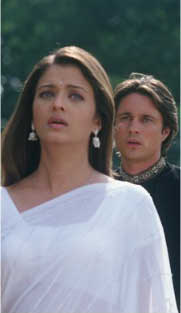
When the minor characters are more interesting than the main ones, it never
bodes too well for an audience’s reception to a movie. Lalita bitches about
how Darcy disagrees with her culture’s customs such as arranged marriages,
but she herself doesn’t like the idea – this is only one of the few contradictions
of her character throughout the movie. The reason why she started to despise
Darcy was that she thought he rejected her when he had trouble fixing his
costume. However, she then starts to harp on his “imperialistic” tendencies
instead of the real truth behind her annoyance. Lalita also retaliates by
nitpicking everything Darcy says into a political and social conspiracy deserving
of public lambastes from her. Her brain seems to be transplanted from an
over-reactive student marching in a riot somewhere in the world for some
idiotic cause. Although the façade is gorgeous who would want a conversation
with such a belligerent person?
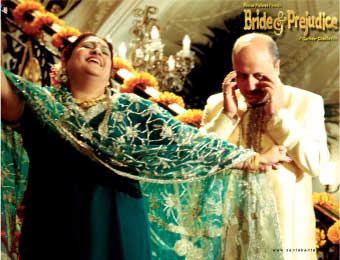
The supporting cast is the highlight of B&P. Anupam Kher (Mr. Bakshi)
must have been thrilled to be playing a serious father instead of the goofball
daddies he’s been playing in just about every major, successful, and popular
Bollywood flick in existence. The only movie I’ve seen so far where Anupam
wasn’t a paternal sillyhead, with children a million light years more mature
than he, was in 1942: A Love Story. He is one of India’s finest supporting
actors and I hope that he will receive more pivotal roles to play in the
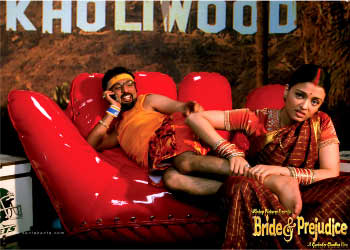
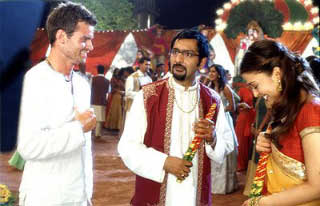
future. Nitin Ganatra’s Mr. Kholi was great and was probably the one guy
who generated the most laughs – his hip-hop wanna-be antics were hilarious.
I liked his performance a great deal and it was memorable. He poked fun at
himself and was a wonderful comic presence. Ashanti was a guest star and
does a Bollywood song-and-dance number during a Goa club scene, and I’m not
sure what to make of it other than it’s not extravagant enough for me – this
is India – throw in more gold, diamonds, rubies, emeralds, extras, lots of
extras, and even elephants for god’s sake. Even though the Cobra Dance, performed
brilliantly by Meghna Kothari, was a farce it was still well-danced.
British actors Indira Varma and Naveen Andrews had some very intimate moments
in 1996’s Kama Sutra: A Tale of Love, and it is hard to maintain a suspension
of disbelief as they now play the Bingley brother and sister in somewhat
gross fashion. Namrata Shirodkar was perfect as Jaya or Jane, exactly how
Austen has written her character. Mrs. Bakshi (Nadira Babbar) was appropriately
loud, pompous, and small-minded. The youngest sister Lucky (Peeya Rai Chowdhary)
was very annoying, and the evil side of me says that she and that conniving
Brit Johnny Wickham (Daniel Gillies) deserved each other. Aside from Ash’s
unreal beauty, there is no real magnetism to the main characters, and the
supporting cast saved the day as well as provided much relief when the storyline
between Ash and Henderson became too tedious.
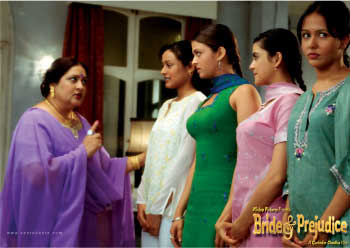
Mrs. Bakshi chides Lalita for not giving into an arranged marriage with Mr.
Kholi, “First you marry, then love grows, she wants love from the very beginning!”
It must be odd for the average individualistic Westerner to accept marriage
not based on love and marriage that is made possible by official matchmaking.
I think arranged marriages have been unfairly vilified in the West, although
I do believe that people should have the freedom to choose their spouses.
The older I get the more I realize that there’s more wisdom to this thinking
than the blindly individual search for love based on emotions and chemistry
alone. Objective parties are more clear-headed and perceptive about who’s
a better match for you in terms of temperament, interests, background, education,
habits, and family lifestyles, as “being in love” tends to overlook these
things which will in time rear their ugly heads and break unions apart. Families
do their research and background checks for you.
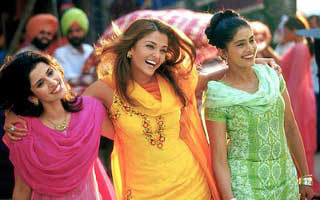
I think in the end B&P again simplified the complexity of arranged marriages
into black-and-white formulas – arranged marriage is bad; marriage based
on love is good. For example, Lalita marrying Darcy is good while her best
friend marrying Mr. Kholi, an arranged marriage, is just a joke. Gurinder
Chadha emphasized that B&P was “diaspora-centric” and I can certainly
respect that attempt except that it needs to be more thorough. While diaspora-centrism
may apply to Bend It Like Beckham, it hardly applies here. The only Indians
who are diasporic Indians are Mr. Kholi, Niran, and Bajral, and they are
just peripheral characters. The Bakshis are just well-to-do farmers in Amritsar,
Punjab, and most of the movie takes place there with a few instances where
the Bakshis end up in London and L.A. for sightseeing and a wedding attendance.
It’s hardly a discussion on the Indian diaspora at all.
In the end this film is a marvelous spectacle if you completely ignore the
discrepancies of the plot and characterizations. If you can’t get over these
discrepancies, then the shortcomings might just be enough to override your
enjoyment. The visual splendor was so colorful and energetic that you forgive
these problems during your viewing; it is after your viewing that you begin
to question some of the issues this film superficially raised and titillated
without much in-depth exploration.
Rating: 8.0
Gurinder Chadha’s Bride and Prejudice and Jane
Austen’s Pride and Prejudice: Character List
Lalita Bakshi (Aishwarya Rai) – Elizabeth
Bennett
Jaya Bakshi (Namrata Shirodkar) – Jane Bennett
Maya Bakshi (Meghna Kothari) – Mary Bennett
Lucky Bakshi (Peeya Rai Chouhuri) – Lydia Bennett
Mrs. Bakshi (Nadira Babbar) – Mrs. Bennett
Mr. Bakshi (Anupam Kher) - Mr. Bennett
Balraj (Naveen Andrews) – Mr. Bingley
Kiran (Indira Varma) – Miss Bingley
Mr. Kholi (Nitin Chandra Ganatra) – Mr. Collins
Will Darcy (Martin Henderson) – Fitzwilliam Darcy