Lagaan: Once Upon a Time
in India
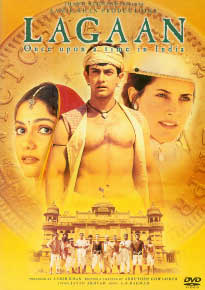
Reviewed by Anabela Voi You
Director: Ashutosh Gowariker
Music: A.R. Rahman; Lyrics: Javed Akhtar
Year: 2001
Running Time: An eternity or around 350 billion minutes. aka 224 minutes
After seeing Lagaan on many Bollywood’s “must-see”
lists and hearing about its praise in general, I had a hard time trying to
warm up to it. I can see the technical and artistic merit of this film –
the idea is original and the scriptwriting was excellent. However, I found
the momentum and energy lacking in the film. Perhaps because the characters
in the story were flat, myopic, and uncomplicated, the movie’s total focus
was on the cricket competition, barring the viewer from getting too emotionally
involved in the experience of the characters. I don’t know if I or Lagaan
was the problem, but I was not thrilled with it. At times the boredom was
so sedative that I caught my mind wandering into another galaxy.
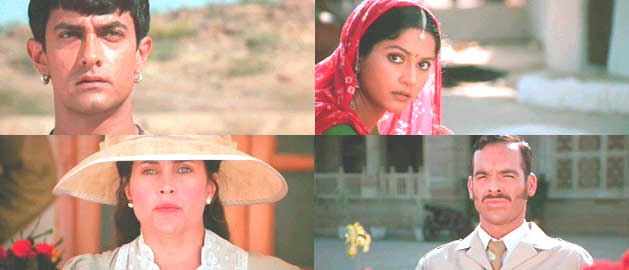
Lagaan is a simple film, nothing to it. (Insert inner voice expletive: I
am dying of boredom). Rather boring, though you wonder where all these European
extras came from. They probably hail from some backpacker hostel of joint-inhaling
kids somewhere in Delhi. You sort of guessed that the flick was going to
be a snoozer once the Academy Oscar Hollywood people get to it. Of all the
great movies these frozen yogurt-eating, yoga contortionist wanna-bes of
Southern California could have nominated from Bollywood, they had to choose
this one. Lagaan is at heart a good film but I really wonder how Aamir Khan
and crew came up with the idea of combining a story on tax and cricket with
a British versus Indian storyline. With such a far-out and seemingly inconceivable
idea, you’d think the product would be surreal and nonsensical, but the movie
couldn’t be more conventional and mainstream. Don’t get me wrong – you might
enjoy it if you’re into cricket or tax evasion.
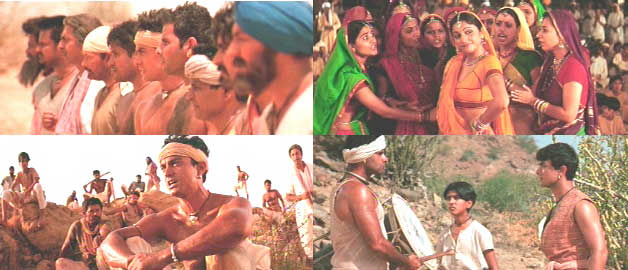
The film was nowhere near bad and indeed it could be classified as a good
to very good film. (Inner voice expletive: Trying to be as objective as possible).
The problem was that it lacked the typical Bollywood charisma and energy,
and obviously this is a subjective statement. The storyline was well-written
and clever, and the unlikely story of cricket and tax was very well-portrayed
in such a down-to-earth manner I couldn’t believe it. The cricket competition
was also well-depicted and choreographed. Technically, I couldn’t complain
about any glaring flaws regarding the acting, the music, plot, cinematography,
etc., because all these elements were smoothly weaved into a classical cinematic
symphony. The musical and dance aspects of the film were nothing memorable,
but to its advantage, these numbers were performed under naturalistic lighting
and in the outdoors which evoked a feeling of pastoral beauty.
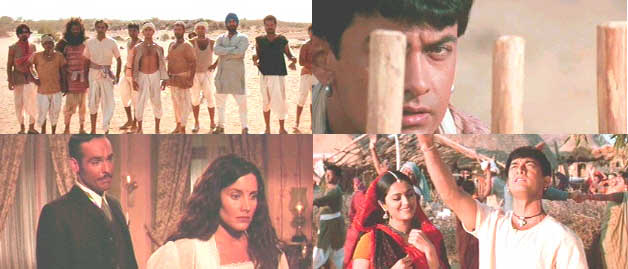
Just a bit of trivia: Rachel Shelley’s song-and-dance routine was sung by
playback singer Vasundhara Das, the bride caught with another lover before
her wedding in Monsoon Wedding. Mr. Aamir Khan is considered one of the greatest
technical actors in India in the ranks of Shah Rukh Khan. I haven’t seen
Aamir Khan’s other performances so I can’t be the final judge of his acting,
although Lagaan just didn’t convince me he was all that. I hope to be corrected
in the future, as talent is rare. Aamir produced Lagaan and it became a huge
success. He’s known to hit the jackpot of gold with not several movies a
year but with one or two, quite unusual for the frantic Bollywood assembly
line of movie-making.
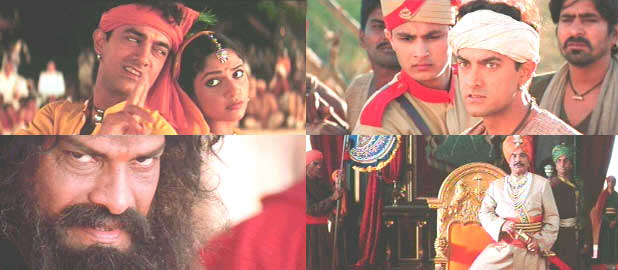
The reason why Lagaan was unusually long even for a Bollywood film is that
it covered a cricket match of the Brits versus Indians over a period of 3
days plus a quadra-love-angle, having simple villagers learn the British
sport in 3 months, and some ethnic-religious conflicts/resolutions! (Inner
voice expletive: Kill me now.) You knew the Indians were going to win but
the revolving door of British wins and losses was well-done and kept the
tension bubbling. (Inner voice expletive: Purple stars, ocean moons, diamond
cakes, my eyelids are drooping.) Contemporary cinema doesn’t like black-and-white
categorization, a.k.a. bad guys versus good guys. One of the good guys is
a Brit called Elizabeth, played by Rachel Shelley, the sister of the villain.
All the actors delivered good performances, while I doubted Aamir Khan’s
performance as Bhuvan, a simple farmer with guts and determination. (Inner
voice expletive: Botox face?). I can’t tell the difference whether he’s being
macho with minimum emoting or that stiffness is his state of being.
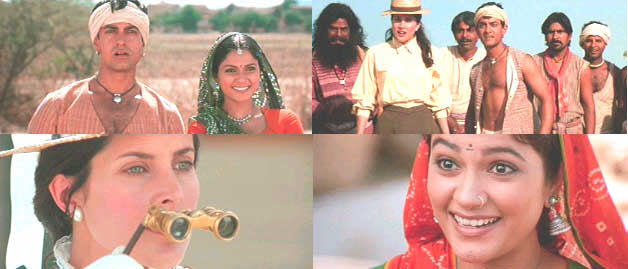
I haven’t seen Aamir Khan in anything else but he’s from a strong pedigree
of Bollywood greats and has won several awards for his acting including Lagaan.
I’m surprised to be honest because he appeared rather Zombie-esque rather
than a young man containing all that inner passion inside that is just waiting
to burst out. Assessing acting ability is an incredibly subjective activity,
and although many praised Anil Kapoor for winning Best Supporting Actor in
Taal, I just don’t get it. Maybe I have a different taste in acting styles,
but the same thing applies to Aamir Khan – I don’t get what the thunder is
about. It’s “safe” to do a little emoting from time to time; it justifies
your acting school fees.
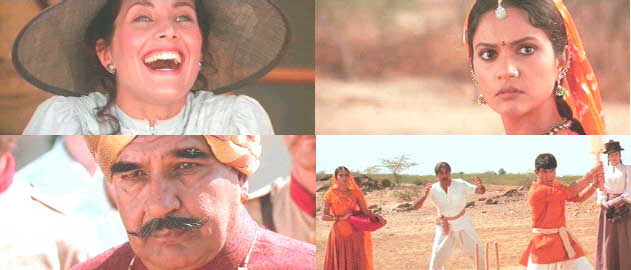
The storyline is very simple: the villagers of Champaner are about to be
required to send in their taxes and most of their produce to the Brits who
plan to double their taxation. They are already living in poverty and drought,
so they protest further taxation. However, the British villain Russell takes
a gamble with the villagers: 1) If you (villagers, symbolic of all India)
beat us the (Brits, symbolic of evil colonialism) in cricket, then you, not
just your village but the entire province, won’t get taxed (lagaan) for 3
years. The villagers have 3 months to prepare. Well, the problem is the villagers
don’t know how to play cricket nor do they have the equipment. The villain’s
angelic sister feels sorry for the villagers and teaches them cricket.
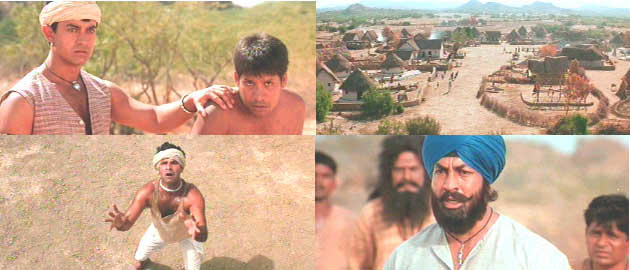
Aamir Khan sets out to find the perfect players for each tactical position
of his cricket team – he even finds a lame boy who has an unusual ability
to throw spinning balls. He knows how to find talent and utilize and maximize
his players’ natural abilities. For example, the village’s chicken farmer
is extremely agile with catching fleeing chickens and he was chosen to be
the catcher. Of course, the whole film is a political allegory that calls
India to overlook its differences and unite – it wasn’t hard to guess that
when one of the Muslims in the movie came out and said, “I don’t care about
our religious differences, I just want to fight our common enemy [the Brits]!”
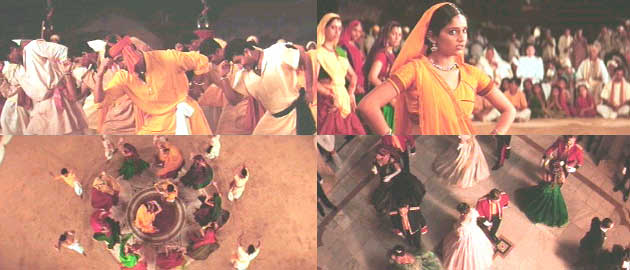
Gracy Singh’s Gauri performed well as a village girl in love and stands by
her man in times of crisis. She exuded feminine earthiness and vivacity.
Despite being jealous of Rachel Shelley’s Elizabeth, she stood by Bhuvan
(Khan), putting love second to the fate of her nation like a good, traditional
woman would. Even when she was jealous she was still adorable. Rachel Shelley’s
Elizabeth was light, airy, angelic, and her presence was lovely to behold.
Rachel Shelley’s Bollywood red-clad, song-and-dance routine was rather unnatural
and made me feel a little embarrassed for her, because somewhere in my twisted
mind I can see Madhuri Dixit laughing her ass off. Of course, there’s an
annoying spy that blows all the secret information to the villain, but the
community accepts him back like the prodigal son that has gone astray, further
compounding the political message that calls for unity.
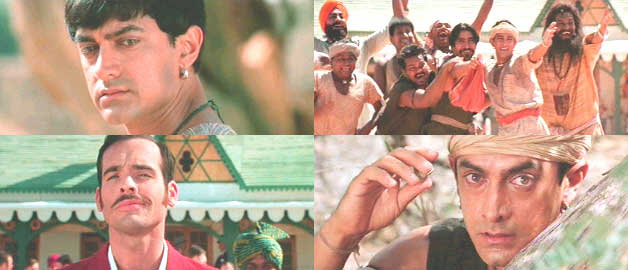
One of the deleted scenes has a tribute (unintentionally, I believe) to "The
Usual Suspects" where Bhuvan and Elizabeth are trying to find the spy-culprit.
They made them stand in a line and say, “I’ve been no use.” It is reminiscent
of how the "God of Cookery" also had an "Usual Suspects" moment. Lagaan’s
version didn’t have much humor except when the village mystic/oracle man
screamed, “Disaster is on the way!” In the deleted scenes, the superiors
of Russell even made sure they would go to the match so that there won’t
be foul play, knowing how wicked their underling is. The superiors enjoyed
the cricket match, mouthing sportsmanlike praises during highs and lows of
the game. They were quite nice and pleasant “chaps” who restrained Russell
and put him into place though often enough. Nobody knows what was the problem
with Paul Blackthorne’s Russell, but he probably suffered a major childhood
or sexual crisis that resulted in his being a total git of pomposity, vindictiveness,
and despicability as an adult. Although the boredom didn’t quite make me
hemorrhage, I do have enough distance to concede that Lagaan is a well-made,
clever, and original film as well as harboring enough content and quality
to make it enjoyable.
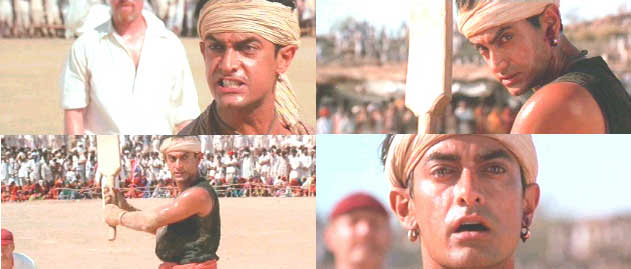
Rating: 7.5