Satya: The Other Side of
Truth
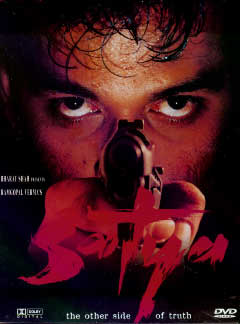
Reviewed by Anabela Voi You
Director: Ram Gopal Varma
Music: Sandeep Chowta, Vishal
Cast: J.D. Chakravarthi, Manoj Bajpai, Urmila Matondkar, et al.
Running time: 2 hours and 54 minutes
Year: 1998
Satya is not just one of the best gangster
films ever made in India, but one of the best gangster films ever made.
The story is told in a narrative overflowing with humanity and without sentimentality.

Unsmiling Satya, whose name means “truth,” (J.D. Chakravarthi) arrives in
Mumbai with no family, history, friends, money, or connections. He later
tells his love Vidya (Urmila Matondkar) that he is an orphan but one can’t
be sure of his origins. His one asset is his unflinching, stone-cold fearlessness.
At first he lives inside a buffalo stable and works as a waiter who unfortunately
offends Jaggabhai, a big-time gangster and bully who’s so scary-looking he
makes the average Hong Kong cinema villain look like a puppy. Satya’s run-ins
with Jaggabhai increase but Satya never backs down. Jaggabhai finally frames
him to go to prison where he meets a happy-go-lucky and hot-headed gangster
Bhiku (Manoj Bajpai).
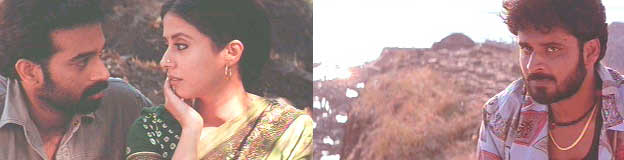
Unlike Jaggabhai, Bhiku is impressed by Satya’s cold and calculated fighting
ability and recruits Satya into his organization. Satya’s first assignment
is to kill a man, and he doesn’t have a problem with it at all since the
target is Jaggabhai who framed him in the first place – sweet coincidence,
eh? Bhiku’s world is full of happy-go-lucky gangsters like himself such as
Chanders (Snehal Dabi) and the seal-like Uncle Kallu Mama (Saurabh Shukla).
Satya is fearless; he is not courageous for courage is characterized by overcoming
one’s fears. Satya has no fear because he is a nihilist, nothing to live
for, nothing to lose, and nothing to fear. He is only propelled by an animal’s
instinct for survival, which is why Satya behaves with such mental clarity
as emotion and moral issues, which plague others, are completely bypassed.
Those intense, void-bearing eyes alone are chilling enough to make you forget
to breathe.

Satya turns out to be a natural born killer even more so than his trigger-friendly
brethren. He is also an intelligent, ruthless businessman and strategist.
The film progresses to a discussion of the trinity of the underworld, the
police force and politicians, and the labyrinthine relationship among the
three forces unfolds in a mesmerizing narrative. Each camp makes intelligent,
foresighted decisions, surveying the enemy’s every move. The police are having
a headache trying to curb the incessant shootouts of rival gangs and dealing
with problems of civic safety. When asked how to solve the problem, one policeman
called Khandilkar (Aditya Srivastava) unemotionally declared, “Just kill
them all.” Khandilkar’s superior responds by saying that the problem is a
significant number of Indians are illiterate and uneducated, but he doesn’t
expand on his theory; such movie characters, who utter social theories which
have little to do with their personalities, are often the mouthpieces of
the intelligentsia and probably belongs to the director’s voice, not coming
necessarily from a weak, armchair policeman. Later in the movie Bhiku says
he took his wife to see a “lizard” movie called Jijamata Park, which
turned out to be Jurassic Park. I suppose that was the vague reference
to the lack of education (at least Hollywood education!) and how people have
turned to crime for their livelihoods.

The Commissioner Amodh Shukla (Paresh Rawal) insists that the underworld
can do anything because it’s allowed to trespass the law, while the police
force can’t do much within the law without breaking it. Then the politicians
proclaim that any measures, extreme as they may be, must be taken to exterminate
the hooligans regardless of the consequences and costs, because the rights
of other Indians are being violated and India must maintain its democratic
ideal. Despotic measures are taken to maintain a democratic, safe society
– a contradiction. The Commissioner is given free reign to eradicate the
gangsters and a bloody full-scale police-gangster-politician war ensues.
I liked how the film wasn’t partial to either side, and although much of
the movie was a gangster tale, it didn’t portray the police as gratuitously
evil, stupid, or one-dimensional – they are dedicated to their jobs in a
world they have little control over, and they too have families and loved
ones.
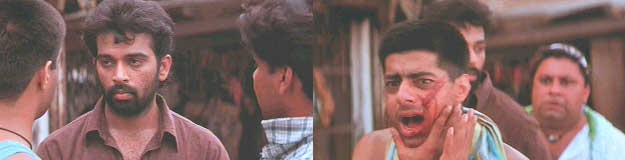
They all have a job to do and sometimes it involves unethical practices such
as torturing, interrogation, shooting, and betraying people to reach their
organizations’ goals and to defend their livelihoods. As the Commissioner
bemoans in a passionate speech, there are accusations of human rights violation
all over the place when the police makes mistakes, but the public is fearfully
silent when gangsters annihilate the innocent ones. The politicians reap
the benefits of dictating the policies that the police help execute but it
is precisely the police who are held responsible when things go awry. In
the meanwhile, politicians remain safely invisible behind their curtains,
free from condemnation and protected from the line of fire.

In Satya politicians are portrayed shamefully who use the other two
worlds of the police force and gangsters to do the dirty work for them. The
most despicable man in the movie is Bhau, who keeps one foot in the legitimate
world and the other foot in the illegitimate one, and he manipulates both
worlds against each other for his own self-promotion. Aside from Bhau, most
of the characters were shining with humanity. He is only out for himself
and his own interests, as Satya accurately assessed, while others, regardless
of their actions, are at least caring for another person or a group of people.

Satya becomes successful in this war because he isn’t afraid of removing
obstacles, that is, highly respected gangsters and even police Commissioners.
Conversely, everyone around him is wallowing in their emotional turmoil and
mindful of breaking the least significant of unwritten rules and codes of
honor. Satya’s head is hunted and there was one brilliant scene where Satya
escaped from police arrest after watching Border in the cinema. Chakravarthi’s
performance is remarkable - Satya displays an icy disregard for anything
or anyone in the beginning, and then later a love-struck Satya conveys a
child-like vulnerability, a transition of character that is tough to pull
off. Before Satya came to Bombay he was a little more than a cold-blooded
animal, and I find this transition from a cold-blooded animal into a passionate,
caring human being to be deeply engrossing. After his entry into the underworld
and meeting his love, he learned about brotherhood and family. It is ironic
that when Satya actually entered a world of extortion, murder, and deceit
that he finally learns about camaraderie and love. Without Vidya he wouldn’t
even know how to pray in a temple.

Ever read all those rumors and sensational stories about how gangster-infested
Bollywood is? Satya devotes a significant part of the film to this
issue while brilliantly exploring the Mumbai underworld and politics at large.
Now that I re-watched the movie and read the disclaimer of protocol about
how “any resemblance to real live events and people is purely coincidental,”
it just made me giggle. Bollywood’s “film financing” by the underworld has
been widely reported, and rumors of how so-and-so ascended to the top or
how so-and-so got killed because of non-payments to the underworld are rampant.
The varying moods of Satya can easily echo John Woo, Johnnie To, Tarantino,
Coppola, and even at times Fernando Mereilles’ City of God and the
result is riveting.

While underworld films by Tarantino or Coppola have an air of self-indulgence
and decadence, Satya is always firm on the ground, focused and intent
on delivering its message and its purpose. In a way I was reminded of every
gangster film in the genre I’ve ever seen because each and every theme was
so thoroughly explored, and most of the characters were given plenty of screen
time and development. Without her knowledge, Vidya gets her job as a playback
singer by having Satya pull some strings that was very reminiscent of Godfather
I’s extortion scene with a Hollywood director. There is also a shootout
scene that’s comparable to The Mission’s shootout scene in the shopping
center, and, although it’s not as stylish and smooth as The Mission’s
whose visual mastery is nearly unsurpassable, Satya’s shootout was
quite gripping. Later on, there’s a scene where a “soldier” from the rival
gang is caught and they torture him while they casually chat and giggle.

I was reading reports from the Nanjing Massacre and how Japanese war criminals
recounted how desensitized they become to human suffering and how valueless
human lives become in their eyes. Sadistic cruelty is a part of the job description;
I wonder what it’s like to live a life where you never know when you’ll get
caught, tortured, and killed by the enemy and where you have to witness death
and destruction so often in a day. In Satya some of the deaths were
accidental, and accidental death is pretty much a part of the job description
too. The accidental as well as premeditated deaths, the rush of adrenaline
when you realize it’s happened, were well captured.

I liked the sound effects, which are eerie and delve into the human heart’s
darkness much like the music in Asoka. There are only a few songs that are
performed without much pageantry to fulfill the audience’s basic musical
thirst, and the music was generally understated but also enhanced the storyline.
They could be forgettable at the first viewing, but the melodies really caught
onto me and haunted me at the second viewing. I loved the songs “Baadalon
Se” and “Tu Mere Paas” which are sultry, evocative, and romantic songs that
accentuate the urbanity of Mumbai. “Gholli Maar” was also a great, gritty
drinking song where the guys spill beer with reckless abandon and dance,
or rather hurl, to the music. The songs were akin to something like Mumbai
blues. The cinematography was seamless and masterful. The breath-taking beauty
of the scene where Vidya and Satya are strolling down a glittering beach
during sunset makes you wonder how such contradictory sights can be in the
same film. Urmila gloriously poses in her plain yellow, white, blue saris
holding the sheer fabrics against the sun in “Tu Pere Paas.”

Often times there isn’t enough focus on Mumbai itself in Bollywood movies,
and I didn’t have the faintest idea what facets of the city looked like even
in a movie that is supposedly about Mumbai as in Bombay. For the first time
on film I got to see a satiable glimpse of Mumbai’s colonial architecture,
shantytowns, beaches, high-rises, harbors, food stalls, night markets, real
estate developments, temples, jewelry shops, movie theaters, back alleys,
religious festivals, and an overall paradoxical flavors of this major complex
international city. The cinematography is gritty and “realistic” but simultaneously
the story is handsomely presented. Many of the scenes are shot outdoors and
I loved seeing the prolific urban landscape of Mumbai.
I can’t praise the cast enough – they were simply fantastic and superb on
the whole. Manoj Bajpai received more publicity and praise for this film
than the leading Chakravarthi, probably because Manoj is more handsome and
has a higher profile, but I disagree that Manoj out-performed everyone else
in the cast. Chakravarthi was excellent and Manoj was also outstanding. It
would be unfair to compare the two performances, as their characters were
a far cry from each other, which contrasted and complemented each other.
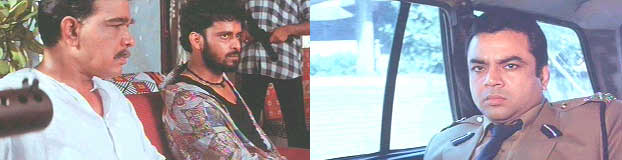
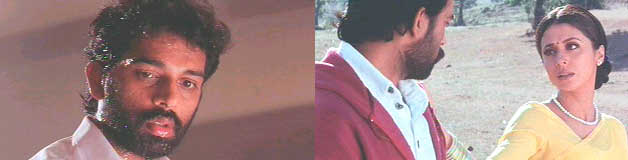
There is an absorbing scene where Vidya realizes who Satya really is and
the sense of trauma and deceit is etched in her face in such a way that she
is transformed from a vivacious girl to a lifeless, blanched face. Vidya
is a simple, nice, honest, filial girl and singer who is just the innocent
“girlfriend” to a ruthless gangster. Satya, however, portrays women
differently than other gangster films where women are portrayed as burdens,
excess baggage, the ball and chain, an obstacle to a man’s career, a hapless
victim that is used for kidnapping and extortion, wrecker of brotherhood,
and other tedious stereotypes. This time, on the other hand, women and families
are portrayed in such a loving, tender light and given such importance that
they give the gangsters a ray of hope, and really, the purpose of their lives.
The relationship between Bhiku and his wife Pyaari (Shefali Chhaya) is so
touching that it gives Satya a humane look at the gangster world.

The spiraling events of retaliations, vendettas, betrayals, killing sprees,
informers, assassinations, and convenient relationships/friendships that
mask hatred underneath are the elements that make Satya so engaging
to watch. The film also sufficiently explores the major issue of how a gangster
juggles his private life of love and family with his profession. Uncle Kallu
(Saurabh Shukla) was absolutely marvelous – you can sense every alternating
thought he had in his chaotic mind and his fear was so palpable that your
heartbeat synchronized with his. It turns out that Saurabh Shukla does indeed
have something special - he co-wrote the script! Ram Gopal Varma wrote: “My
tears for Satya are as much as they are for the people whom he killed.” Each
and every fiber of the film remains conscious and faithful to the heart of
this message. This is a phenomenal work by Ram Gopal Varma and crew, and
I think Satya is nearly perfect as I haven’t been this passionate
about a film in a long time.
Rating: A resounding 9!