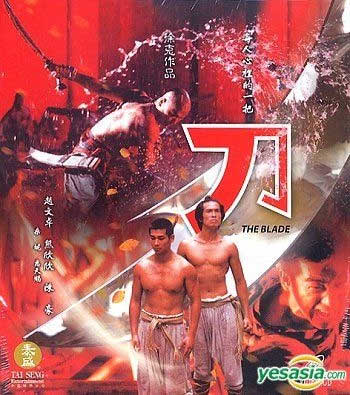
The Blade
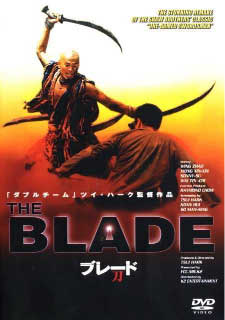
Director: Tsui Hark
Year: 1995
As a counter point
to Wong Kar Wai’s Ashes of Time, Tsui Hark has concocted a visually stunning
sword film. At moments you wonder if it is a philosophical treatise told
in the form of a traditional sword fighting film or is it a sword film within
the veneer of modern philosophical concepts of alienation and the meaning
of life.
The film unfolds within the loose (perhaps
opium induced) narrative structure of Ling (Sang Ni), the daughter of a sword
maker in a small town in a remote province of ancient China. The recreation
of this world feels very authentic. She talks of her flirtatious affection
for two of her father’s workers - Iron Head and On (Chiu Man Cheuk) but can’t
decide which she likes better. All seems idyllic in this young woman’s life,
but soon her life and everyone else’s is turned upside down and by the end
of the film all innocence is gone, everyone has changed .
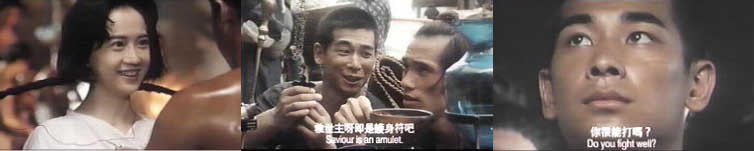
Iron Head and On go into town to shop, catch their first glimpse of the prostitute
played by Valerie Chow, and see a monk killed by some animal hunters who
have stopped in the town. This is an intriguing scene as Tsui Hark plays
against our expectations. At first it appears that the monk with his kung-fu
powers will easily defend himself against such unworthy opponents, but their
sheer numbers and cowardly traps finally bring him down and he is brutally
murdered. Much of the rest of the film also plays against the viewers expectations.
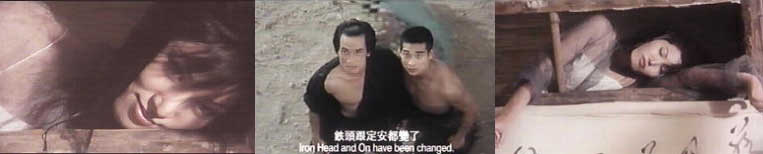
Soon after On, who is an orphan, decides to leave the small town and look
for the killer of his father - the only thing left of the father is the broken
blade he used to protect his infant son from the killers. This sets
up a chain of events as Ling leaves the compound to stop him from going and
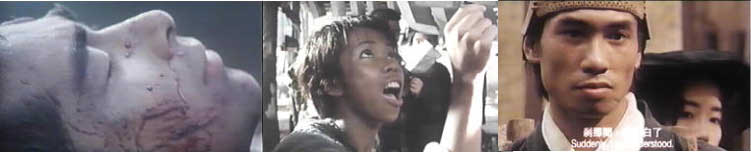
is captured by the hunters. On rescues her in a amazingly harrowing sequence
of bear traps and bamboo. He loses his arm though - thus re-creating the
One Armed Swordsman legend - and disappears over a cliff. He is found by
a young girl and nursed back to health.
At the same time both Iron Head and Ling start a search for On (or is it
more than just that ?) that turns into a journey through Hell - as a world
of thieves, murderers and rapists dominate the landscape. On meanwhile discovers
a half burned sword’s instruction book and trains to meet the killer of his
father. The final conflict is an amazing duel of speed, swordsmanship
and determination.
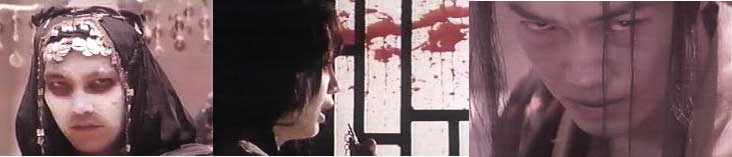
Tsui Hark truly creates another world in
this film full of incredible images and sounds and almost smells. You can
seemingly taste the dirt and dust in your mouth, feel the fear in the air.
The editing is brilliant and the screen is always full of either magical
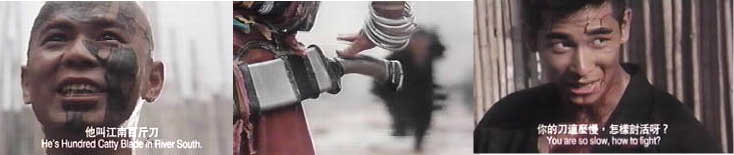
imagery or frenetic action. The fighting scenes are done in rapid editing
fashion that are breathtaking.
Now perhaps I praise this film too much especially considering that the first
time I watched it I had a slightly negative reaction to it. This was primarily
because the three main characters feel so distant, so unemotional, so isolated
from each other. I didn’t care what happened to these characters. The film
seemed to be all technique with little heart. On second viewing though ,
I was even more overwhelmed by the technique, by the incredible fluidity
of this film; and the apparent coldness of the characters seemed less emotional
detachment as an inability to declare their true feelings of friendship and
loyalty.
At least from my perspective, a film that has to experienced more than once
to be fully appreciated.
My rating for this film: 9.0
Reviewed by YTSL
Pity the poor people -- who I know do exist since
I spoke to one a month or so ago! -- who viewed this Tsui Hark directed and
produced effort thinking that they were going to watch either a standard 1970s
style kungfu movie or even the kind of "new wave" swordplay drama that this
prolific film-maker churned out in some abundance in the same decade as this
1995 work. The fact of the matter is that it is not just the action
scenes in this film but also its dramatic sections, underlying premise and
overall story that are so much more realistic, grimmer and less heroic in
style and nature than what members of the audience might be used to and want.
All in all, one could go as far as to describe
THE BLADE as generally hyper-realistic, ultra-grim and anti-heroic.
Regarding the last point: It's not enough that the film's protagonist
(Ting On comes in the form of the impressive Chiu Man Cheuk) is a factory
worker who is a reluctant hero, at best (in contrast to his much bolder and
respected but less handsome colleague; Iron Head is played by Moses Chan
Ho), and comes to lose an arm by way of an animal trap rather than at the
hands of a kungfu master. Rather, it is also that the tale's narrator
(Ling is the daughter of the chief sword-maker of the factory in which hot
environs Ting On, Iron Head and other muscular young men sweatily toil) could
be said to be mentally as well as intellectually the weakest -- even if not
the youngest and only female -- as well as least developed character in what
could (otherwise) be said to be Tsui's most masculine offering.
Fans of Tsui Hark's other works (E.g., "Peking Opera Blues", "Swordsman II",
"Once Upon a Time in China", "Green Snake" and "The Lovers") know that he
seeks to communicate serious thoughts and ideas as well as entertain, and
is capable of evoking intense reactions from viewers. But whereas in
many of his other movies, thought-provoking segments, political messages
and scenes of torture, pain, humiliation and anguish tend to be not only
offset but also heightened by their being interspersed with some tender and
comic moments, this is not the case with THE BLADE. Instead, this work
is so relentlessly dark in tone and bereft of good humor as to cause this
(re)viewer to actually feel a strange need to laugh at things which elsewhere
might not be all that funny or ridiculous seeming (such as the bad timing
that came when Iron Head fixates at an inn on the erotic actions being forced
on a woman (Valerie Chow looks alternately vulnerable and vampish in this
role) and, in so doing, ignores and provokes the violent ire of a drunken
man who had been trying to offer to buy him a drink).
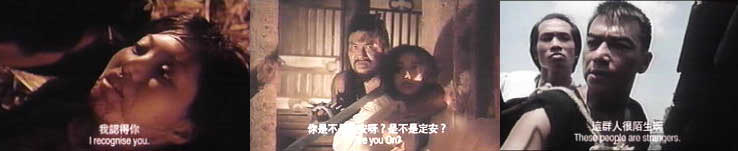
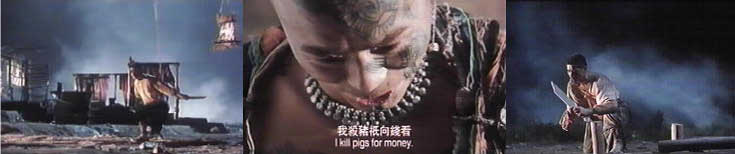
All this dramatic gravity definitely does contribute to the almost too authentic
and grounded feel of THE BLADE. So too do the movie's psychically or
physically blemished characters, chaotic and unglamorous sets along with
the particular unblinking way of filming that Tsui has opted for here.
Then there is the sheer, stark, savage and earthy interpretation of how one
leads life and what one wants out of it (e.g., the young girl does not seem
to love but lust, and want to bring on competition -- rather than encourage
friendship -- between men for herself).
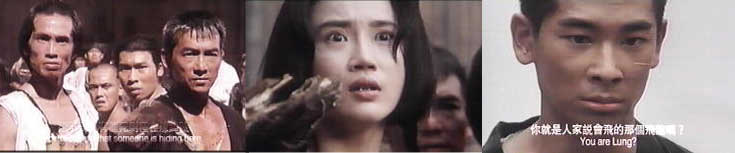
With regards to the movie's fight scenes:
Although the action is often as swift as it is energetic, feral and violent,
it does not seem inhumanly so. Perhaps most pertinently, there is little
sense of wires being used here by bona fide wushu practitioners like Chiu
Man Cheuk (whose name is rendered as Zhao Wen-Zhou in Mandarin Chinese) and
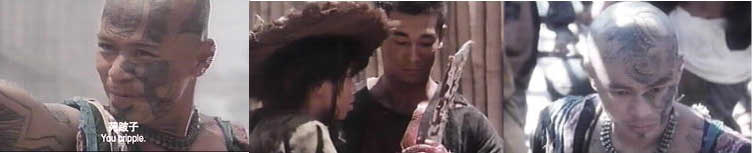
Xiong Xin-Xin (the man who plays the main villain of this piece is also sometimes
known by Cantonese speakers as Hung Yan-Yan); at least not in the extravagantly
fantastic -- and thus obvious -- way that caused Jet Li to spin wildly and
allowed Brigitte Lin to glide ethereally in "Swordsman II".
Howard Hampton has called THE BLADE Tsui Hark's "almost exhaustingly ferocious
answer film to Wong (Kar Wai)'s "Ashes of Time"". Viewed from a certain
standpoint, it can seem like the Canton-born, Saigon-raised auteur was not
only bidding here to compete with Wong but also was mocking the Shanghai-born,
Hong Kong-raised filmmaker's trademark techniques, outlooks and obsessions
to some good effect. Unfortunately, it seems like Tsui sought to do
so on Wong's rather than his own familiar or revolutionary terms. To
be sure, the former did end up with a beautiful yet brutal picture that is
equally impressive as a piece of cinematic work as many of Wong's and his
own previous efforts. But when directly compared with what I believe
to be Wong's masterpiece, I find THE BLADE to be more soul-less than soulful,
devoid of a genuinely affecting emotional center (provided in "Ashes of Time"
by The Woman), and too full of alienating -- rather than alienated -- individuals;
whose woes can be said to be (more) deserving of our sympathy yet with whom
I could not empathize in the way that I did with each and every of the eight
principal characters in Wong's indulgent post-modern epic.
 My rating for the film: 8.5.