Peace Hotel
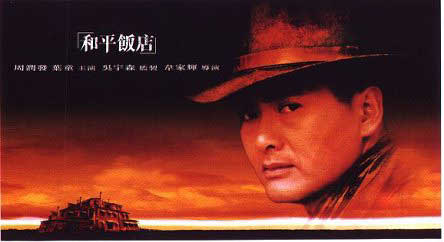
Director: Wai Ka-fai
Year: 1995
Rating: 8.0/6.5
Chow Yun Fat’s final
HK film before departing for Hollywood is an extremely interesting effort
that has been met with a lot of resistance from HK film fans. Many
find it too oblique, too dark, too disjointed and the characters too under
developed. To some degree I can’t disagree with these assessments, but at
the same time I found this to be a beautifully constructed film that is all
about mythmaking. It’s almost as if the director Wai Ka-Fai took the character
from The Killer (John Woo is the producer of Peace Hotel) and transposes
him to a different time and notches up even more the legendary aura surrounding
him.
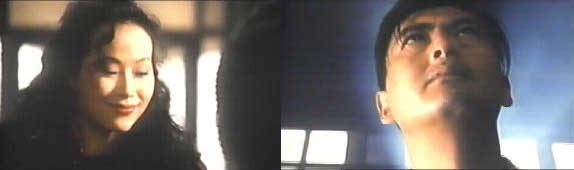
This fits of course into the very Western (as a genre) feel that this film
has. There are themes in this film that are found time after time in the Hollywood
Westerns of the 1940’s and 50’s. Individuality, searching for identity, a
man left on his own to face the bad guys, the now peaceful man who has
to once again pick up his gun to protect society are themes that run through
many Westerns and are very present here. There are strong echoes of High
Noon and Shane (even telling the story from the point of view of a small
boy) that resonate through this film. And like the Westerns of John Wayne,
Gary Cooper, Alan Ladd and Joel McCrea this film is about creating a myth
– not simply telling a story – about a man much bigger and larger than life.
Taken from the eyes of a small boy told many years later, it has taken on
the characteristics of a “tall tale” – to be passed down from generation to
generation – and with each telling becomes more exaggerated. I approached
the film from this perspective and found it to be immensely satisfying.
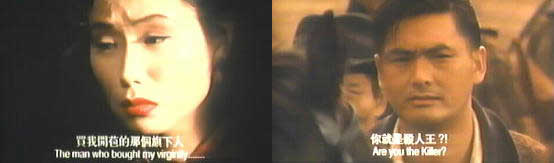
There are a number of cinematic techniques that I really enjoyed about this
film as well. The editing is simply brilliant, the lilting music weaves into
the story line seamlessly (the three man band is a great touch), the tint
that Wai gives the film is just perfect (it places the viewer in different
space, a different era - and again gives off echoes of old time Westerns)
and his use of the camera – at times creating a claustrophobic sense within
the Hotel, at other times it feels cavernous depending on what mood he is
trying to project – and his coming in for close ups and then backing away
for widescreen shots is a pleasure to watch.
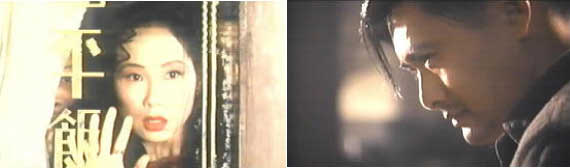
Though John Woo produces the film, one should not have expectations of John
Woo like action. The film has action at the beginning and the end of the film
(which is in fact seemingly much more influenced by Wong Kar-Wai than Woo).
The remainder of the film is about this man, his hotel, the woman who enters
it and the relationship that grows between the two of them. The film explores
themes of identity, memory, community, revenge, sacrifice and love.
In the opening scene, Chow Yun Fat – called
interestingly The Killer – is in the process of slaughtering a large number
of men – and he sees his lover (a cameo from the glorious Wu Chien-lien)
die in front of him. It isn’t until much later in the film that the truth
of what transpired that day becomes clear. After the bloody massacre, a sickened
Chow retires from a life of killing and opens a hotel in the wastelands in
which anyone can receive refuge - no questions asked. No one is allowed to
violate this sanctuary or they will answer to Chow. Over ten years a community
has grown up within the hotel and as long as they stay within they are safe.
Allusions to HK? – perhaps.
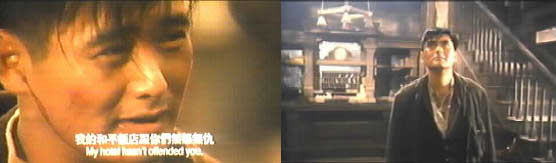
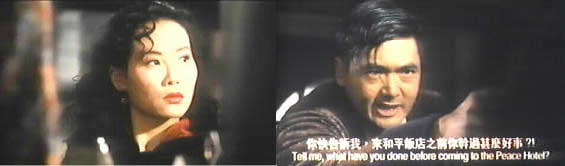
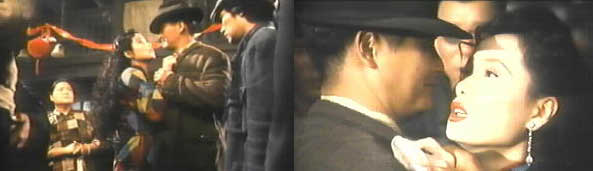
One day Cecilia Yip comes into the sanctuary seeking escape from a large
group of ruffians and claiming to be Chow's dead wife at one point and one
of the Soong sisters at another. Her performance is vibrant, enchanting and
multi-faceted. Who she really is slowly surfaces over the film. The large
band of killers gives Chow a deadline for turning her over to them – or they
will kill everyone within.
My rating for this film: 8.0
Reviewed by YTSL
Though not as demented as “Fantasy Mission Force”
and definitely not meant to be farcical like “The Eagle Shooting Heroes”,
Chow Yun-Fat’s final Hong Kong movie -- before he headed off to try his luck
in Hollywood -- is a rather bizarre as well as confusing piece of work.
While there does appear to be respectful nods in the direction of John Woo
(who produced this film) in such as the naming of Chow’s character as “The
Killer” and the appearance of white doves during a soulful moment, I have
read about director-scriptwriter Wai Ka-Fai’s being particularly influenced
by Wong Kar Wai. Although this seems to have been detected most in terms
of the filming style utilized for this 1995 movie’s action scenes, the production
also does have an atmospheric feel of taking place in a social vacuum as
well as unspecifiable time and place akin to the Wong Kar Wai script-written
“Saviour of the Soul” (N.B. I had feared that it would be a somewhat hokey
as well as improbable Eastern Western but have concluded that it was actually
more of an ahistorical fantasy).
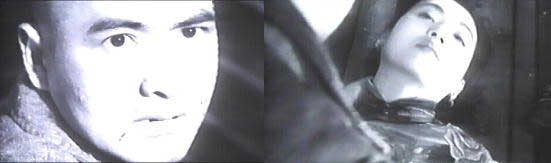
PEACE HOTEL begins with a murderous rampage of a sequence filmed in black
and white that takes place ten years before events that will occupy the rest
of the movie. As if through mist and in a nightmare, we see a bald-headed
man -- who looks to be responsible for the deaths of scores of men (and maybe
one woman (The visually striking Wu Chien-Lien makes a haunting cameo performance
here)) -- hunting down a clearly frightened and desperate youth, only to spare
his life after cornering him. These intense few minutes constitute an
amazing section of film that will be hard to forget.
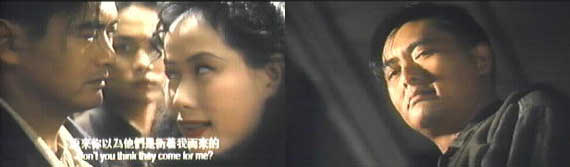
For reasons that I am still trying to truly fathom, the rest of PEACE HOTEL
just doesn’t come close to it in memorability and quality. Although
it is particularly beautiful to view upon getting infused with color, possesses
a rather good musical score (along with a Hong Kong Film Award-winning song)
and seemed to have the requisite elements in place -- at least two strong
characters, a complex and original story with its fill of romance, tragedy
and mystery, etc. -- to be generally interesting, this (re)viewer actually
found her mind wandering in places as well as working overtime trying to figure
out what was actually going on with particular individuals along with the
story as a whole. Additionally, I must admit to having to fight off
several urges to fast-forward through scenes that felt alternately superfluous
and actually irritating (even while I needed to -- and did -- immediately
rewind and rewatch the opening scene before giving my attention to the rest
of the movie).
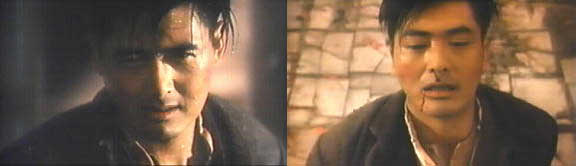
This was especially the case when the movie’s undisputed star (who apparently
was the individual who first conceived of the perhaps too improbable story,
and does receive writing credits along with Wai Ka-Fai for PEACE HOTEL) was
not in the frame. Of course, it’s not Chow Yun-Fat’s fault that he exudes
so much charm and has so much presence that he overwhelms everyone else in
the picture. However, precisely because I felt such sympathy for the
Killer who tries so hard to reform and create a haven for other retirees from
the bad real world, I got thoroughly vexed by his becoming inexplicably enamored
with a woman who so clearly was Trouble (Cecilia Yip possibly overacts but
most definitely is awfully shrill as well as volatile in this over-the-top
role) and was bound to create havoc in his realm. Chow also provides
an unfair yardstick for endowing with humanity what the production’s others
actors could only correspondingly fashion into unattractive caricatures.
It surely was not the intention of the movie’s makers for Chow to look good
at the great expense of the film. At the same time, I can’t help but
wonder how much director Wong and producer Woo were prepared to sacrifice
in terms of overall plot continuity and role development to come up with a
legend-style departure for his PEACE HOTEL character which could also be metaphorically
perceived as their good wishes regarding the charismatic Hong Kong film giant’s
future activities.
My rating for the film: 6.5