A Better Tomorrow
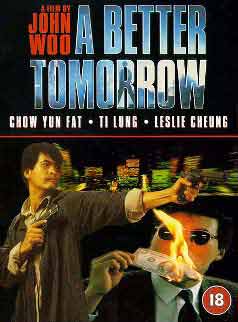
Reviewed by Yves Gendron
Few movies ever had the impact of John Woo’s A
BETTER TOMORROW. Yet despite it’s top grossing, award winning, career
making as well as trend setting (in both movies, and fashion) record, it’s
rather doubtful that many Westerners have any idea how ABT’s tale of brotherhood,
loss, betrayal, and tragic heroism, struck a deep cord within the H-K people
in a way very few movies had in the past and probably none since.
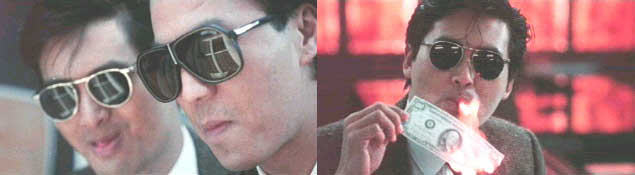
Sung Chi-ho and Mark Lee are two dapper-suited triad wise-guys working as
couriers for a counterfeiting ring. Ho though is planning to retire from
the business for the sake of his younger brother Kit who is about to become
a police inspector. A mission in Taiwan goes dreadfully wrong however, leading
to Ho’s arrest and indirectly to the murder of his father back in H-K as
well as to the crippling of Mark in a gunplay vendetta when he sets out to
avenge his partner. After a three year prison sentence, Ho gets out of jail
determined to leave his triad live behind only to find out that his brother
hates him and wants nothing to do with him, that the now destitute Mark lives
the miserable life of a parking janitor and that Shing his former protege
who may have betrayed him in Taiwan, has become the new head of the counterfeiting
ring. Life as a reformed gangster is not easy as Ho must endure the bitter
rejection of his brother but also pressure from Shing who wants him and Mark
back within the gang and then there’s Mark himself whose struggle to regain
his lost dignity may drive both him and Ho back to a life of being outlaws.
Pressured left and right one has to wonder whether Ho will lose his tentative
struggle to lead a reformed life.
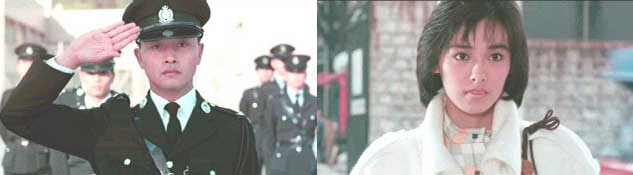
A BETTER TOMORROW has compelling characters and drama, displays consummate
cinematic craftsmanship and features some excellent gunplay action, all of
which contributes into making a rock solid gripping movie. Unsurprisingly,
ABT’s strong qualities are the same of those found in the martial films of
Chang Cheh, John Woo’s mentor. The film acting, musical score and narrative
tone are somewhat far-out by western standards, every drop of melodrama is
thoroughly milked and the plot is somewhat blunt and rough on occasion. “John
Woo, subtlety is not thy name”, one may be tempted to say. Still within the
movie context it all works and the bluntness makes the drama all the more
efficient. Surprisingly there are not that many action scenes and they are
relatively tame by John Woo’s future standards.
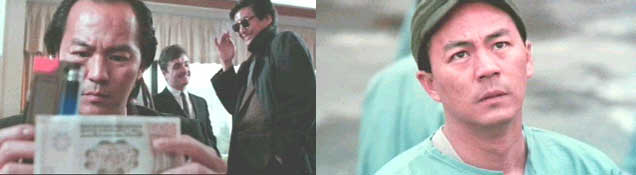
The thing is that the film is intently focused on the story, the characters
and the drama and not on the action as such, which is a nice change for a
H-K actioner. Also one must consider that this was Woo’s first real attempt
at gangster drama and urban action gunplay hence his more tentative approach.
Still ABT contains what may be considered as the seminal action scene of
his entire action film career and even of the Heroic Bloodshed sub-genre
as a whole - Mark’s sneak gunplay attack on a celebrating party of
gangsters, with him, arriving in almost dance-like slow-motion, shooting
down his targets in tidily edited snap-shots, while they fall down bloodied,
again in slow motion. The whole balletic like quality of the Heroic bloodshed
brand of action is encapsulated within this sole sequence, which contains
a fine drama within itself as we see Chow Yun Fat going from his wily smirking
wise-guy, to being a cool gunning killer, to finally a cripple, fallen angel.
It is just… superb.
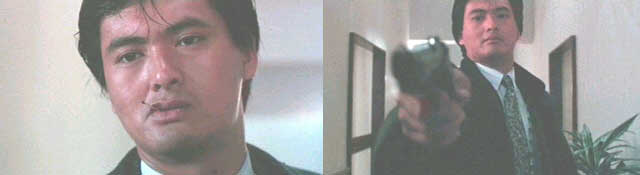
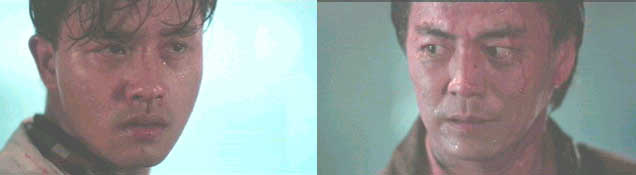
Ti Lung is of course excellent as the weary Ho, while Leslie Cheung on the
other hand is the weak element with too much overacting, but it has to be
said that he, as the soured brother, has the most difficult and ungrateful
part. Basically he is set up as the film’s real bad guy, not Waise
Lee’s Shing who is more like a plot device as Woo’s villains tend to be.
In a Woo movie it’s the relationship in between the protagonists that counts
not with the antagonist. However although the central drama is between Ho
and Kit, ultimately it’s Chow Yun Fat’s inspired performance that more than
anything else gives ABT it’s great haunting quality. Without him the
film might have been a strong yet lesser movie. Small wonder the character
became such an iconic presence and Chow a great superstar. In this reviewer’s
opinion however, Chow is especially great not, when he is his trench-coat
wearing cool self or gunning down opponents but when he’s a destitute fallen
character. His first meeting with Ho in the parking lot…. my what a touching
piece of acting.
Up until directing A BETTER TOMORROW, John Woo’s
film career could be generally summed up as “sorry yesterdays”. He actually
had a promising start though by directing a string of hit caper comedies
for the Golden Harvest studio in the second half of the seventies, which
dubbed him the “King of Comedy”. But what he really wanted to do was some
sort of “heroic gangster” movie, a modern day update of the martial art yarn
showcasing romantic upright swordsman, as done by master martial filmmaker
Chang Cheh, for whom Woo had worked as an assistant director earlier in the
decade. Trends had changed though - caper comedy was in, martial art drama
was out - a point driven painfully home with the box-office failure of Woo’s
most personal project, a Chang Cheh like swordplay LAST HURRAH FOR CHIVALERY.
Since then, Woo’s fortune had been in steady decline as his comedies proved
box-office failures and even changing studios from Golden Harvest to the
newly establish Cinema City did not improve his lot. By 1985 he had hit rock
bottom and had started dinking heavily and was in jeopardy of being labelled
as a washed out director who never was able to fulfill his promise.
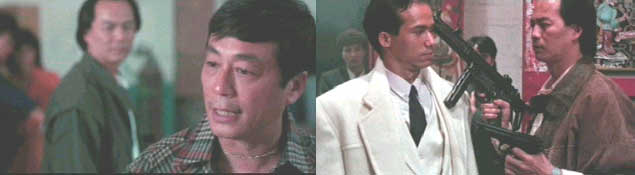
It was at this point that Woo encountered Tsui Hark again. The two had crossed
paths before when back at the dawn of the eighties; it was Woo who had sponsored
the then beginning director’s entry into Cinema City despite his dubious
record of three flops. Years had passed and now it was Tsui who was at the
top, while Woo was down on his luck. Woo talked to him about his dream project
of a modern-day chivalrous gangster movie. Tsui liked the idea but thought
it should be done with girls. In any event, Tsui who had just founded his
own film company, Film Workshop, approached Woo and gave him the opportunity
that he had long sought to realize his own true film.
Tsui and Woo set their sights on remaking THE
STORY OF A DISCHARGE PRISONNER, a semi-classic of the sixties Cantonese cinema
which told the tale of a gangster trying hard to reform despite being caught
in-between his family, his former criminal cohorts and the police. Woo adds
other layers to this original template however, picking-up elements from
Japanese Yakuza pictures, the graphic, blood spurting slow-motion action
of American filmmaker Sam Peckinpah and of course the angst-filled blood
stained, male-centred romanticism found in Chang Cheh’s swordplay’s.
He seems to have been especially drawn to the compelling and intense on-screen
pairings of Ti Lung and David Chiang who together had done nearly two dozen
so called Blood-Brothers movies together for Chang Cheh. It would seem that
Woo in his own way sought to recreate this for his own film by hiring Ti
Lung himself and insisting adamantly on getting an actor best known until
then for this romantic role on TV to reprise the cool, wily forever smirking,
dude done originally by David Chiang. What he ended-up with, however must
have been even beyond his wildest expectations, as his chosen actor, Chow
Yun Fat, gave such a rich and charismatic interpretation, out-shinning all
the other actors around him, that his part was rewritten from being a secondary
character to being the film’s great iconic figure. Ultimately what both Tsui
and Woo ended up creating with their new movie: TRUE ESSENCE OF HEROES (ABT’s
true original Chinese title) was a film unlike any other done before in H-K;
a post-modern action gangster melodrama flick, filled with Armani dressed
triads, explosive gunplay action, and a sanguine completely male-centred
drama - the sort of which had not been seen since the good old days of Chang
Cheh’s martial tragedies.
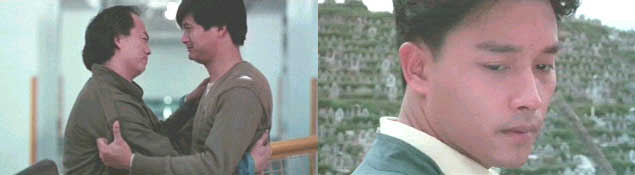
It’s not hard to understand why H-K people were so taken with ABT. After
more than a decades worth of caper comedies and goofy action stunt pictures
they were eager to see something new and the characters, drama and action
gripped them. There was something else too, though going to a far more personal
level as the tale of the movie echoed the H-K inhabitant’s deepest fears
and anxieties. From the early seventies to the mid -eighties Hong-Kong
had grown from a somewhat shabby manufacturing colony into a booming cosmopolitan
miniature financial super-power with it’s inhabitants developing a growing
sense of confidence, identity and individualism. Yet there was a growing
shadow looming over the edge as the hundred-year lease given to the British
over H-K’s New Territory was soon coming to termination, and therefore the
H-K people felt quite insecure and threatened over their future. Such feelings
were crystallised with the shocking, devastating 1997 handover
deal between the British and Mainland governments done in 1984, adding now
a bitter sense of betrayal to the already pervasive angst-filled gloomy mood
to be eventually called “handover blues”. Such feelings of anxiety and dread
had actually found their cinematic expression even before the deal in such
films as New Wave director Ann Hui’s BOAT PEOPLE which was the top grossing
film of 1982, LOVE IN THE FALLEN CITY (1984) again by Hui starring Chow Yun
Fat and HONG KONG 1941 again with Chow. Then a couple of year latter came
A BETTER TOMORROW, which began by showing two highly successful, confident
and jolly professionals (that their activity was illegal did not seem to matter
much), who through tragic circumstances quite beyond their control lose almost
everything: money, status, employment and even family. The only thing remaining
was their devotion towards each other as well as their honour. It is about
their struggle not to lose their last shred of dignity and to regain what
dignity and status they once had. It was strong stuff especially to a people
who were fearful of losing everything.
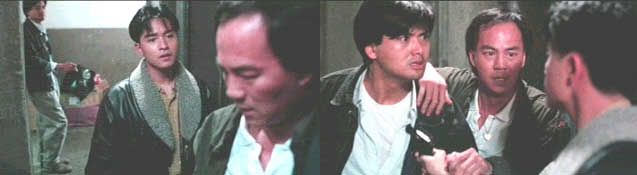
A BETTER TOMORROW ended up earning a record breaking HK$ 34 million at the
box-office, won many H-K cinema “Oscars” including best picture and best
director. It rekindled Ti Lung’s fading career, consolidated the one of Leslie
Cheung and of course took Chow Yun Fat from matinee idol into the ranks of
H-K’s greatest and best acting super-star. The next several years saw Chow
triumph in at least a dozen movies all of various types that ranged from
slapstick comedy, to romance, melodrama, thrillers and action showing him
to be one the most versatile and charismatic actors to ever grace the H-K
cinematic stage. A BETTER TOMORROW’s tremendous success also very much
benefited producer Tsui Hark and his Film Workshop and led to the formation
of a new sub-genre the Heroic tragic Gangster flick also later dubbed “Heroic
Bloodshed”. Yet quite ironically, it took a couple of years for the man who
had started it all to actually move on from his triumph to do another film
from his heart. Indeed Woo was brought in by Tsui Hark to do a sequel to
his great gangster drama, which resulted in the ill-conceived and misbegotten
A BETTER TOMORROW II. Tsui’s sorry habit of interfering with his director’s
work created a feud between the two associates, and Woo had the greatest
difficulty in starting a new film because of Tsui’s meddling. Only when producer
Terrance Chang became Woo’s new associate could Woo truly begin his new project,
the future classic THE KILLER. Woo though never quite recaptured the heart
of the H-K people the way he did with A BETTER TOMORROW even with his most
intense and personal movie BULLET IN THE HEAD that proved itself a dismal
box-office failure. Perhaps in the end it did not matter all that much since
Woo’s movies had found another eager following in the West that would eventually
allow him to be recognized as the best known H-K director in the word as
well as the greatest action filmmaker of all.
Today John Woo has long moved to the new world, although in the mind of most
he has yet to do a movie which comes close to equalling his H-K classic action
dramas. A BETTER TOMORROW has become a widely available classic and
is appreciated as the great beginning of a master action filmmaker, although
some complain that with it’s music and eighties looks it shows some sign
of cinematic ageing. Regardless, in the heart of the often trendy and today
oriented Hong Kong people, ABT remains something of a cherished memory.
My rating for this film: 8.0
Reviewed by Brian
This 1986 film is the first of the great
Heroic Bloodshed collaborations between John Woo and Chow Yun Fat. The movie
plays in some ways like Heroic Opera as tragic themes of loyalty and betrayal
pervade this film with great overflowing passion and gunfights take the place
of arias. Woo manages to take these two small time crooked characters and
make them noble and heroic in the environment he places them in - the last
of a breed who still take honor as a test of character.
It is a simple story. Chow (Mark) and his
friend Ti Lung (Ho) are members of a counterfeiting gang while Ti Lung's
brother Leslie Cheung (Kit) is about to graduate from the police academy.
Kit is unaware that his brother is a Triad member which certainly would make
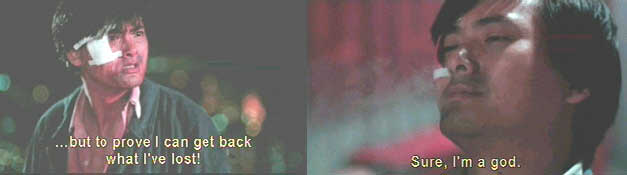
him suspect in my eyes as much of a policeman! Though Chow's character steals
the movie with his flashy matchstick in mouth persona, lighting cigarettes
with fake $100 bills, the long black leather overcoat , the cool sunglasses
- the focus and heart of the story is really the love/hate relationship that
develops between the two brothers. There is actually much less action in
this film than in Woo's later Heroic Bloodshed epics - with the big emotional
and gunplay blast coming near the end - but even this is tame compared to
Woo's later films. ABT is much more a character study than a running
gun battle. This is just a terrifically heartfelt film that is irresistible
as it lays its bare rough emotions out for all to see and respond to.
This film also was a personal triumph for a number of the participants. John
Woo had spent the last few years in a career free fall and had begun to drink
quite heavily. He was frustrated and angry that he was not getting the opportunity
to direct the kind of films that he wanted to. For years Woo had been pitching
to make heroic gangster films - like the old sword fighting films except
with guns. One of his very favorite films is the French film Le Samourai
- about a hitman - and though this influence is even more pronounced in The
Killer, the mood is evident here as well. As a small homage, Chow wears sunglasses
that were Alain Delon's (star in Le Samourai) brand. Tsui Hark had confidence
in Woo's ability and gave him this opportunity. Chow Yun Fat, though successful
in TV, was thought of as a light comedian and romantic star. Woo though
thought Chow was perfect for this role - and fought very hard to get him
over the money men's objections. Ti Lung was of course a huge star in the
Shaw kung fu films, but with the loss of popularity of those films, he had
fallen on hard times. This film revitalized his career.
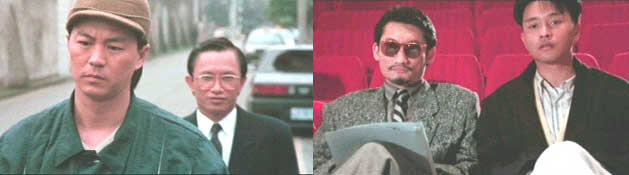
Look for Tsui Hark in a small role in the audience during Emily Chu's (Kits
girlfriend) audition. And Woo of course plays the Taiwanese cop after Chow.
Other supporting roles are Kenneth Tsang as the taxi business owner, Tien
Feng as the father and Kam Hing Yin as Leslie's supervisor.
My rating for this film: 9.0