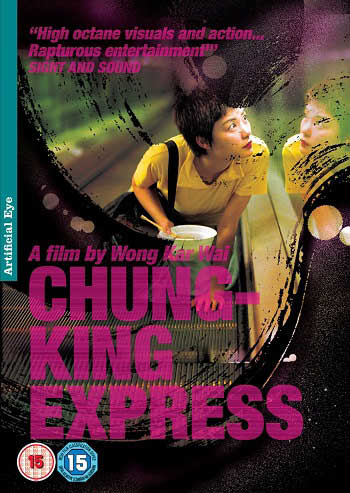
Chungking Express
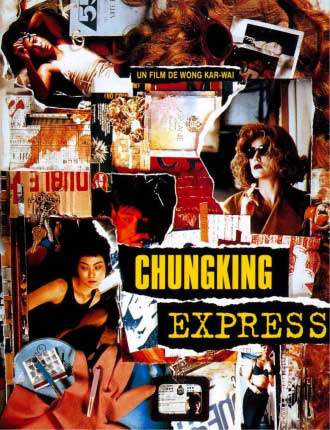
Director: Wong Kar-wai
Year: 1994
Rating: 9.0/9.0
At some point in
this film Faye Wong ruminates to herself “Can dreams be catching”
and that comment captures the mood of this ephemeral quirky film.
Wong Kar-Wai’s use of editing, music, unstructured story and time line creates
a dream like quality. As does the strange way in which small things about
the characters seem to shift from one person to another or the way the characters
appear in the other characters story for a fleeting moment and then are
gone. Sort of like our dreams.
During a break in the very lengthy
and difficult production of Ashes of Time, Wong Kar-Wai threw this film
together in a very short time frame. Much of it appears to be film making
on the run - ad hoc and improvisational - yet it all weaves together. Somehow
he created magic. Captured lightening in a jar. This is just a delightful
charming montage of a film.
It is a film about relationships in modern
day Hong Kong or perhaps the lack of relationships. Everything is connected
and yet at the same time unconnected. Everyone is out of synch and out of
time with the people around them. WKW’s film technique to show this is brilliant
as from time to time his characters are nearly motionless as the world zips
by them at blinding speed. Nobody really communicates with anyone else. Almost
the entire film is internally narrated by one of the four main characters.
They rarely talk to anyone directly and when they do it is often elliptical
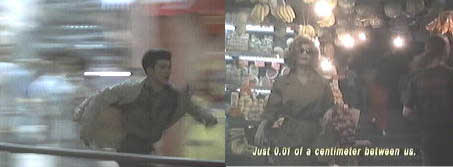
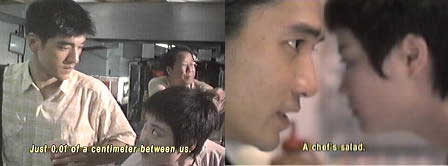
and unimportant. Nobody gets close. As Takeshi Kaneshiro says in the opening
frame as he passes by Brigitte Lin - “this is the closest I ever came to
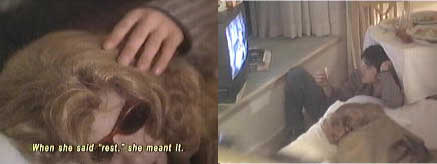
her”. Later he spends the night with her, but watches TV and eats Caesar salads
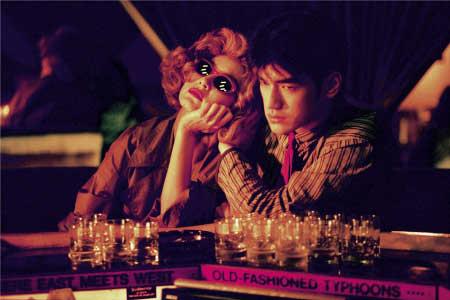
all night as she curls up to sleep in her raincoat and wig. And yet this
is a joyful film - a gentle comedy full of intriguing characters, very funny
moments, fascinating editing, eccentric dialogue, terrific songs, charismatic
actors and an enigmatic yet hopeful ending.
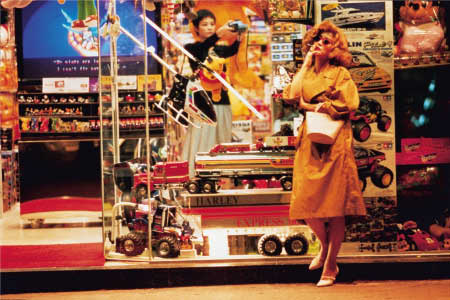
Briefly the film is segmented into two stories.
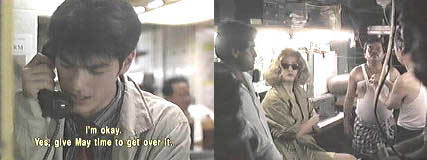
The first is with Takeshi Kaneshiro as a
cop who has recently been jettisoned by his girlfriend May. He pines for her
and tries to connect with her but is never able to. Brigitte Lin is trying
to put together a drug smuggling scheme that falls apart and she has to
go looking for her mules. They cross paths for a moment. It
is a peculiar story in which relationships and lives “expire” on May 1.
I enjoy this segment more each time I see it, but it is the second story
that really enchants the viewer.
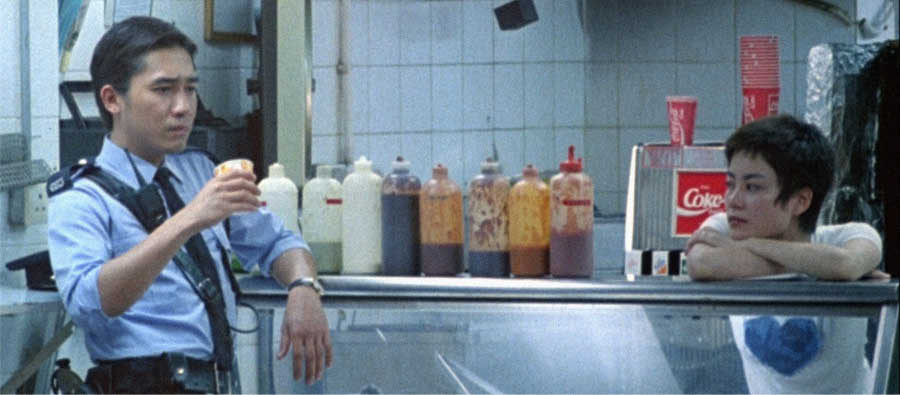
It concerns another cop - Tony Leung Chiu-Wai
who hangs out at the same outdoor vendor type restaurant that serves as
a linchpin between the two stories. He is about to find out that his stewardess
girlfriend - Valerie Chow - is also dumping him. We see them in a
romantic flashback in which WKW humorously has Dinah Washington singing the
sultry “What a Difference a Day Makes” on the soundtrack and Valerie is playing
and practicing to the Airplane Safety Instructions. As they roll into
bed the recording is saying “sit back, relax and enjoy your flight”.
Faye Wong works at the restaurant and she
becomes infatuated with Tony and starts to secretly visit his apartment during
the day - cleaning it, putting fish in his aquarium, replacing his soap
etc. (of which Tony notices nothing in his out of synch state). Much of this
is shown in a wonderful music video montage with Faye singing the Cranberries
song "Dreams" on the soundtrack. She is a wonder in this film - sadly the
only thing she has been in so far. With short hair, an elfin face, caterpillar
eyebrows and eyes as big as Christmas morning, she is a delightful
energetic presence. Whether wiggling to California Dreaming or face set in
wide eyed surprise, she captures the heart of this film.
A wonderful film that crosses all boundaries
and cultures.
The last lines of the film after Faye has
suddenly re-appeared after a year away as a stewardess.
Faye - “Where do you want to go?”
Tony “Wherever you want to take me”
A sweet ending, but where will it go from
there?
My rating for this film: 9.0
Reviewed by YTSL
Although one need not have watched the magnificent
"Ashes of Time" in order to enjoy the modest movie that Wong Kar Wai (and
company) whipped up while back in Hong Kong from location shooting his
desert epic, I think that it does help one to understand -- or at least
imagine – the director's frame of mind when, and impetus for, coming up with
this gem of a motion picture. In Wong's own words (which I found floating
around somewhere on the Internet): "After the very heavy stuff, heavily
emphasized in "Ashes of Time", I wanted to make a very light, contemporary
movie, but where the characters had the same problems." This he did,
in approximately two months; during which he wrote the script in the daytime
and filmed scenes mostly at night (or the day after).
CHUNGKING EXPRESS not only was made in a pretty
short time period but also with very simple equipment and a cast consisting
of crew members (the film's still photographer doubled as the "Midnight
Express"' owner, the make-up artist played the waitress named May, and the
person in charge of lighting behind the camera assumed the role of the convenience
store clerk in front of it!) as well as professional actors (two of whom --
the always mesmerizing Brigitte Lin Ching-Hsia and very capable Tony Leung
Chiu Wai (who won a Best Actor award for this movie) – also appear in "Ashes
of Time") plus a Cantopop phenomenon who was making her movie debut (Faye
Wong). The sense that this was a fairly low budget or casually put-together
production is heightened with the realization that the apartment inhabited
by Leung's character actually belongs to the movie's principal cinematographer
(Christopher Doyle)!
Although this surprisingly fresh and personable
ode to often lonely city dwellers who emotionally, even if only temporarily,
connect with some others definitely is imbued with star power (other main
performers in this movie are the delightful Takeshi Kaneshiro and Valerie
Chow), it was almost like Wong Kar Wai was trying to strip down his actors,
concepts and pretensions. Thus, the film not only consists of two
disconnected, arguably flimsily structured stories (one of which features
a love-lorn cop who's lost his girlfriend and a drug-trafficker who's lost
her "mules"; the other of which centers on yet another policeman who loses
his girlfriend, albeit one who has attracted the attentions of another female)
but also is one in which an actress who is famed throughout Asia for her
looks is saddled with a fairly ratty blonde wig and has her eyes entirely
obscured throughout by dark shades, and a respected dramatic actor appears
for much of his time on screen in just his underwear.
The genius of the film's heralded director cum
producer and the beauty of CHUNG KING EXPRESS, though, is that: Rather
than this creation turning out to be a slapdash and empty movie; what came
about is a frivolous- and fleet(ing)-feeling yet alternately fun- and thought-filled
offering. There is a high likelihood that the same scenes -- involving
such as cans of pineapples with a particular expiry date, chef's salads,
the simultaneous wearing of sun glasses and raincoats, a man allowing a
woman to sleep unbothered, his taking her shoes off to prevent her feet
from swelling and then wiping them clean with his tie, United Airlines stewardresses,
household items like towels and soap, stuffed toys, and pieces of paper masquerading
as plane tickets -- which strike the viewer as amusing but not much else
when (s)he watches them will return as constituted and increasingly fond
joggers of memory and thought in the days and months post experiencing
as well as sampling the delights of this Hong Kong Best Picture award winner.
Two other standout elements of this vibrant movie
which ought not to go unmentioned are the film's transnational -- not just
cosmopolitan -- feel (particularly in the first segment, which I personally
got more out of) and music video quality (which stems, logically enough,
from Faye Wong's presence and performance). With regards to the former:
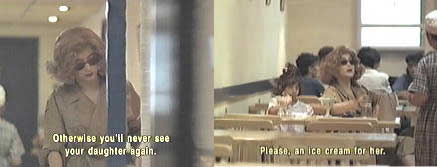
I think particularly of the wonderful scene in which a lonely young man
starts off a conversation in a bar with an older female stranger by asking
her the same question in four different languages (Cantonese, Japanese, English
and Mandarin). With regards to the latter: If only the background
or accompanying music used had been more frequently Faye Wong's rendition
of a popular Cranberries song (used "only" twice!) than "California Dreaming"
(which came on at least 5 times in the movie!)...
Postscript: This Brigitte Lin fan is loath
to let it go unmentioned that this was the actress' final film appearance
before her marriage to the major shareholder of Esprit (who was one of
the sponsors of this offering!). In a movie industry that is fond
of making in-jokes and allusions, I find it hardly coincidental that she
essentially ended her career with a bang here and that the very first conversation
that we are witness to between her CHUNGKING EXPRESS character and another
goes as follows:-
Him: "You look terrible."
Her: "I'm not sleeping."
Him: "(Then) maybe you should quit!"
My rating for the film: 9.
Lots of screen captures here and here