Fallen Angels
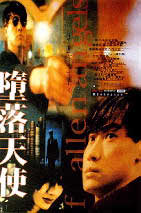
Director: Wong Kar-wai
Year: 1995
Rating: 6.0/8.0
In many ways Fallen
Angels feels like another segment to Chungking Express and perhaps initially
that was the intent. Like Chungking, it tells two tales of displacement in
modern HK and there are certainly connections between the two films (can
of expired pineapples, a hit on Indians, living in the Chungking Mansion).
It utilizes many of the same film and editing techniques and inner narrative
style, but it doesn’t capture the same zest, the same magic. One really gets
the feeling here that Wong Kar-Wai is more concerned with film technique
than telling a good story and having interesting characters. There is no
soul, no heart in this film. It is all camera angles and distortion and strange
color tints. To such an extant that watching the film is almost uncomfortable
at times.
The two stories shift back and forth here
as opposed to Chungking. One relates the story of a hitman, Leon Lai, and
his strung out agent Michelle Reis. WKW does everything he can to make Michelle
as unattractive as possible. Eventually Leon decides he wants to get out of
the game. I didn’t care about either character or that of Karen Mok who gets
involved.
The second story follows Takeshi Kaneshiro
and his meandering lifestyle. He is a mute and plays his character as a hopped
up Harpo Marx and though his character has a touching sweet relationship with
his father that connects with the viewer, it is only a small piece of this
film. Charlie Yeung plays the wacked out girl who shows up at the end as
. . . a stewardess of course!
There are some good moments in this film,
but it is still a major disappointment after Chungking. It left me cold and
restless for the most part.
My rating for this film: 6.0
Reviewed by YTSL
IMHO, there are quite a few Hong Kong movies that
benefit from a second (and third, fourth and so on!) viewing. With
some, this is due to their whirlwind pacing and mindboggling sights (I think
here of "Swordsman II" and its even more frenzied follow-up, "The East is
Red"). With others, it's because their premise and contents are so
unexpected, exotic or downright weird (the blue-faced hopping corpse-filled
"Mr. Vampire" quickly comes to mind!). There also are those full and
complex offerings in which there is so much to absorb intellectually as
well as emotionally, aurally as well as visually, that one can only appreciate
if they somehow eventually cease to overwhelm (or, as was the strange case
for me with regards to "Chungking Express", I honestly had to learn to not
underestimate...).
The first time I watched FALLEN ANGELS, I not only was distinctly unimpressed
but also actually felt physically sickened by it. This 1995 Wong Kar
Wai movie has been described as the companion -- or adjunct -- piece of his
easily likeable "Chungking Express" (and quite a few elements of that vibrant
release -- including the CHUNGKING Mansions that is a venue for many interesting
(!) occurrences and the Midnight EXPRESS eatery -- do reappear here).
My own sense and conclusion though was that FALLEN ANGELS was in fact the
1994 Hong Kong Best Film Award winner's dark (yet not humorless) and deranged
sibling, what with its having: Bizarre -- rather than just quirky --
characters (contrast Takeshi Kaneshiro's lonely yet charming "Chungking Express"
policeman with his eccentric FALLEN ANGELS character); scenes filmed using
a camera that not only shakes, bounces and veers a lot but which also successfully
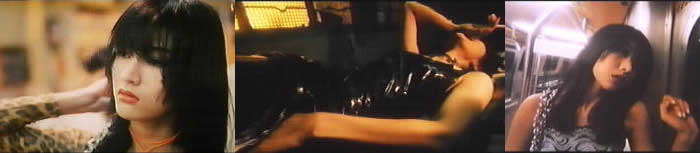
makes a former Miss Hong Kong, Michelle Reis, look quite unappealing (as well
as -- famously -- have a nose like Pinocchio's!); the kind of editing that
caused scenes to change disarmingly abruptly and arguably prematurely; and
the employment of discomfort-inducing tones and colors. Suffice to
say that I truly came away from the experience loath to watch another film
directed by the man who many Hong Kong actors seemed eager to work with but
whose movies Asian audiences weren't exactly flocking to see.
Since then, I have become a fan of the self-described "not very successful
commercial film director" (In Fredric Dannen and Barry Long's "Hong Kong
Babylon", 1997:52) by way of viewing his sublime "Ashes of Time" and impressive
"Happy Together". Having recently realized that there is so much more
to "Chungking Express" then initially meets the eye, I decided to check out
Wong's fifth directorial effort one more time. Post doing so, I can
confirm that it still can and sometimes does appear excessive, irritating
and (especially in the first half of the movie; or at least until one gets
used to it...) nausea-inducing to this viewer. There really are times when
I am moved to think that Wong and those members of his crew who were involved
in the production of "Ashes of Time" (notably cinematographer Christopher
Doyle but also co-editor cum art director William Chang) made use of FALLEN
ANGELS to seriously but desperately attempt to shake off the nervous energy
and frustrations left over after making that ambitious "action movie about
inaction". At other times, I wonder whether they were just indulging
themselves by audaciously experimenting with different film(ing) techniques.
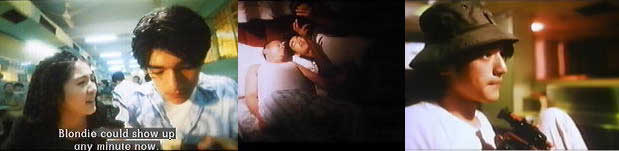
In any case and nonetheless, I honestly feel that there truly are some
wondrous moments, sequences and elements to be found in this admittedly
-- maybe deliberately? -- rough work. These range from the amusing
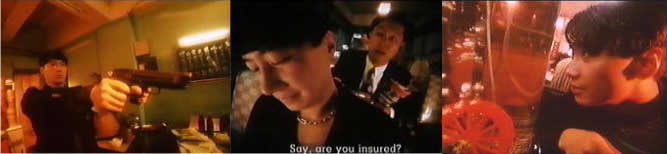
(Leon Lai's assassin's encounter on a bus with a grade school classmate who
now sells insurance) and ridiculous (Charlie Yeung's explosive character's
one-sided phone conversation which prompts her to go off on a demented search
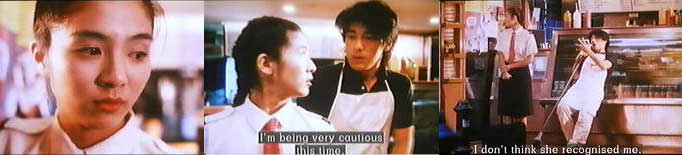
for a person named Blonde) to the tender (Takeshi Kaneshiro's character's
father watching -- with pleasure -- his son's video recording of him on his
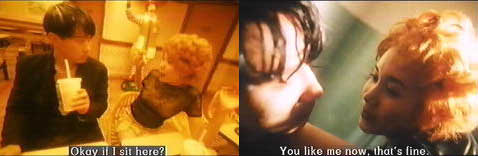
sixtieth birthday); and also include the obviously painful (Karen Mok's bleach
blonde's leaving a physical mark on her lover's hand so that he will remember
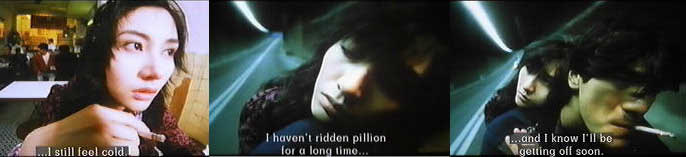
her) along with that which is somehow satisfying (the moment when Michelle
Reis rests her head on Takeshi Kaneshiro's shoulder while riding pillion
on his zooming motorcycle). I will also throw in the opinion that FALLEN
ANGELS has an incredibly memorable and appropriate soundtrack (Frankie Chan
and Roel Garcia deservedly won awards for the Best Original Film Score) which
effectively contributes to one's viewing as well as listening pleasure.
In conclusion: IMHO, FALLEN ANGELS does pale in comparison with the
energetic yet thoughtful "Chungking Express"...but then, most films (made
in Hong Kong or elsewhere) would. Neither is it the cinematic jewel
that is "Ashes of Time". Consequently, I must admit to feeling somewhat
irritated that I had to go through so much to appreciate this flawed but still
genuine gem. Do I (now) have good impressions and memories of it though?
And would I watch this often disjointed yet ultimately involving film again
at some point? The answer to these questions -- weird and inexplicably
(even to me) yet true enough – is an emphatic "Yes"...!
My rating for the film: Upon first viewing,
6; but now risen to an 8.