Days of Being Wild
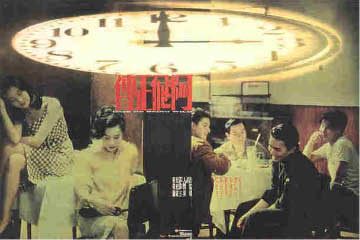
Director: Wong Kar-wai
Year: 1990
Rating: 8.5/7.0
Like nearly all of
Wong Kar Wai’s films, this - his second film - is not easily and immediately
accessible as it forces the viewer to be very patient. If the viewer is
willing though to invest some time and thought on it I think that this film
can be an extremely rewarding experience. It is a very dense, claustrophobic
and slow moving film that can both repel and fascinate. In some ways the
film may appear to be fairly straightforward on the surface, but there are
layers of meaning underneath that are complex and intriguing.
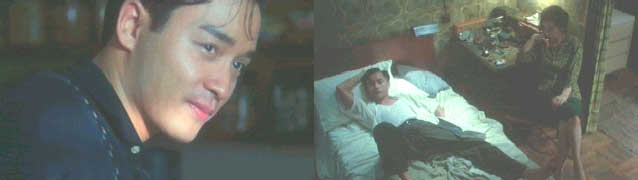
The time period of the film is the early 60’s and Wong manages to depict
it in a wonderfully minimalist manner. The hairstyles, the clothes, the blowing
fan, a few old pictures, a package of Craven cigarettes and empty coke bottles
is all he needs to make it look and feel very authentic. But this is not a
sweet nostalgic look back at those times as the title might imply but instead
a moody nearly morose exploration of various shifting relationships. As in
many of his future films, none of the relationships ever seem to go anywhere,
nothing and no one ever connects. It often feels as if everyone is with the
wrong person or in the wrong place at the wrong time.
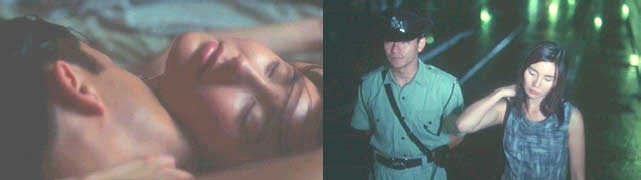
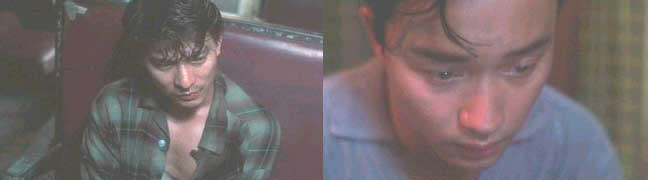
The main character is Yuddy - a young handsome narcissistic self-indulgent
fellow who is financially supported by his foster mother (Rebecca Pan) and
he appears to have no true feelings for anyone. Leslie Cheung is perfect for
this role with his sullen pretty boy looks - the quivering lip, the bedroom
eyes, the insouciant smile and his slicked back hair. His odd love/hate relationship
with his foster mother hints at something more than is ever revealed. It turns
out that his attitude towards the women in his life is a reflection of his
natural mothers’ towards him. She deserted him at birth and he has a desperate
need to find her.
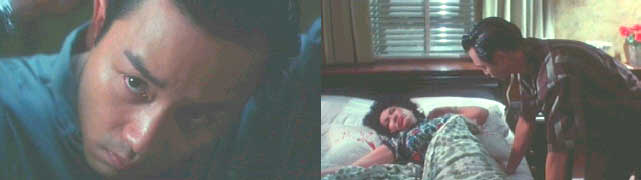
Two other women pass through his orbit - Maggie Cheung and Carina Lau -
who both lead somewhat sad lives. Both love Yuddy and are fascinated by him
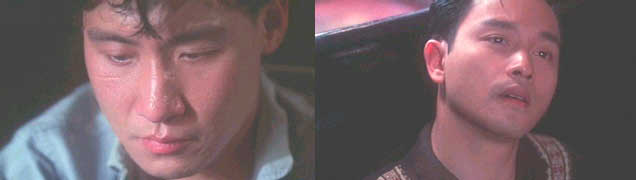
though he returns little affection to either. Carina asks Yuddy’s friend
Jacky Cheung “Do you know what he is ever thinking?” and Jacky replies no.
No one does. As soon as someone becomes close to Yuddy, he loses interest
in them. He compares himself “to a bird with no legs so it has to keep flying
because if it lands it will die”. But for all his prepossessing manners,
he is in fact completely displaced and empty inside. The only person he needs
(his mother) is the one person he can't have. Near the end of the film he
says about himself “I was always dead”
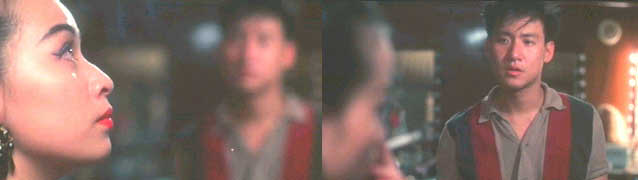
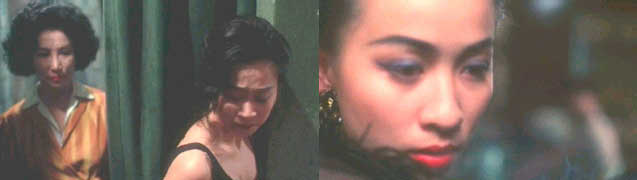
The performance by Carina is brilliant. She gives a passionate, sensual
and yet ultimately fragile performance as a dance hall girl desperately in
love with Leslie. She comes across as so real and such a mature full-blooded
woman – there is absolutely nothing girlish about her – and you can sense
that she has had her share of bad relationships and bad men. That history
is written in her every look and every gesture.
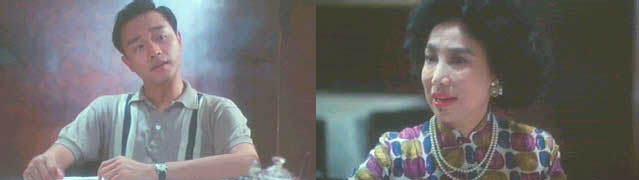
Maggie’s role is much more restrained, as she appears almost plain and washed
out - and very lonely. Her life is momentarily brightened by the attention
paid to her from Yuddy – the one minute in time that she will share with him
forever. She carries around the pain from the inevitable rejection like a
sack of ashes around her shoulders. Her pain and depression makes her oblivious
to the attentions of Andy Lau – a beat cop.

There are a number of moments that resonated with me in the film. In one
short scene Carina walks down from Yuddy’s apartment and passes Jacky Cheung
sitting on the stairs. He asks her what she does for a living and she says
“turn up your radio and I’ll show you” and then breaks into a small can-can
dance that has a wonderfully spontaneous feel to it. For her it’s only a passing
moment of elation – but that moment changes Jacky forever. He falls hopelessly
in love with Carina, but she feels nothing towards him.
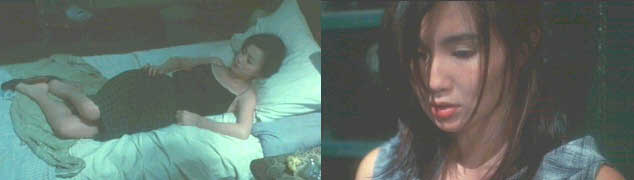
Another small moment that had an emotional impact was when Maggie finally
calls Andy – the call box and street deserted by Lau’s departure – the ringing
of the phone like an unanswered prayer for help in the night – and it symbolizes
all the missed opportunities and all the things that people didn’t say to
one another. What people don’t say in this film is often more important than
what they do say. Words are often only used to create illusions or to deflect
feelings.
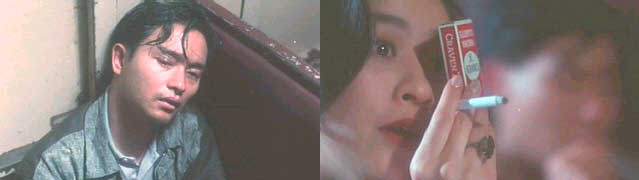
The film is almost a continuous rondelay of intimate scenes played out between
two of the six characters. Whenever a third party breaks in it feels like
an intrusion, as if they don’t belong but these occasions are very rare. Wong
Kar Wai utilizes a number of intriguing devices to emphasize the intimacy
of this film.
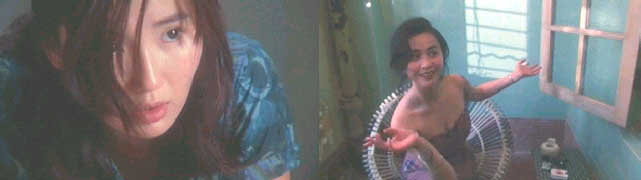
Most of the scenes are photographed in murky
tight interiors or in the dusk of the evening and the colors are usually
very muted. Nearly all the outdoor scenes take place at nighttime. Many of
the individual shots are almost still life paintings – beautifully framed
and the movement is imperceptible. The two characters often totally fill
the screen and are in close proximity to one another and this creates a very
claustrophobic feeling much of the time.
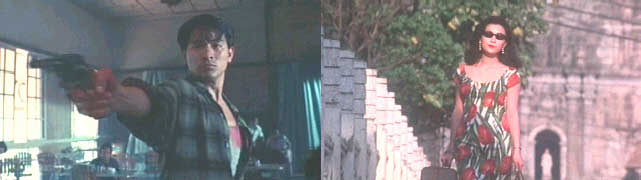
Another fascinating thing that Wong does is to create a world nearly devoid
of people. There are hardly any extras whatsoever in the film. Once you begin
focusing on this (which I did after reading a remark from Fonoroff) it really
jumps out at you. This cinematic world for all intents appears to be only
occupied by these six characters. Even the outdoor scenes that
primarily take place between Maggie and Andy are usually completely empty
of other characters. When a few scenes take place in a café – the camera
focuses only on Yuddy, Carina or Jacky. Where is everyone else?
Wong uses sound for the same purpose. Listen carefully to the background
sounds and what do you hear? Usually nothing. An absolute almost eerie silence
– as if there is no other world beyond the walls of intimacy that Wong has
built around his characters. On occasion he fills the background with a ticking
clock, raindrops falling, the tide turning – all marking time passing – and
opportunities lost. On one occasion when Yuddy finally learns where his natural
mother is living – there is a sudden sound in the background of a ship’s horn
– signifying that his life will be changing, that he will soon be moving on.
I am not sure what all this means (maybe
just a slim budget!) but it makes for a fascinating thought provoking film
- though some might perhaps call it pretentious. It occurred to me that
Wong intentionally threw the characters into an almost Sartre “No Exit” like
scenario. The characters are in a waiting station – no longer part of the
living world. Everyone moves slowly, talks slowly as if weighed down with
fate. Another telling choice from Wong is his choice of music. It isn’t from
the 60’s – but is in fact music from Xaviar Cugat a Latin conductor from
the 40’s and 50’s – perhaps when these people were in the “live” world?
I don’t really think that this is where Wong is going with this film – there
are certainly many other elements in the film that would contradict this –
but he is up to something here that is more complex than is initially apparent.
There certainly is a death like quality about the characters and the constant
darkness within which they live.
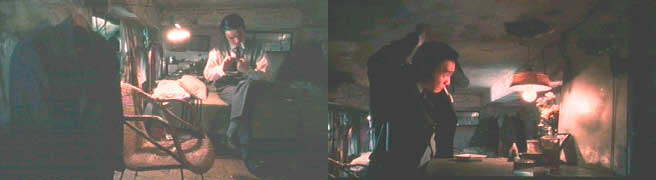
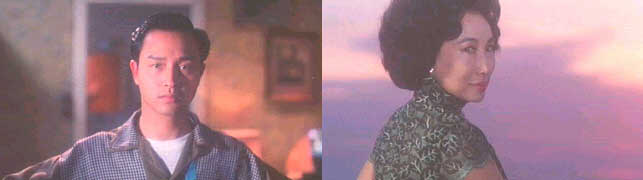
The very last two-minute scene by the way is of Tony Leung Chiu-Wai who
has not been in the film previously. He seems to be a reflection of Yuddy
as he is getting all dressed up and combing his hair. Is it Yuddy in a parallel
universe or Yuddy reborn or as YTSL conjectures perhaps he is Yuddie’s never
mentioned father? But that is it – no explanation of why this is inserted
at the end of the film, but I can’t help but wonder who he is getting dressed
up for and why he sticks a huge wad of money into his pocket. I wish the camera
had followed him out the door and down the stairs. In an interview in the
book “Wong Kar-Wai”, Wong explains that he filmed much of a second story,
but it ended up on the cutting floor even though he says Leung’s performance
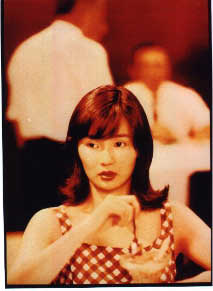
“is mesmerizing”. There is also a publicity shot of Maggie (pictured below)
in a scene that never appears in the film.
My rating for this film: 8.5
Reviewed by YTSL
Wong Kar Wai is one of the rare Hong Kong moviemakers
whose offerings may be more likely to be found in mainstream American than
Chinatown video stores. Not only that but his works might actually
be more accessible to those Western cinemaphiles who love foreign "art" films
than the general movie audience both in this Shanghai-born auteur's adopted
home or the rest of the world. I (also) find it telling that those movie
rental establishments which take particular pride in being trendy and cosmopolitan
tend to end up (mis)placing his titles in the China section -- next to the
films of Chen Kaige and Zhang Yimou – or risk provoking the ire of seekers
of action movies in the vein of those with Jackie Chan or by John Woo who
surely would not be satisfied with the likes of "Chungking Express" and
"Fallen Angels", even if they do feature killers and policemen!

Of all of the films that Wong has directed to date, his second is my definite
nominee to be that which is most unlike what many people would expect of a
Hong Kong movie. This is not just because some DAYS OF BEING WILD's
dialogue -- that between Yuddy (the cha-cha-cha-ing Leslie Cheung steals the
show!) and the older woman who could be said to be his foster mother (played
by Rebecca Pan) -- segues into a language that I can't identify but know
to be other than Cantonese. Neither is it a consequence of part of
the story taking place in the Philippines. Rather, I feel that this is due
to its generally being extremely leisurely paced and (consequently) appearing
to take itself -- if an inanimate object can do so! -- too seriously.
In (yet) other respects (though), DAYS OF BEING WILD could be said to be
unlike most other films from anywhere. For one thing, it relies more
on objects (such as clocks, earrings and bedroom slippers) and moments of
silence (especially pregnant pauses) than people to make comments, and narration
rather than action to move the story along. For another, it is an artistically
subversive commercially backed product whose maker is experimenting not so
much with cinematographic techniques (at least definitely not to the extent
of "Fallen Angels" or even "Ashes of Time") as with audience expectations.
For example, although it shares the same Chinese title as "Rebel without a
Cause" (yes, the 1955 James Dean vehicle!), "(n)OT only is there no glorification
of rebellion and action; there is very little of either rebellion or action
to be seen in the film at all" (Ackbar Abbas, "Hong Kong: Culture and
the Politics of Disappearance", 1997:50).
Released in the days when Hong Kongers eminently preferred domestic offerings
to those from elsewhere in the world, it seems obvious now that the 1991 film
described by Dannen as "an unconventional film for any movie market" would
die at the local box office (See his "Hong Kong Babylon", 1997:50).
Even though its cast includes the three stars (Andy Lau, Jackie Cheung and
Maggie Cheung) of Wong's profitable as well as critically acclaimed directorial
debut ("As Tears Go By") and adds another talented Cantopop singer cum actor
(Leslie Cheung) plus the respected acting pair -- and real life couple --
of Carina Lau and Tony Leung Chiu Wai, reputedly the most expensive motion
picture until "Ashes of Time" failed so miserably to draw in the crowds, let
alone excite audiences, that a planned Part II was never completed.
On a personal note: I must confess that as much as I (think I can)
theoretically appreciate what DAYS OF BEING WILD represents in terms of film
and statement making, the reality for me is that the actual viewing of it
does not make for too entertaining or engaging an experience. The bottom
line about this work I find way more interesting to read, think and write
about than watch is that this fan of (much of) this director's work is glad
that it is the only Wong Kar Wai helmed film which I don't own a video copy
of!
My rating for the film: 7.