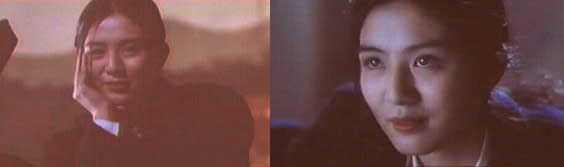
What Price Survival
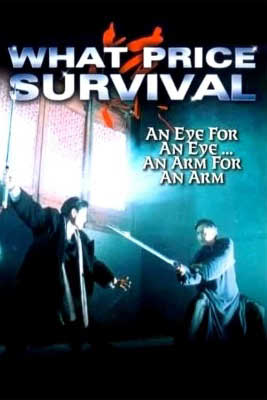
Director: Daniel Lee
Year: 1994
Rating: 8.5
Drowning with fatalism
and saturated in romanticism, this film held me enthralled for much of its
running time. Stunning rapid-fire images come at the viewer in scenes that
you nearly want to breathe in and not let out. There are moments in time
that you want to hold on to, an image that you have to retain, an expression
that you need to remember. At times I had to turn off the film because I
simply needed to slow it down.
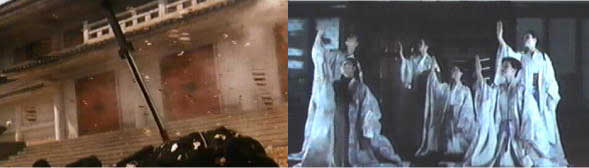
With allusions to references as varied as the One Armed Swordsman, to Christ
bearing his cross to Golgotha, to Oedipus being blinded and forsaken, the
film takes on a layered sense of complexity that is thought provoking and
yet not entirely clear. I came away from this film with many questions and
no answers. It leaves you a bit frustrated because it is difficult to know
how much of this apparent symbolism and subtext is valid and meaningful or
simply thrown into the mix for stylistic and theatrical purposes. It left
me wondering how much of the film I had truly understood.
This is a sword fighting film in which the
action is fast and exciting – pushed along by blink of the eye edits – and
yet it is often the quiet moments – the slow dance to a languorous ballad,
the ravishing close up, the faces in profile, the look of betrayal or the
sudden acknowledgment of impending death that capture your heart. It
takes place in the 1930s/1940s and yet the modern age doesn’t really seem
to have encroached on their traditional world of honor and revenge
- a world in which guns never appear. In an odd choice the director shows
many glimpses of the scenes to come during the opening credits – but it is
done so quickly that it only rivets your attention rather than giving away
too much.
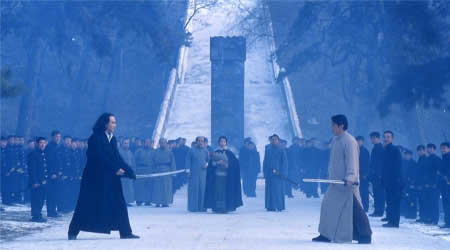
Two swordsmen are in a duel with a great
deal at stake. David Chiang (of many of the Shaw classic sword films such
as The New One Armed Swordsman) is the head of a sword school and he is battling
with Norman Chu who had broken away in anger from the school years previously
to set up his own school. Chu is clearly the bad guy here and in a sneaky
move (“feigned suicide”) is able to defeat Chiang. Rather than killing him
though, he claims Chiang’s newborn son. Chiang’s wife slowly walks over to
Chu and hands him her son – turns to Chiang and smiles for a brief moment
before collapsing into the snow.
Twenty years later the son has grown up to be Wang Ning (Wu Xing-Guo) and
he has been brought up to believe that Chiang killed his mother and father.
He has been waiting for his moment of revenge for many years. Wang is sort
of part of a Jules and Jim relationship with Chu’s daughter, Charlie Yeung,
and another student Jie. It is clear though that Charlie is in love with
Wang when she tells him “good swords must come in pairs”. Finally Chu sets his long term plan in motion
and tells Wang that it is time to meet his destiny. At the same time Chu has
secretly enlisted the aid of Damian Lau – Chiang’s right hand man. Chiang
learns that his son is alive and is coming to kill him. In a beautiful scene
he goes to the grave of his wife and tells her that their son is now a fine
man, but neglects to tell her what is about to transpire – only that he may
soon be finally joining her.
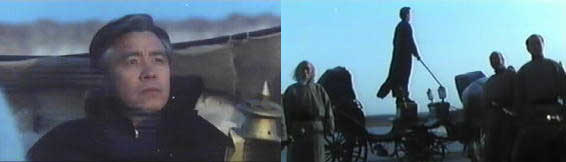
The fight between the son and father is an incredibly powerful scene as the
father tries to teach the son his philosophy of life between thrusts and
the film is quickly going back and forth between the fight and Chu far away
watching his courtesans perform. I felt like I was holding my breath for
the entire scene. After the intensity
of this scene, this film feels a bit deflated and goes somewhat flat. It
isn’t until near the end that it really picks up again with the final showdown. The emotions
of this film are right there on the screen – visceral and larger than life.
Either you get sucked into this Greek tragedy – or you may find it
simply baffling and boring. I clearly was sucked in. Its very theatrical,
beautifully filmed, has some wonderful sword fighting action - but is without
a doubt overlayed with a layer of pretention - that I kind of enjoyed, but
I could easily see it turning many people off. There are a number of logic
gaps – why doesn’t Chiang tell his son the truth (well perhaps there are
reasons but they are never spelled out) and the ending is stunning but also
perplexing - but I think it is one of those films worth experiencing one
way or the other.
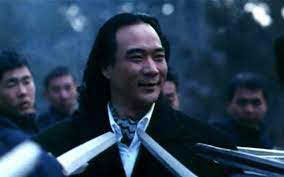
One disappointment with the film is that CharlieYeung
does not get as much screen time as I was expecting and is not involved with
the action at all. Apparently, there are two versions with alternate endings.
If you wish to know what they are - do a deja vu search for this film and
look for a posting from Dale Berry.