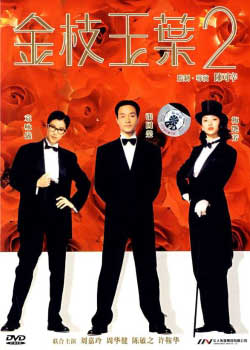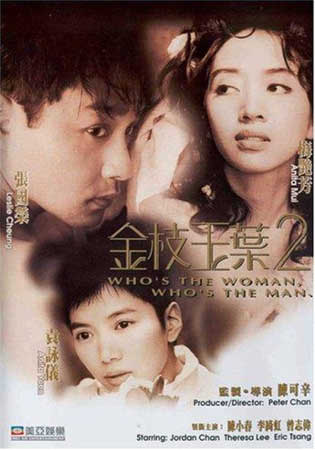
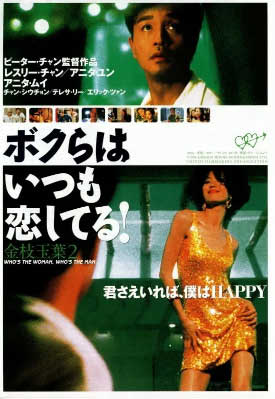
At the end of He’s a Woman, She’s a Man Leslie declares his love to Anita Yuen “I don’t care if you are a man or a woman. I only know that I love you”. A happy ending to be sure – or is it? This sequel begins with the same words, but then continues the story through the many ups and downs of their relationship. In the same vein as the first one, this film deals with issues of cross-dressing and gender and sexual confusion. It doesn’t quite have the exhilarating sense of innovation and comedic exuberance of HAWSAM, but it still generates a number of laughs along with some touching and dramatic moments.
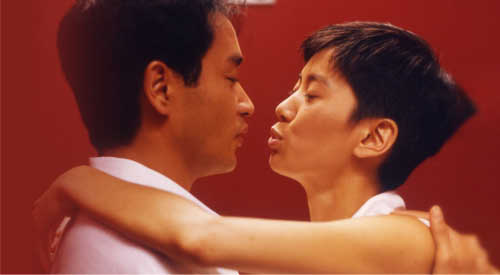
A brief recap of HAWSAM – Wing (Anita Yuen) pretends to be a man so that
she can try and get close to her pop idol – Carina Lau. Instead she falls
in love with Carina’s boyfriend Sam (Leslie Cheung) and becomes a huge pop
sensation herself. Of course everyone thinks she is a man and she has to
continue that charade through this film as she has become this androgynous
symbol of a new age. Here she moves in with Sam but he soon realizes that
living with Anita is a different matter than loving Anita. It’s nice to visit
the zoo, but you don’t want to live there! Anita first invites her friend
Fish, Jordan Chan, to move in, then refurbishes the apartment and throws
bizarre costume parties – all of which are driving Sam crazy and causing
him song writer’s block. He is also bothered by the fact that since he is
living with Wing and everyone thinks Wing is a man – everyone assumes he
is gay. The look on Sam’s face is priceless when Wing tells the world
that she loves Sam at an awards ceremony.
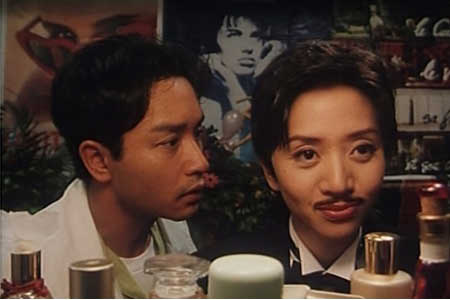
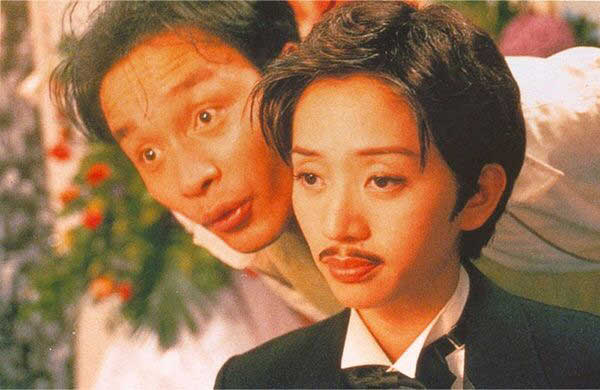
At the same time a mysterious and legendary singer has moved in downstairs – Fan Fan (Anita Mui) – and she ends up having a drunken one nighter with Sam – he in a Woody Allen mask, Fan Fan in a Whoopie Goldberg mask. It was a surrealistic and very weird love-making scene! To add to the theme of sexual confusion Jordan falls for Fan Fan’s assistant (Theresa Lee) who is a Roller Girl type lesbian. Jordan realizes this when he notices that they are both having fantasies about the same person – Christie Chung! – but he never gives up – going so far as to shave his legs and wear a dress. And it just gets more peculiar as Fan Fan becomes attracted to Wing (thinking that Wing is a man) – but then Wing starts getting strange thoughts regarding Fan Fan – like picturing her naked. Leslie just watches in total horror as the two of them have a long – deep – passionate kiss while filming a scene from Gone with the Wind.
I found all this very funny – there are some wonderful small moments –
the two workmen (Andy Hui being one) coming out of the closet, Eric Tsang
as Sam’s openly gay friend calling back a singer for another audition, Anita
stuffing her brassiere to make Sam happy. Part of the amusement and adding
to the sexual confusion comes from knowing that HK gossip for years has been
that Leslie is gay – and he has all but admitted it. Still I appreciated
the very relaxed and casual attitude this film takes towards the less than
mainstream sexual content. Though more serious than the first and not quite
as magical, this is still a wonderful film that somehow manages to be very
commercial with non-commercial themes.
From comments I have read though, it seems that this film is often held in
little esteem by many. I can’t quite understand why unless it is because
it falls a bit short from the first film or the sexual themes go too far
for some. Perhaps it was easier to find Leslie falling in love with Wing
in the first one a cuter more romantic concept than Wing being attracted
to Fan Fan who is in fact a woman.
My rating for the film: 8.0
Story-wise, WHO'S THE WOMAN, WHO'S THE MAN? does
pick up immediately from the end of "He's a Woman, She's a Man" (so it really
would help its viewer(s) to have seen the first film). Fairly early
on in the film though, one starts to feel certain disparities and discontinuities
vis a vis that big U(nited) F(ilmmakers) O(rganization) hit: Notably,
in terms of Auntie (the Agony Aunt character played by Eric Tsang) sporting
a different hair-color as well as -style; and Wing – somewhat annoyingly for
me -- declaring a new character, Fan Fan (portrayed by Anita Mui), to be
her idol (whereas in "He's a Woman, She's a Man", that honor went to Rose
(played by Carina Lau)). I also sense a tonal shift in that although
this production continues to have many bright and comic moments (including
those furnished by Wing's friend, Fish (played by the amusing Jordan Chan),
and Fan Fan's assistant, O (who comes in the form of the squeaky-voiced Theresa
Lee)), a certain wistfulness and more tears are evident here.
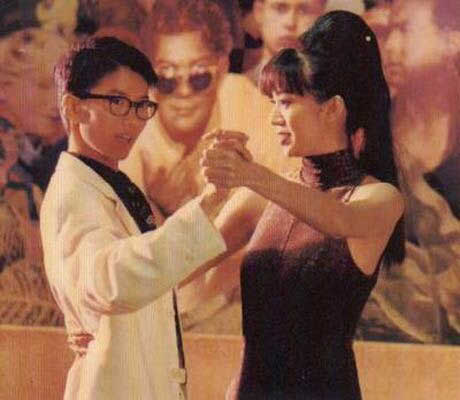
While there are many (more) interesting characters
in this absorbing movie, in some ways, the focus is now much more on Lam
Chi Wing (perfectly played by Anita Yuen). Viewed from a certain perspective,
the primary significance of the actions of Sam Koo (Leslie Cheung reprising
his "He's a Woman, She's a Man" role) and Fan Fan lie in the consequence they
have on (their relations with) Wing. Hopefully without giving too much
away, I will suggest that the main tale here concerns Wing's making new discoveries
about the precious commodity that is innocence and suffering growing pains
along the path that takes her from being a childlike being to a bona fide
adult.
I am not sure how many non-Cantonese speaking Hong Kong movie fans are aware that in Cantonese (along with other forms of Chinese like Hokkien and Mandarin as well as Kiswahili and Bahasa Malaysia!): A single gender-neutral word covers the (different) ground(s) of the English "he", "she" and "it"; and the word for "human" is effectively synonymous with that for "adult". I additionally think that HK movie fans would be well served if they realize that it is traditional practice for Chinese people(s) to address unrelated familiars who are older -- and presumably better... -- than them with a kin or other kind of honorary title attached to their name (N.B. Fan Fan being addressed as "Fan Chea" (older sister Fan) by Wing and O in this movie, and Sam being referred to as "Koo Sir" by members of his production crew in "He's a Woman, She's a Man"). With this information in mind, I think that greater significance -- and evidence for the points I made in the last paragraph! -- will be seen in such occurrences as O, at a certain key point, calling Wing "Chea". It also seems to me that however intriguing and diverting are the gender and sexual shenanigans, it might do the (potential) viewer well to not consider them the "be all and end all" of this seriously likeable film.
My rating for the film: 9.