The Postman Strikes Back
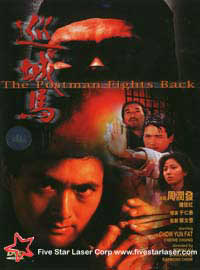
Director: Ronnie Yu
Year: 1982
Rating: 7.0/7.0
In this film Chow
Yun Fat lives in a HK that has been nearly destroyed by nuclear war and one
day he chances upon a bag of mail and decides to take the Star Ferry to
Kowloon and deliver it - thus bringing back civilization.
Oh, wrong film. Sorry, in this one he plays
a rugged handsome drifter who chances upon an isolated diner, a sultry wife
(Veronica Yip) and a greasy husband (Ng Man-Tat) and the inevitable scenario
is played out.

Oh damn, it’s not that one either. Actually Chow Yun Fat is not even the
postman in this Western kung-fu flick. Western in the sense that it reminded
me very much of the old Hollywood westerns. Four men (CYF being one of them)
are hired by Eddie Ko to transport a box with unknown contents across hostile
territory. They are attacked constantly by bandits, bounty hunters and revolutionaries.
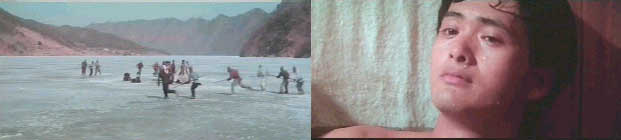
They cross barren plains and snow covered vistas. At one point they even do
a “circle the wagons” scenario when they are crossing a frozen lake and surrounded
by sword wielding ninjas on ice skates!
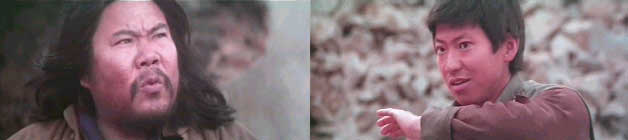
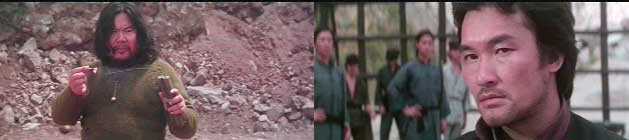
Chow Yun Fat – looking very young and trim – does some kung fu, but lets
just say that it was a good thing that "heroic bloodshed" came along. He does
have a neat wrist projectile weapon that is sneaky and deadly. I wasn’t really
expecting much from this film, but as it goes along it gets better and better
with a lot of action and the tension starts to grow. There are some really
imaginative bits; such as tying dynamite to the tails of rats and setting
them loose in the enemy's compound. Cherie Chung in her first role tags along
with the foursome, but this first of a number of pairings with CYF has no
romance. Ronnie Yu (Bride with White Hair) directs.

My rating for this film: 7.0
Reviewed by YTSL
Eighteen years before he played a kung fu master
in “Crouching Tiger, Hidden Dragon”, Chow Yun-Fat appeared in a Ronnie Yu
directed film that contains its share of martial artistic action and characters
who get revealed somewhere along the line to be less innocent than they initially
appeared. Although these two entertaining efforts surely are on opposite
sides of the spectrum with regards to such as the budgets that their makers
had at their disposal, one other similarity that this often spartan looking
production -- which nonetheless can boast of having quite a few notable names
in its crew as well as cast -- does share with Ang Lee’s celebrated offering
is that the individual who has been lauded as “the God of Actors” -- but was
looked upon as “box office poison” back in 1982 -- does not have as big a
part to play in the actually shot-in-South Korea (as opposed to any of “the
three Chinas”) movie as it might be assumed that he would.
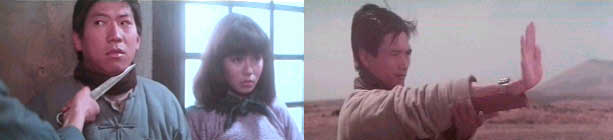
Instead, the titular character of that which is variously known as “A Postman
Fights Back”, “The Postman Fights Back” and POSTMAN STRIKES BACK comes in
the more than capable form of Leung Kar Yan (AKA “Beardy” to his fans).
At the start of the Tony Au art directed work (that’s set in the turbulent
early part of the twentieth century during which Yuan Shi Kai had risen up
to challenge Sun Yat Sen’s administrative authority), its pragmatic protagonist
-- who gets referred to in the English subtitles as “courier” Ma -- is shown
being content to lead a modest plus honest existence as the deliverer of letters,
small packages and messages for residents of remote Chinese villages who
(nevertheless) may have relatives and contacts in metropolises like Shanghai
and Canton. However, first economic realities, then those with major
politics and/or deception seriously on their minds, intrude and induce him
to agree to deliver four medium sized boxes containing a gift from a powerful
personage who had declared himself the emperor of China to a glorified warlord
whose loyalty he was seeking to win over.
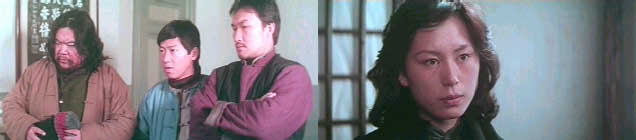
The far from rich Ma meets the acquaintance of the wealthy looking man who
announced that he was willing to pay an unmiserly 300 taels of gold for the
successful execution of a job that was not supposed to take up more than seven
days by way of a petty thief type character named Yao Chai (who gets rather
thanklessly played by Yuen Yat Chor). In turn, Yuan Shi Kai’s emissary
-- who identified himself as Hu (and is suitably given mysterious plus arrogant
airs by Eddy Ko) -- introduces the courier to a gentlemanly individual named
Fu Jun and makes a convincing case for it being beneficial to have Chow Yun-Fat’s
POSTMAN STRIKES BACK character along for what promised to be a hazardous
ride on account of his having “underworld” (i.e., “jiang hu”?) contacts that
could be utilized (should the need arise to do so). What with Hu dramatically
stating that he would prefer that this shipment get blown up than get into
the wrong hands, it (also) made sense for an explosives expert named Bu (essayed
by Fan Mui Sheng) to be added to this delivery team.

Just as the four men are about to set off on their mission, they get joined
by a female villager named Gui Hua (quietly portrayed by Cherie Chung), who
seems to have illogically opted to take a roundabout as well as potentially
dangerous route to the big city where she hoped to be reunited with a sister
who her impoverished father had sold. Midway in their journey (which
does end up being a pretty dangerous one that involves their being attacked
more than once by gun wielding as well as kung fu fighting individuals), this
rather rag-tag five-some run into a woman who is being pursued by bandits
and successfully rescue her from them. Since Ms. Li (who may have been
the one and only Hong Kong movie role that Guk Ching Suk ever had) claimed
to be from the place near where they are headed, they (temporarily and fairly
happily) add her to their group. After all, they knew so little then
about those things and people that they would have much cause to regret having
latterly encountered.
At this juncture in POSTMAN STRIKES BACK, that which looks to be a transitional
piece that admittedly is more of an Old School kung fu movie than a New Wave
production or wire fu work has certainly not been boring but still seems to
have steered along fairly conventional lines. Soon thereafter though,
it gets considerably enlivened by the kind of imaginative touches that Hong
Kong film fans have come to associate with its credited presenter (but not
action director). More specifically, certain devices, elements and imagery
that feature in this offering will seem familiar to those who have also viewed
the Ching Siu Tung helmed “Duel to the Death”, “A Chinese Ghost Story” I
and II (and presumably also III), and “Swordsman II”. This (re)viewer
is additionally willing to wager that commonalities will be detected between
one of this Golden Harvest production’s female characters and Brigitte Lin’s
in the Ching Siu Tung action directed “Peking Opera Blues” (that, perhaps
not entirely coincidentally, does take place in the same troubled time period
as this earlier effort that also happens to have Cherie Chung in its cast).
My rating for the film: 7.