The Bare-Footed Kid
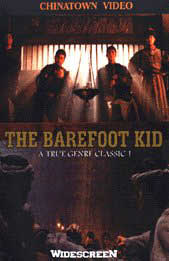
Director: Johnnie To
Year: 1993
Rating: 7.0
This period kung-fu
piece has a fairly good reputation among HK film fans, but for the most part
it left me unmoved. In my mind its main weakness lies at the feet of Aaron
Kwok. He is the main character in this film and his performance is as light
as cotton candy and feels very much out of synch with everyone else’s performance
and also with the atmosphere of the film. It’s unfortunate because everyone
else in the film is fairly good – and certainly the plot and production values
are fine – but I could never get over how inappropriate Kwok feels for this
type of role. The film starts off in a light-hearted manner, but soon turns
surprisingly dark and violent, but Kwok’s acting simply is not able to keep
pace with these emotional changes.
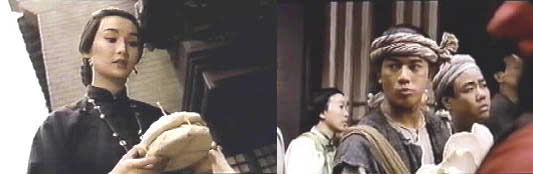
In his bare feet, Kwok arrives in a small provincial town from the countryside
looking for an old friend of his dead father who can hopefully provide him
with work. While he is walking the streets of the town – and taking in all
the exciting goings-on – he notices Maggie Cheung on two occasions performing
charitable acts. It later turns out that his father’s friend – Ti Lung – is
a servant to Maggie and Kwok is able to get work at Maggie’s weaving factory.
Kwok is basically an innocent happy go lucky kid – with amazing martial arts
skills - but he unwittingly sets in motion a series of events that brings
on catastrophic results to the people in his life.
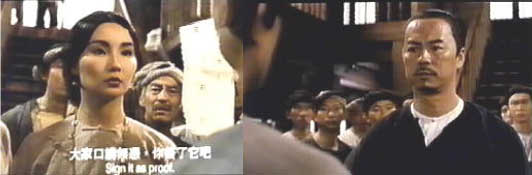
From Ti Lung, Kwok receives a pair of plain black shoes and as his status
rises during the film so does the quality of his shoes. In a heavy-handed
manner, the change of shoes symbolizes both his increased stature and yet
also his moral decay. Kenneth Tsang
is the big man in town – greedy and vicious – and he is trying to gain
ownership of Maggie’s company. Heroically, Kwok tries to stop him, but his
lack of knowledge regarding the town’s political power structure increases
the danger to everyone and Maggie and Ti Lung ask him to go back to his home
in the country. Instead, Kwok takes on employment as the martial arts instructor
for Tsang’s men and receives a fine new pair of shoes. The plain black ones
are quickly discarded, as apparently is his common sense.
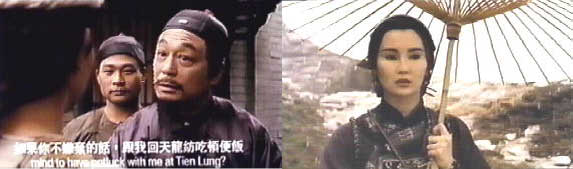
The heart of the film and certainly the most interesting part for me was
the relationship between Ti Lung and Maggie. She is a widow from an arranged
marriage – never having even known her husband who died when he was
twelve – and is of much higher status than Ti Lung – her servant. Yet the
unspoken love and respect between them is evident and very powerful. Ti Lung
is just very charismatic here and one wishes that Kwok could have borrowed
just a few ounces of it. Maggie’s character is underdeveloped and she seems
a bit distant throughout. Kwok has a romance going with a schoolteacher
Wu Chien-lien, but this relationship is also burdened by the fact that he
is on a much lower social scale than she is. His unthinking actions also bring
tragedy into her life.
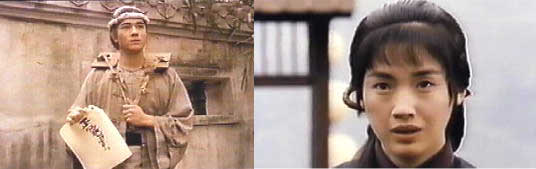
There is a fair amount of action – primarily involving Kwok, but also Ti
Lung on a few occasions. Towards the end it gets very good and has a real
emotional impact to it. Much of the action sequences are imaginative, but
the fight choreography suffers somewhat due to a mix of sometimes speeding
it up too much and then sometimes using Wong Kar Wai slo-mo blurring effects.

So this is a difficult film to judge overall.
Certainly if Aaron Kwok is your cup of tea this film will appeal to you,
but I find him quite colorless and with no depth to his acting. Still though,
there are some really good scenes in the film. It is fast paced and energetic
with a few unexpected turns and the story will take you along to its emotional
finish. It is directed by Johnny To.