Iron Monkey
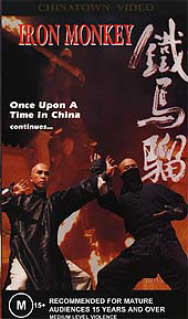
Reviewed by YTSL
That which can be suitably viewed as a prequel
to the "Once Upon a Time in China" series of films did not fare too well at
the local box office in 1993, ranking as only the 58th "best" performer of
143 domestically produced releases that year and lasting but a mere 12 days
in Hong Kong cinemas. Perhaps it was due to the market then being overly-saturated
by dramatic action pieces; what with its coming out in the same year as "The
Bride with White Hair", "Fong Sai Yuk", "The Heroic Trio", "Project S", director
Yuen Woo Ping's "Tai Chi Master" and producer Tsui Hark's "Once Upon a Time
in China" III & IV, "The Magic Crane", "Green Snake" and "Swordsman III:
The East is Red". It also may be that the stars of this Film Workshop
production -- Yu Rong-Guang (who had supporting roles in "Project S" and
"The East is Red"), Donnie Yen (who was quite impressive in "Once Upon a
Time in China II"), Jean Wong (who made a short but very memorable appearance
in "The East is Red") and Tsang Sze-Man (who may have played the boy who
grew up to be the Leslie Cheung character in "The Bride with White Hair")
-- just do not have the audience drawing power of, say, Brigitte Lin and
Jet Li.
Although it may not have truly big names in front
of the camera, IRON MONKEY still is an extremely watchable as well as complex
piece of work, which thoroughly deserves the cult status it possesses in
Western Hong Kong movie fan circles. This is not least because the
movie does contain Yuen Woo Ping's trademark wire-fu touches (the sight of
Yu Rong-Guang and Jean Wong's characters gracefully gathering up pieces of
flying paper in their clinic gives a hint of what was to come – think re
Michelle Yeoh's actions in the "tofu scene" -- in Yuen's 1994 "Wing Chun")
and set-piece spectacles (as in "Tai Chi Master", there are those involving
human heads and wooden logs but the ante is raised here with regards to the
latter by some of them being ablaze!). Then there's the additional
layer of meaning possessed by the film whose title refers to a sort of Chinese
Robin Hood (in terms of his robbing the corrupt rich to help the poor):
Which comes by way of the kind of indirectly flighted yet on target -- like
a particular style of arrow utilized by the East Chamber in "Dragon Inn"!
-- political commentary at which Tsui Hark (who co-wrote the script) excels.
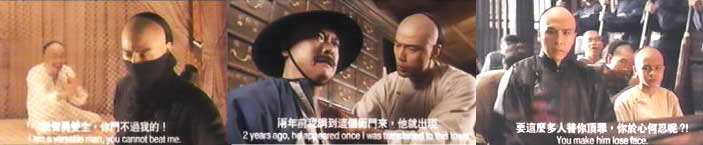
It also helps a tremendous lot that the characters in this at times quite
touching movie are amazingly well fleshed out and presented for a primarily
historical action effort. Effort has really been made to show more
than one side to the man who is Dr. Yang during the day and Iron Monkey by
night (Yu Rong-Guang impresses with his acting as well as martial artistic
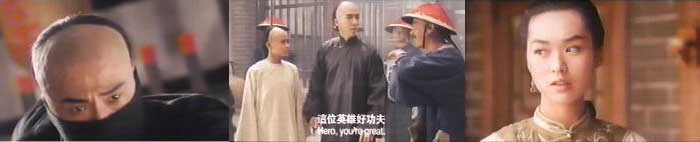
abilities). The woman whose baby Dr. Yang was unable to keep alive
but who he was able to save from a continued life as a prostitute is shown
to be his valuable aide as well as competent student (Jean Wong charms as
Miss Ho). Wong Kei-Ying is shown to be a loving father and good cook
as well as righteous man, a(nother) skilled medical man and expert martial
artist (Donnie Yen capably performs all that the role requires). It
is a relief and unexpected pleasure to have the young Wong Fei-Hung depicted
here as neither an annoying brat nor entirely precocious child (Tsang Sze-Man
is amazing both in terms of HER fighting skills and dramatic portrayal of
a boy trying hard to become a man!). While the chief villain is 100%
evil and another predominantly farcically so, IRON MONKEY does additionally
benefit from having at least one character whose loyalties are not entirely
certain – and feelings are appropriately mixed -- for much of the proceedings.
Bey Logan is absolutely right though in stating that: "The film is
memorable for having as much heart as it has martial art" (In Stefan Hammond's
"Hollywood East", 2000:93). The warm emotions that IRON MONKEY engenders
are what really make this a standout movie for this (re)viewer. Apart
from being a spirited tale of good versus evil, this at times deceptively
tonally light offering also contains stories of the love between a father
and son along with a generous patron and grateful woman. Also part
of the narrative equation are the friendship between good men, their mutual
respect for each other, the care that they possess for their fellow humans
and the loyalty as well as admiration that they can bring out in other people.
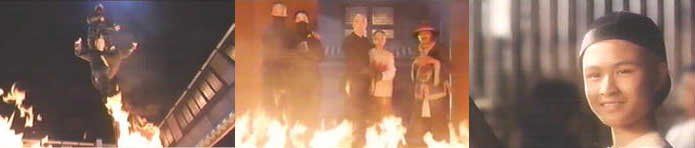
At film's end, when the camera focuses on the boy who would become a legendary
hero and freezes for a few seconds on his smiling face, I can pretty much
guarantee that the viewer will feel shivers going down his or her spine.
What will then follow is an almost irresistible urge to hum the Wong Fei-Hung
tune (which can be heard in IRON MONKEY as well as Tsui Hark's "Once Upon
a Time in China" but is illuminatingly wistfully rendered in this movie while
rousing in that popular series) and either rewatch or spread the good word
about an effort that deserves a larger audience, or follow it up with a viewing
of the first "Once Upon a Time in China"! While this work will not
be everyone's cup of tea (I'm thinking here of those people who like their
action straight up and wire-less, others who just will never like any movie
with some amount of fighting in it and still other individuals who might
be a bit insulted by its alternately inserting wicked, ironic and just plain
playful humor into certain otherwise serious situations), it surely will
be greatly appreciated by those who go for this multi-layered, genre-blending
kind of cinematic experience and impact.
 My rating for this film: 9.5.
Reviewed by Brian
Other than the emotionally powerful threads
that run through the film, Iron Monkey is also a dazzlingly choreographed
action film. It is imaginative and mindboggling throughout and somehow Yuen
Woo Ping manages to make each action scene stand on its own merits as a distinct
gem. True, the action is speeded up and the wirework is at times obtrusive,
but it is done with so much flair and passion that the viewer simply begins
to overlook it and to take it as reality.

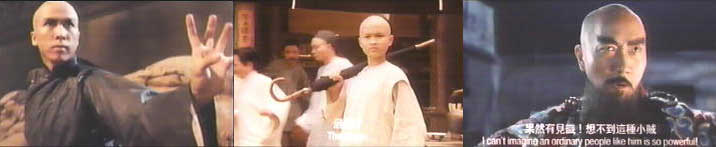
All the characters get their share of wonderful action sequences and Yuen
makes them all look so good. Jean Wong has a terrific fight against a gang
of ruffians in which she has some lovely graceful moments and Tsang Sze-Man
is simply incredible in a few fights as she fights off numerous adults with
various instruments at hand. Needless to say both Donnie Yen and Yu Rong-Guang
(why didn't this guy become a huge star?) have a number of powerful conflicts
– against each other, against a group of treacherous monks and against
the wonderfully evil Yam Sai-Koon (Heroic Trio).
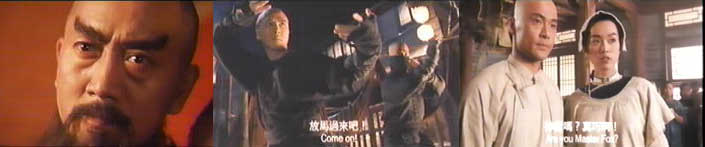
As good as the fights were that preceded it, the finale surpasses them. It
has to be seen to be fully appreciated. It is simply a stunning set piece.
Yu and Donnie match up against Yam and most of the fight takes place on top
of a number of wooden poles with a fire raging down below. The three of them
leap from pole to pole all the time delivering vicious blows and attempting
to knock each other into the fiery death that awaits them below. It is one
of the more brilliant action scenes I have come across in HK films. You sit
there thinking – how the hell did they do this?
My rating for this film: 9.0