Tai Chi II
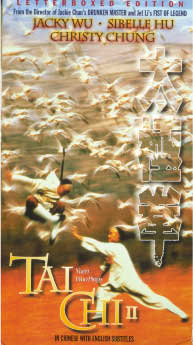
Director: Yuen Wo-ping
Year: 1996
Rating: 6.0
Even though this
film was also directed by Yuen Wo-Ping and displays elements of the Tai Chi
fighting style, it has absolutely nothing to do with Jet Li’s Tai Chi Master.
This is an odd little film that has its good points, but it is difficult
to take it too seriously. It has a serviceable enough plot dealing with the
last years of the Ching dynasty, some solid actors and a number of well-done
action routines – but for some reason it just comes off as kung-fu lite.
The film feels much too pretty, amiable and adolescent to really rank as
more than a trifle.
Much of this has to do with the lead actor
– Jacky Wu in his debut film. The man’s wushu skills are extremely impressive
and apparently he was a member of the same wushu team that Jet Li once belonged
to. Whenever Wu goes into action, the fluidity of his movement and the acrobatics
are really quite amazing and he makes it look nearly effortless. Perhaps
that is part of the problem – Wu is always smiling and never seems to exert
much energy or anger in his fights. So even if you can admire what he is
doing, it comes across as more show than real and one never becomes emotionally
involved in it in any way.
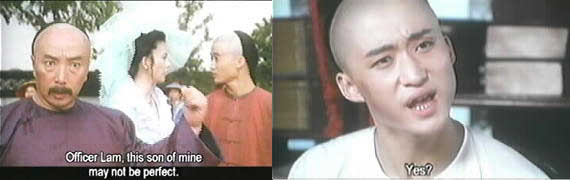
In the opening scene, his father (Yu Hai) is announcing to the world that
he is retiring from the world of martial arts to educate his son and spend
more time with his wife, Sibelle Hu. Billy Chow interrupts though to challenge
Yu Hai and an enjoyable fight commences. Yu Hai starred along with Jet Li
in the wonderful Shaolin Temple trilogy and is a top wushu performer as well.
Both he and Billy Chow bring an authenticity and gravity to their action
scenes that are all too lacking in Jacky’s fights. Billy Chow is defeated
in his challenge but vows to return one day.
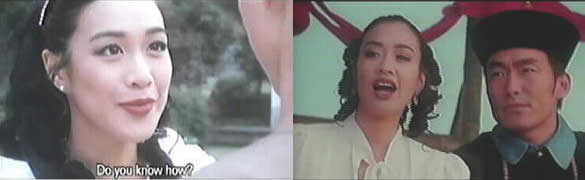
Years pass and Jacky has practically spent all this time locked up in his
room studying the classics. Secretly though he has been studying kung-fu
manuals and it’s amazing what one can learn from books! He soon sneaks off
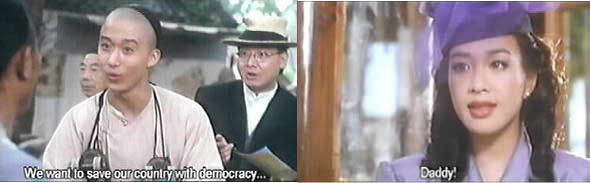
one day – meets the enchanting Christy Chung – and soon gets into a fight
with officials of the Ching government because of her. She has recently returned
from receiving her education in the West and is intent on bringing democracy
to China. She enlists Wu into the movement – though he refuses to cut off
his pigtail – which is just as well since his Pig-tail stance is his most
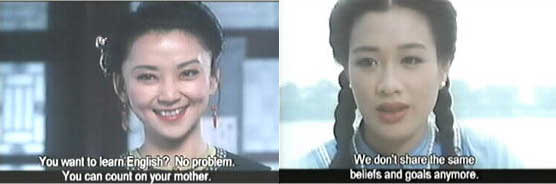
lethal weapon! Jacky gets tips from his mom, Sibelle Hu, on how to court
a Western educated female – by teaching him to say “yes” to everything she
asks and how to tango. In the sub-titles, Hu’s character claims to have been
born in the Bronx!
Jacky and Christy have to fight not only Ching officials (Mark Cheng), but
also some devilish English opium smugglers. There are some fine – though
very wire enhanced – action scenes that have some excellent choreography.
One involves his father coming out of retirement to take on a platoon of
Ching soldiers and then the final fight against the gweillo – Darren Shahlavi
– is a lot of fun and must last for fifteen minutes.
To some degree this plot is fairly typical
of many kung fu films that came out after the popularity of Once Upon a Time
in China. Still the mix of traditional Chinese ways and the influx of ideas
from the West could have been interesting if it had gone beyond being simply
cutesy. There is just no weight to this film.
Strangely, it seems as if Jacky Wu has not done much in film since this was
made. Though his acting needed a lot of work, his physical skills are undeniable.
Of course, sadly there is not much need these days for wushu stars in HK
cinema.