Just Heroes
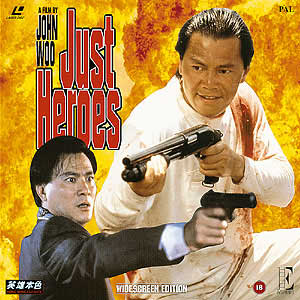
Director: John Woo, Wu Ma
Year: 1989
Rating: 6.0
This is the forgotten
John Woo film. Though it falls between A Better Tomorrow II and The Killer,
like the proverbial uncle in jail this film is rarely ever mentioned in
public. I finally had an opportunity to see it the other night in a showing
at BAM in Brooklyn – and though its weaknesses are all too evident I still
found it enjoyable for the most part.
The directing duties are credited to both
John Woo and veteran Wu Ma so it’s difficult to say with authority which parts
are Woo or Wu! In an interview published in Asian Cult Cinema, Woo states
that he directed 80% of it while Wu Ma, Danny Lee and David Chang directed
the remainder. It certainly contains a lot of the Woo cinematic trademarks
– bullet ballet, slo-mo, over done melodrama, heated male bonding – but also
displays some tongue in cheek humor directed at himself. A young man has
A Better Tomorrow fetish – and before a gunfight he plants guns in every
vase and flowerpot he can find!
The film was done as a favor to Woo’s one time mentor, legendary director
Chang Cheh, – and the “charitable” nature of the film and multi-direction
shows at times in the sloppy editing, the Byzantine story line and the large
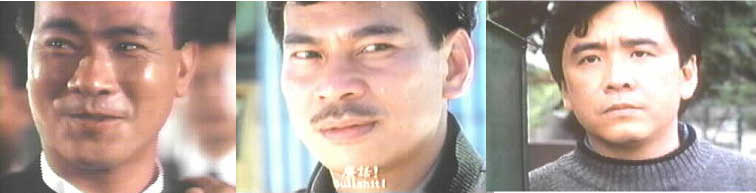
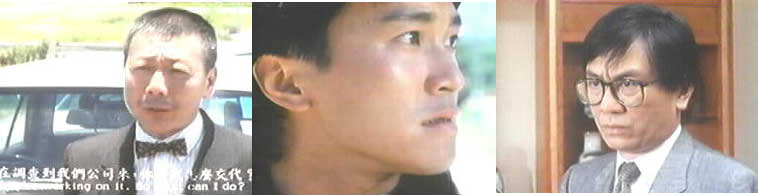
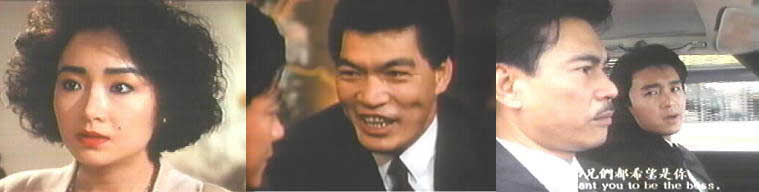
cast. A number of cameos are also made – Ti Lung, Yuen Woo Ping, Lo Lieh,
Bill Tung, Paul Chun Pui – as no doubt a favor to Chang. The main cast is
terrific as well – David Chiang (who of course made a number of films for
Chang), Danny Lee (who began in Shaw Brothers films), Chen Kuan-tai (another
Shaw veteran), Stephen Chow, Shing Fui On, Wu Ma, James Wong and Tien Niu.
Woo states in the same interview that the budget was very small (and in fact
the cast worked for free) and that explains why it is so uneven. In the end,
Chang Cheh refused the money and gave it to help the study of cinema.
The respected elderly head of a triad family
is assassinated and a search is begun for the killer and whoever is behind
him. The search plays out well as suspicion falls on two of his adopted
sons – Danny Lee and Chen Kuan-tai – and on an outside triad leader, Shing
Fui On. Also looking like possible suspects are the smooth and able consigliere,
Wu Ma – and even possibly the third adopted son, David Chiang, who has retired
from the family business. The spark that ignites the action is hotheaded Stephen
Chow (this film made right before he made it big in comedies) who is Chen’s
right-hand man and suspects that Danny Lee is behind the killing and out
to grab power. As the three adopted brothers alternate between bonding and
then turning on one another, the film gets convoluted (hurt by some confusing
flashbacks) but also intriguing. The audience is kept in the dark till near
the end of the film as to the guilty party.
The film has four action scenes – some of it done well, some not so well
and some I would have to imagine is either a parody of Woo’s earlier work
or a warming up for The Killer, which came out in the same year. In fact,
one gets the idea at times that Woo was using this film to work out some of
his ideas for The Killer. The final fight is reasonably well done – very reminiscent
of the final fight in A Better Tomorrow II – when a home becomes a slaughterhouse.
Still there are good reasons why this film is not held in the same regard
as Woo’s other late 80’s/early 90s work. The melodrama is almost soap operish
at times – an alcoholic wife of one of the brothers in love with another brother,
another wife (Tien Niu) losing her unborn baby, the story has too many characters,
the plot is overwrought, the action not up to Woo standards – but still it
is almost so messy - so overdone - as to be rather fun.