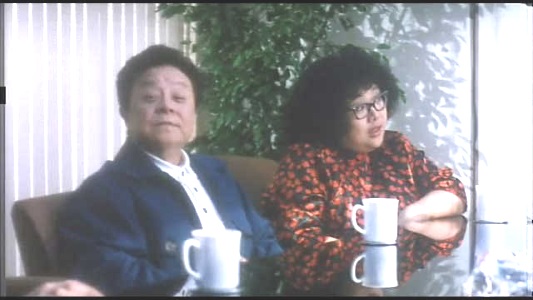
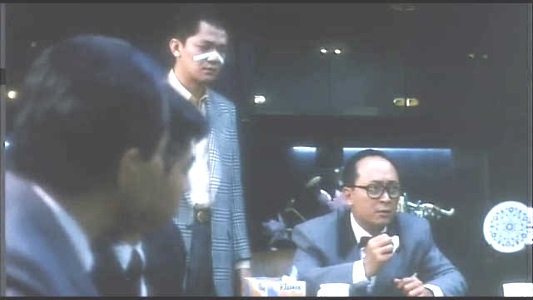
It's a Mad, Mad, Mad World
I - IV
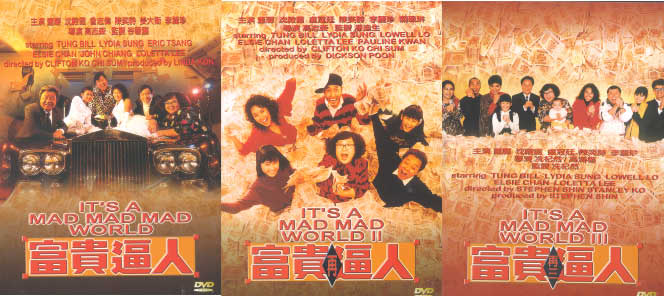
From 1987 to 1989, this series of family
comedies was brought to the screen with a fair amount of popular success
in HK. All three films had the same five actors portraying a middle class
family - the father (Bill Tung), the mother (Lydia Shum) and their three
daughters Elsie Chan, Loletta Lee and Pauline Kwan. Hong Kong audiences found
these films appealing because they humorously spoke to a number of issues
that troubled them at the time. The small indignities of daily life in HK,
the fears of the Mainland take-over and a wish to emigrate before it was
too late, how to keep your head above the economic waters, the desire to
get rich quick and finally the importance of family.
The film seems to say that in the end it
is family that truly matters. Money and success come and go but your family
is always there. As Bill Tung says at one low point "My three daughters
are the real treasures in my life". The comedy tends to be low key - more
situation and character driven than typical HK slapstick or word play humor
- and though there is some universality to it - much of it is clearly directed
at the local HK audience.
The performers are very appealing and never
become tiresome over the course of this series. Bill Tung is perfect as
a father trying to keep what little control he can of his wife and three
daughters, Lydia Shum as his large mahjongg playing wife with dreams of getting
rich is amusing, Elsie Chan as the oldest daughter on the verge of womanhood
is sweet with just the right amount of sex appeal, Loletta Lee is adorably
full of pouts and smiles as the middle daughter and Pauline Kwan is surprisingly
charming as the youngest in a film industry that is notorious for it's annoying
child actors.
These themes of family, economic turmoil,
get rich, get poor, money can't buy you happiness and fear of the turnover
run through all the films - but here is a short rundown on each of the three
films.
Part I - 1987, Director - Clifton Ko
Bill is a news announcer on TV (clearly they
are paid much less in HK than in the U.S.!) and his family lives in a Public
Housing building where the quarters are tight, the walls are thin and items
fall dangerously from the building onto the streets below.
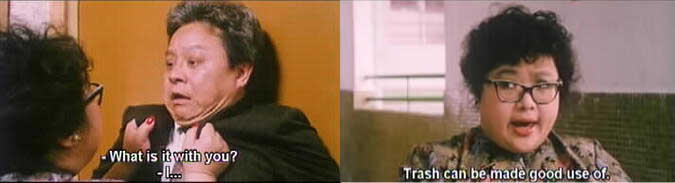
The daughters are in those teenage headache inducing years - Elsie is being
courted by a very hip fast talking Eric Tsang and Loletta is into J-pop and
wants to travel to Japan to study their culture. Bill reminds her that the
Japanese invaded their country and she has nothing to learn from them. I should
also mention that a strong touch of xenophobia runs through these films as
well - whether Japanese, Canadian or from the Mainland.
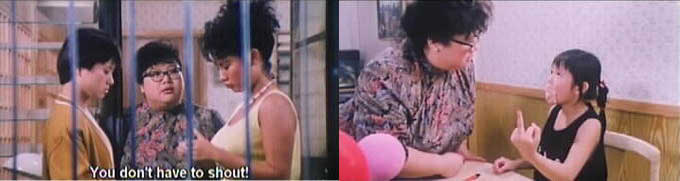
Lydia's day finally comes and she wins HK $19mm in the Mark VI Lottery.
They all dream of different ways to spend it – but at the same time don't
want anyone to know they have won for fear they will try and borrow money.
Bill's brother (David Chiang - credited here as John) comes to visit and
advises them to invest the money in his bank. They do and the bank goes under
and there goes the money. At the same time, three fellows who don’t believe
all the money is gone kidnap Pauline.
 My rating for this film: 6.0
Part II - 1988
- Director - Clifton Ko, Francis Sung
Bill has a new job (after insulting management,
he quit his last one on air after winning the lottery) working for Yip Wing
Cho and Wong San in a newspaper. The two of them conclude erroneously that
Bill knows that they are embezzling money from the firm and send him and the
family to Vancouver, Canada to work there. So again, the factor of a dislike
of foreigners is brought into the story as most Canadians are portrayed as
silly idiots.
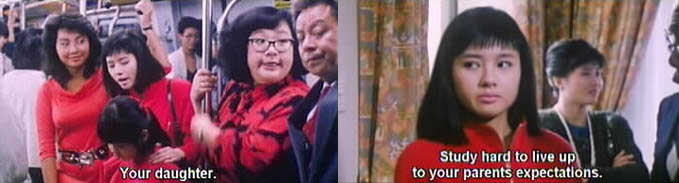
Loletta goes off to university and Elsie picks up a new boyfriend - Lowell
Lo (one of HK film's better composers). The family adjusts to life in Canada
- the cold, the fact that no one speaks Chinese - Lydia finds some Mahjongg
partners and plays the Canadian lottery - but eventually Bill’s two employers
realize that Bill knows nothing about their shady dealings and fire him on
the spot and kick him out of the house.
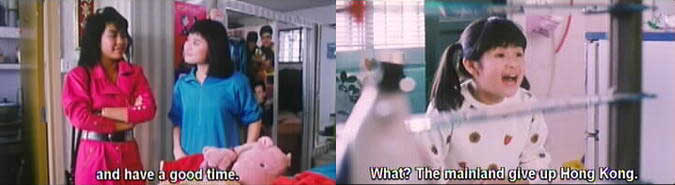
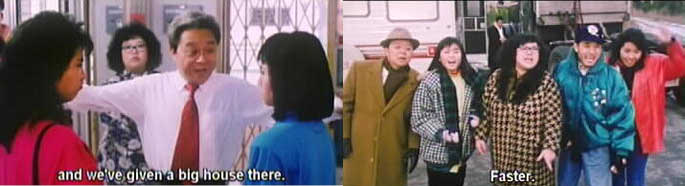
So it is back to HK - with no job and no prospects and living in an apartment
that is a level lower than Public Housing. It's like they are starting all
over again - but then Lydia learns that she has a winning ticket in the lottery
and it is a mad rush back to Canada to claim the prize before it expires.
Yip Wing Cho and Wong San learn of this and try and steal the ticket from
them.
 My rating for this film: 5.5
Part III - 1989,
Director - Stephen Shin
Clifton Ko directed the first two films,
but he passed this duty off to two directors for this third instalment and
it shows. The film is much more jumbled than the previous two and feels
very much out of ideas. They also introduce too many new characters in an
attempt to put some spark in the story, but this only causes it to lose much
of its focus and chemistry. It also did much more poorly at the box office
bringing the series to a halt for three years.
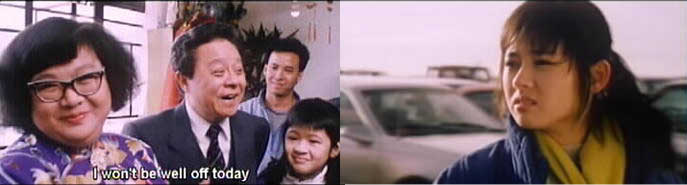
The family is in the money once again - but you know it is just a matter
of time before they lose it - and they do in perhaps the lamest manner imaginable.
Elsie is still being courted by Lowell Lo, but Eric Tsang reappears as a love
rival and Loletta picks up a boyfriend (which infuriates her protective father)
who's father is played by Ng Man-Tat.

There are other elements thrown into the mix - Lydia thinks Bill is having
an affair, she gets the gambling bug - but as expected all ends up happily
for this little family.
 My rating for this film: 4.5
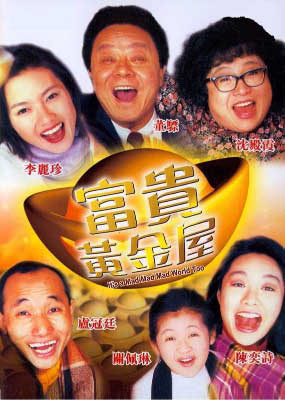
Part IV - 1992
It is nice to finally catch up with this
Hong Kong film - the fourth and final one in the Mad, Mad, Mad World series.
There was one each in 1987, 1988 and 1989 but a three-year gap before this
one. I was expecting it to have lost some of the cast and characters of those
early comic films, but it takes off right where the others ended. These films
center around the sweet Lui family - husband, wife and three daughters -
and the films are all very Hong Kong with this loving and sometimes fighting
family having to manage the ups and downs of life in Hong Kong. Having to
deal with financial struggles, real estate concerns, noisy neighbors, three
daughters all growing up, triads, making money and losing it. The foibles
of chance. The aggravation of everyday living in a crazy wonderful city.
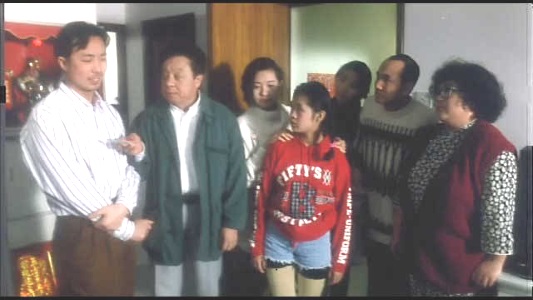
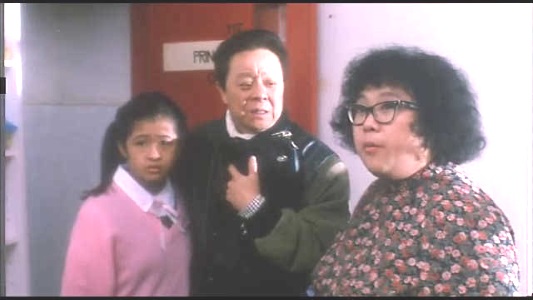
Not only is the setting as Hong Kong as
you can get but so are the parents played by Bill Tung who many may know
from the Jackie Chan films and the rotund Lydia Shum, one of the top comedians
in Hong Kong since she was a teenager. Often called Fatty. They were both
institutions. In these he is the calm let things pass spoil the girls father
while Lydia is a whirlwind of emotions, mahjong and kung fu in her Bruce
Lee yellow sweat suit. No one escapes her wrath. All five of the family were
the same actors through the series - Tung, Shum and the three daughters played
by Loletta Lee, Elsie Chan and Pauline Kwan.
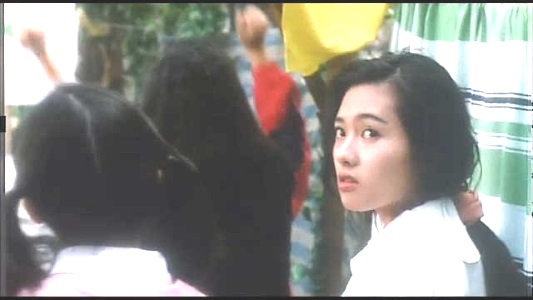
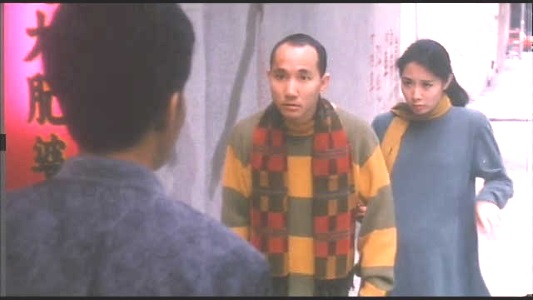
Elsie is now married to Lowell Lo and very
pregnant - he was a suitor of hers in the second and third film. They all
move into an apartment that they purchased and life is good. For a while.
Two neighbors next door are part of a rock band and play their music loud
and late. Lowell it turns out has a mistress in Shenzhen who is warning him
that she is coming to Hong Kong. But the major plot revolves around a rotten
real estate developer (Henry Fong Ping) who wants to buy the building - at
a reduced price. When the building residents refuse, he orders his main henchman
(Tommy Wong) to drive them out. He
tries every dirty trick he can think of such as switching the water pipes
with the sewage pipe, keeping them up all night, putting up brothel signs
in their building, threatening them - but this little family bands together
and fights back. Finally, they come with machetes. It sounds serious but
this is all played for laughs and generally succeeds. Lowell Lo who almost
always plays this nerdy guy that a strong wind or an angry woman could blow
away was one of the top composers of soundtracks in history - an amazing
set of films.
My Rating for this
film: 6.0