Young and Dangerous 4
Reviewed by YTSL
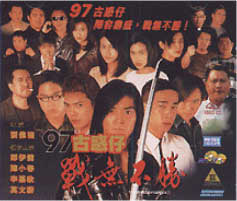
The story of Ho Nam, Chicken and company continue
to provide more chills, thrills and food for thought in this 1997 offering
from director-cinematographer Andrew Lau and producer-scriptwriter Manfred
Wong. In this fourth "official" Triad Boyz installment (Prior to the
production of this "Y&D" episode, there had already been produced a spin-off
entitled "Sexy and Dangerous" -- in which Loletta Lee and Karen Mok portrayed
female equivalents of the male Hung Hing society members played by Ekin Cheng
and Jordan Chan -- and two off-shoots starring Francis Ng entitled "Once
Upon a Time in Triad Society"), the topical ground covered -- including rivalries
between different "rascals", ill-fated couplings, an incursion into Hung
Hing territory and affairs by a malevolent individual (Roy Cheung rather
confusingly plays a different character in this film from that which he portrayed
in "Young and Dangerous 3"), plus an excursion to a foreign land (in this
case, Thailand) -- has become largely familiar.
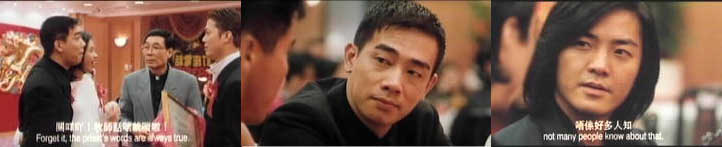
What is different about YOUNG AND DANGEROUS 4 though is its having by far
the most pessimistic outlook thus far. Perhaps it is coincidental that
it is the only one of this popular and influential series that was came out
in the year of Hong Kong's Handover by the British to the Chinese.
What surely is not accidental is that the character who utters the most cynical
sentiments and delivers the most explicit anti-Triad message is that of Ho
Nam; supposedly the most successful as well as "righteous" and heroic of
the group who started off this series of films fairly innocently playing
hooky and soccer in a neighborhood recreational facility. It also seems
pertinent as well as just plain intriguing that Ho Nam and his generation
are shown to be under challenge from a younger but far more vicious and way
less honorable one; whose classroom confrontations and outbursts against
their lot, the existing system and their teachers (whose ranks include characters
played by Karen Mok and Michelle Reis) reminded this (re)viewer of those
in Ringo Lam's anti-colonialistic, heavily censored "School on Fire".
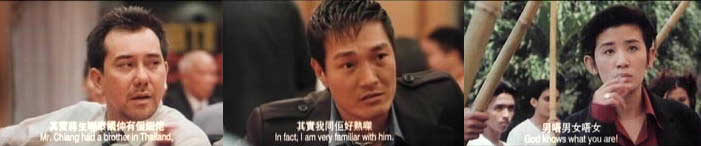
In comparison to the three previous segments, YOUNG AND DANGEROUS 4 feels
somewhat subdued, less intense, less edgy, and actually tired. While
it retains a sense of drama and does contain the requisite bursts of violence,
its ability to shock is mitigated by the more deadly episodes not suddenly
coming off the kind of heartwarmingly tender or amusingly quirky sections
which the other "Y&D" movies had in spades but which this offering generally
lacks (despite the efforts of Jordan Chan's Chicken, Sandra Ng's Sister Thirteen
and Anthony Wong's Tai Fei). A further factor might be not only that
of key individuals growing older and wearier but the overall cast age --
as well as number -- increasing with the introduction of older section heads
(even as it has gotten depleted from episode to episode with the deaths of
younger, rawer, more idealistic -- if not naive -- characters).
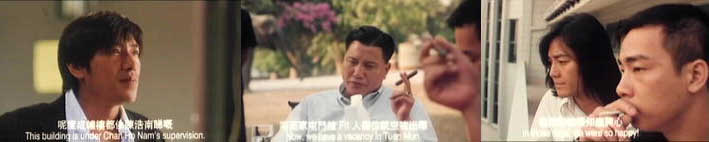
For those who have yet to enter the Triad Boyz world proper, I would caution
against using the most pathos filled episode as your introduction to the
series and genre that it has spawned. There also might not be too much
here for those who were primarily attracted to the "Y&D" movies because
of their consciously fashioned sense of style and exciting cinematography
(It should not be forgotten that Andrew Lau has been a Wong Kar Wai collaborator.
It probably is no mere coincidence that along with Michelle Reis and Karen
Mok, the actor who played Takeshi Kaneshiro's father in "Fallen Angels" makes
an appearance in YOUNG AND DANGEROUS 4. It also surely means something
that when Maggie Cheung was asked in London in 1996 to comment about the
"Y&D" films, her remarks consisted of the following: "Yes, they
were the "noise" this year. The director was the cameraman who did
"As Tears Go By", so to me it's still Wong Kar Wai who dominates" (In Miles
Wood's "Cine East", 1998:42)).
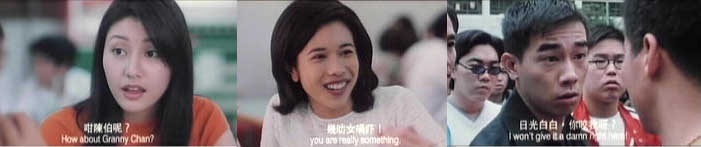
Alternatively, those who favor a mature and considered approach to all kinds
of matters might actually be pleased -- even if not entertained -- by this
fourth film in a not at all unintelligent series that continues to develop
and still be capable of springing surprises, evoking warmth and eliciting
(sad) fellow feelings for criminal character who actually increasingly seem
not that different from many "real" ones we may know. If you do fall into
this category of (potential) viewer, I would recommend that you view all
the three previous installments not only for themselves but also so that
you will better appreciate the movie whose Chinese title of "97 Wise Guys:
No War Cannot Be Won" gives little inkling of its prevailing sense that warring
acts never come without costs.
 My rating for the film: 7.5