Night Club
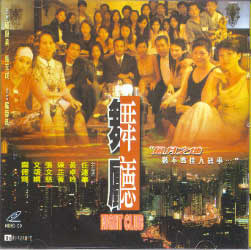
Reviewed by YTSL
Some days, it can feel like every other person
in Hong Kong -- or at least the movies that come out of that small territory
which is home to some 6.8 million people -- is a policeman/woman, triad gang
member or "call girl" (Although gigolos also do populate this landscape, they
don't seem to exist in as great quantities as their female equivalents).
In any case, it may well be impossible to think of even a single actor or
actress who has not appeared in at least one of these guises.
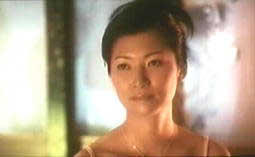
In NIGHT CLUB, it is the turn of Ruby Wong --
more usually to be found assuming strong supporting roles in recent male-centric
Milkyway productions (like "Expect the Unexpected" and "Running Out of Time")
-- to play a Mamasan named Lai Wah, Astrid Chan (who looks like a more mature
version of Gigi Leung) to portray an older prostitute, Annie Man to appear
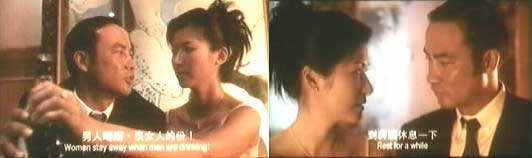
as a newcomer to the trade, and Simon Yam to take on the role of the Night
Club owner-manager with a triad background. Re the lead actress:
It is interesting how she brings the same serious and quiet purposefulness
to this role that has characterized her portrayals of such as a small-time
innkeeper in "Where a Good Man Goes", a bartender in "Loving You" and a firefighter
in "Lifeline". Re the leading man: Although it initially looked
like he was being asked to play against type as an old-fashioned and out-of-touch
elder, Yam's charm comes through in such as the scene when he slow-dances
with Ruby Wong and his character's able qualities do reveal themselves before
too long.
This 1999 production tries to distinguish itself from other prostitute dramas
with an incursion into triad territory, an additional focus on Ruby Wong's
character's and others who work at the NIGHT CLUB's relationship with a now
rebellious son (played by Kwan Tak Fai) whom she gave birth to at the age
of thirteen, and director Lo Shun-chuen's claim that much of this movie is
based on real life events. The first two factors cause seemingly inevitable
chopper-wielding battle scenes (N.B. Ruby Wong shows not just once but twice
that she can look most impressive -- as good as Karen Mok in "Young and Dangerous
3" – even when scared while doing such!) to be included in a movie whose
scenes largely and equally tensely show carefree-acting but troubled-really
women working at pleasing difficult men. The point about NIGHT CLUB
supposedly being based on, not just reflecting, reality may account for its
sober(ing) tone but it leaves unanswered the question of what kind of audience
is being sought by the makers of such an emotional downer of a movie.

Although the movie's first few minutes (which interspersed introductions
to the main characters -- complete with credit information like that to be
found on a TV show -- with shots of a pair of women dancing suggestively
and slowly but surely stripping off their already revealing clothing) had
me wondering whether this Category IIB rated film was going for the exploitation
angle, it definitely soon settled into being primarily a women's (melo)drama.
This is evident in details like its being so that: Although Mamasan
Lai Wah values her relationship with her son and the NIGHT CLUB owner-manager,
she is closest -- and not in a sexual way, I will point out! -- to her long-time
friend who, we are told early in the film, is seeking for her twelfth year
in the business to be her last; and also in the women's characters being
more fleshed out than that of the men (who are generally reduced to being
one-dimensional ciphers like "the problem-causing son", "the evil triad boss"
and "the disgusting customer who refuses to wear a condom"). I think
it illuminating too that a heated and damage-causing quarrel between two
blustering male customers of the NIGHT CLUB is broken up by a female-headed
police squad (Pinky Cheung makes a cameo appearance as the law-woman that
the triad big brothers bow to and Simon Yam's character sugarily curries
favor with).
Although NIGHT CLUB can boast a solid group of actors and actresses, it would
be stretching the truth somewhat to proclaim it a high quality offering.
The obvious low budget of this production is all too evident in such as the
grainy quality of the film, bad lighting effects and a script that is too
full of holes -- as well as too overwhelmingly melodramatically downbeat
(this is not to say though that it can't move; I was especially touched by
the speech that Lai Wah gives to her son detailing the dubious milestones
of her sorry youth) -- for even capable individuals like Simon Yam and Ruby
Wong to entirely cover. Still, if you are a fan of these two performers
as well as female-oriented works (like I am on all three counts), this respectable
enough movie ought to be worth renting and viewing (but not buying).

My rating for the film: 7.