Candlelight's Woman
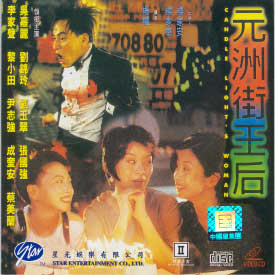
Reviewed by YTSL
If this movie were made by other than Hong Kongers,
I could imagine the hue and cry that might greet public screenings of it.
This is not so much because it's a bad(ly made) film but, rather, that its
portrait of Hong Kong is one which is incredibly grim -- so much so that
this (re)viewer has doubts of it being truly realistic (Otherwise, everyone
living in that territory would be horribly emotionally and/or physically
scarred by the time they reached adulthood, if they managed to survive past
their teen years. Or they are superhumans who can endure much more
mental and physical abuse than the great majority of us). Then there
is the matter-of-fact as well as emphatic assertion that 2/3s of Hong Kong
men avail themselves of the services of prostitutes (with the unspoken suggestion
seeming to be that much of the remaining 1/3 don't do so because they possess
mistresses).
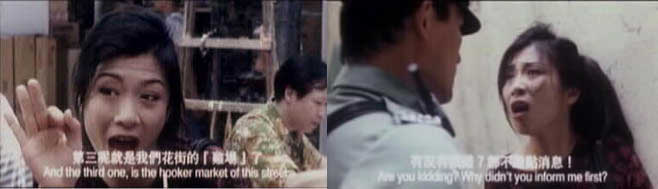
To be sure, it's not as though there are no nice and "good" people in CANDLELIGHT'S
WOMAN. However, their lives seem so inevitably and invariably full
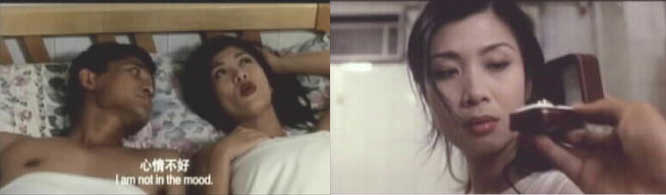
of struggle, trouble and tragedy. Take for example that of the lead
character (portrayed with characteristic professionalism by Carrie Ng): Hung
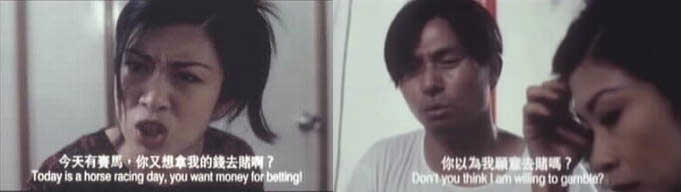
Chea, an aging prostitute with a kind heart plus a precocious and sensitive
child as well as a crippled and gambling-addicted husband (Cheung Kwok Keung
actually succeeds in making the latter character somewhat sympathetic as
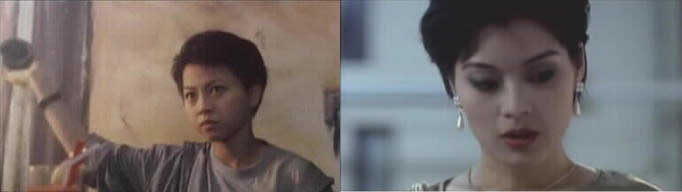
well as not entirely pathetic). Then there's her friend, Fei (played
by Jan Lau): A night club hostess whose younger sister (Rain Lau actually
seems to bear a physical resemblance to the other Lau), when we first meet
her, is a tomboyish lesbian with violent as well as -- we find out before
too long -- suicidal tendencies.
Yes, to a certain extent, CANDLELIGHT'S WOMAN is yet another melodramatic
call girl movie (of which Hong Kong cinema really does seem to have produced
quite a few!). Still, while it bears some similarities to such as "Call
Girl 92" (and the 1999 "Night Club" seems to have taken some themes from
this 1995 work), it still possesses sections and themes that could be said
to be unique. The divulgence of at least one of these would act as
a major spoiler (Hence my decision to not go near those portions of this
production!). However, it seems safe enough to disclose that one of
the film's sub-plots involves the kind of reporter (played by Lee Ka-sing)
who seeks sensation so much that he would be willing to play an active role
in effecting it while another adds some needed light touches to an otherwise
dark depiction of the low and budget end of the human skin trade.
As with "Girls without Tomorrow" and "Night Club", CANDLELIGHT'S WOMAN's
gritty call girl world is one in which the Triads have their dirty fingers
in. And like those other prostitute dramas, those members of the Chinese
equivalent of the Mafia to be found here are not the kind of (generally)
honorable rascals that populate such as "Portland Street Blues" and the "Young
and Dangerous" series from which that Sandra Ng vehicle spun off. Instead,
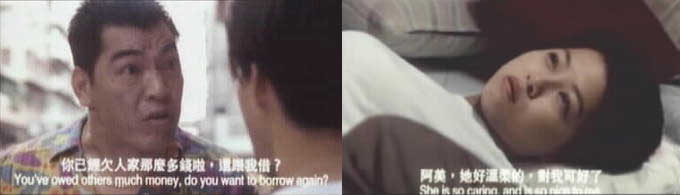
they are oafs, bullies and abusers (chief of whom is a character menacingly
portrayed by Shing Fui-On), about whom Hung Chea says at one point in the
film: "They are not only playing with us. They are pushing us
to dead end".
With such elements in place, it is but a foregone conclusion that there will
be conflicts and clashes between the "good" working women -- and their friends;
who include a policeman in love with Hung Chea (portrayed by Wan Chi Keung)
and a foodstall owner who has strong feelings for Fei -- and the "bad" men.
Similarly, the ending of CANDLELIGHT'S WOMAN might not come as too much of
a surprise for many. Still, I am wagering that the viewer will care
for individual characters (notably that of Carrie Ng's Hung Chea, who seems
to like eating red bean pudding as much as Anita Yuen's "C'est la Vie, Mon
Cheri" character), and that some of their fates are less predictable than
others.
My rating for the film: 7.