Kitchen

Reviewed by YTSL
A central character whose first words only get
heard after we have gone some 27 minutes into the film (Aggie, a Hong Kong
woman, is played by Japanese actress, Yasuko Tomita). A flamboyantly
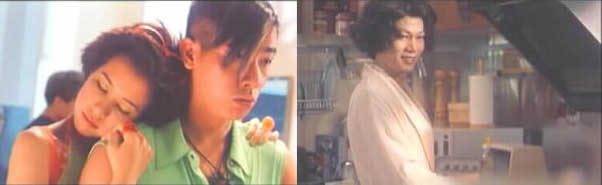
dressed and idiosyncratically coifed hairdresser who looks to fit the stereotypical
image of a gay man but likes -- in sexual as well as other ways -- women (Jordan
Chan is delightful as Louie). A loving club hostess mother who turns
out to have previously been a father (Law Kar Ying's portrayal of Emma earned
him a Hong Kong Film Award best supporting actor nomination). These
descriptions of its key personae alone should establish that bundles of contradictions
abound in this cinematic adaptation by respected director and scriptwriter
Yim Ho from a novel by a popular Japanese writer named -- rather appropriately,
considering the food themes throughout the work -- Banana Yoshimoto.

This is all the more so with my view of this quirk-laden contemplative piece
as an often simultaneously sparse, sensual and spiritual offering.
Right from the beginning, when the screen is filled with beautiful blue moving
water -- out of which shallow depths a face gradually emerges -- and the
first measured notes of its haunting instrumental theme flood the air waves.
Up until its similar, yet not identical, end images and sounds. And
in between, when KITCHEN slowly and subtly but surely reveals its often simple
sounding -- yet never banal nor stupid -- messages; which are sandwiched
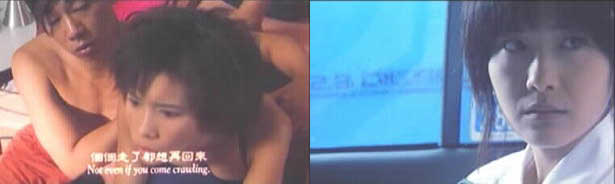
by short, sharp, dramatic bursts of action and pulsating energy (a significant
portion of which surface whenever Karen Mok, in a supporting but very eye-catching
role as Louie's sometime model girlfriend, Jenny, appears in the movie).
To state the obvious: KITCHEN is not a typical movie, on many counts.
A(nother) case in point: Though one might expect it from its title,
this domestic drama -- which has as its heart the meeting and coming together
of people who understand and honestly care for one another -- doesn't showcase
culinary skills and pleasurable eating in the manner of "The Chinese Feast",
"Eat, Drink, Man, Woman" and "Babette's Feast" (In fact, there's actually
more of that -- along with, of course, fight action -- in "Iron Monkey" than
in this film!). Although they are not necessarily oppositional, what
gets emphasized more is nourishment for continued living -- whose source
is not always, but can be derived, from the preparing and sharing of food
-- rather than hedonistic indulgence or celebratory consumption.
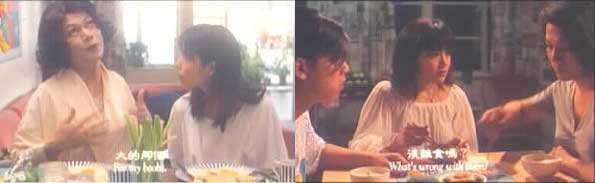
I think it also worth noting that the principal characters in this visually
stunning work (whose cinematographer, Poon Hang Sang, also lensed "Peking
Opera Blues", "Centre-Stage" and "Red Dust") focus more on the sense of smell
and touch than that of taste (and -- despite the film's being suffused with
incredibly evocative music -- sounds). Then there's their favoring
of the kitchen as space in which to hang out and exchange confidences --
even sleep (if you think this is weird, howzabout Aggie's choosing to sleep
INSIDE a refrigerator at one stage in the movie?!) -- rather than just cook.
There is no denying that KITCHEN demands a lot from its viewers (including
a tolerance of eccentricities and patience for unhurried unfoldings -- the
second of which is NOT my strong suit -- as well as time plus attention).
Neither will this approximately 2 hour long piece be to everyone's taste
(But then, I don't think it was meant to be). This is not least because
this life affirming film -- despite its starting off with a death of a loved
one; an event which sent sensitive Aggie into an extended period of immobilizing
depression as well as mourning -- is such an incredible mix of things that
it can appear to be the cinematic equivalent of an unbalanced as well as
heavy smorgasbord.

However, I am inclined to think of it as more like an inviting as well as
delicate and clean(sing) plate of combination sashimi (complete with fiery
wasabi). As such, my personal experience of this ultimately quietly
optimistic -- even if at times almost overwhelmingly melancholic feeling
-- as well as clear-eyed production is that it does give plenty of food for
thought (there may well be more meaningful advice and observations in a single
letter by Emma to Louie than can be found in many other movies), laughter-evoking
amusement and heart-warming vibes in return.
My rating for the film: 8.