Three Summers
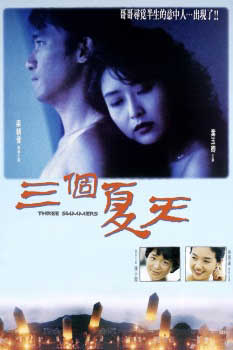
Reviewed by YTSL
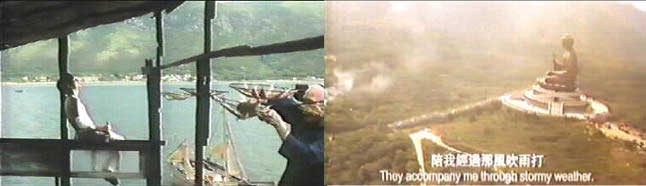
There are quite a few things that this Taiwan-Hong
Kong collaborative effort has got in its favor. Chief among them is
a very nice end sequence: Complete with an (actually completely English
subtitled) end song whose lyrics are as alternately wistful and encouraging
as its tune is lyrical; accompanied by wonderful aerial and scenic views
of largely rural Lantau Island along with a final lingering shot of the individual
who looms large in the life of the narrator. It is one which this (re)viewer
would rank up there with the best of (Hong Kong) movie endings in its ability
to evoke precisely the kind of bitter-sweet emotions that can feel so powerful
and "real".

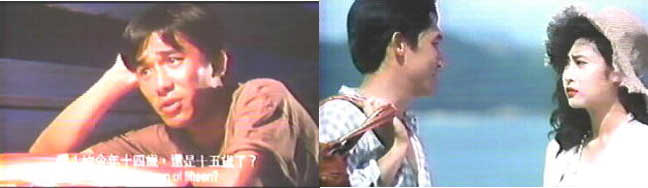
THREE SUMMERS also benefits from having major acting talents at its service.
Although sweet-faced Wu Chien-Lien and the charismatic Veronica Yip do feature
in the 100 minute length offering, I am actually referring more here to the
two people whose characters' stories are at the heart of this rural "coming
of age" drama: Debut-making and Hong Kong Film Awards Best Newcomer
nominee, Cherie Chan, an actual Lantau Island villager playing one whose
life is affected by urban folk -- including a New Zealand resident and a
man originally from the U.S.A. as well as visitors from more built up parts
of Hong Kong -- in addition to her fellow villagers; and Tony Leung Chiu
Wai, an A list actor who is immensely convincing in his role as the elder
brother who is idolized as well as loved by his younger sibling but has worries
and frustrations of his own.
In such as director Lawrence Ah Mon and executive producer Sylvia Chang,
there also are quite a few respected names in the crew list of this earnest
feeling production. This notwithstanding, my sense is that there could
have been a better script than that which has been co-credited to the director
(whose "Gangs" and "Spacked Out" make a strong case for the South African-born
man's being a most expert chronicler of Hong Kong youth), executive producer
(one of whose previous co-scriptwriting as well as on-screen efforts had
been "All About Ah Long"), Cheung Tat Ming and Bill Yip.

To be sure, Ah Mon and Co. deserve some praise for their decision to pay
attention to socially responsible people -- including an interracial couple
(referred to in the English subtitles as Mr. and Mrs. Veggie!) in charge
of an experimental environmentalist educational project whose main participants
are urban high schoolers -- who are not usually represented in (Hong Kong)
movies. It also was interesting to see points being made about time
irrevocably changing people as well as healing the emotional and physical
wounds who need to go on with their lives. However, the obviously well
intentioned script and movie could have done with some time-saving trimming
and better linkage (the film's rather disjointed feel might or might not
have been due to its focusing on events occuring over a single season of
three years). THREE SUMMERS also suffers from certain situations depicted
in it feeling too moralistic or good to ring true (though I did think that
the sections featuring the monk friend of Ah Wai were well done).
Then there were the rather hackneyed bids to introduce danger and glamour
into otherwise fairly mundane proceedings by way of having people be involved
in love triangles -- or, in Wu Chien Lien's Flora's case, a love quadrangle
-- and a key individual's crossing the paths of Triads while in the city
(Trivia note: Paul Fonoroff reported that the Hong Kong title for the
film had been changed to highlight this secondary element even while the
Taiwanese stuck with the Chinese version of THREE SUMMERS). Still,
those who thrill at the prospect of seeing Veronica Yip and Tony Leung Chiu
Wai in a love scene that came about from that venture might not complain
too much about this!

Fans of the sultry actress ought to be warned though that she is more a guest
star than major player in this message- and issue-oriented movie. Similarly,
Wu admirers should note that the Taiwanese beauty really doesn't get that
much opportunity to shine in THREE SUMMERS. Rather, Lantau Island is
highlighted more: With life there forming a great part of the main
story rather than just the backdrop; and the scenes of Tai O village elders
gossiping while playing mahjong, children flying kites by the pier, a dragon
boat race and the transportation of a religious statue to a new home being
as lovingly filmed as either Wu's famous face or Yip's infamous body.
For these and other reasons, my sense is that this 1992 work is not going
to appeal to that many (overseas) Hong Kong movie fans. However those
looking for a change of pace and scenery could do worse than to check out
this rather atypical offering.
My rating for the film: 6.5