Duel to the Death
Reviewed by YTSL
When one thinks of Hong Kong action films, John
Woo, Ringo Lam, Jackie Chan and Sammo Hung (the latter two as (action) directors
as well as actors) appear to be the primary individuals who come into many
people's minds. With regard to visionary auteurs who work in the former
British colony, Tsui Hark and Wong Kar Wai are the names with which people
tend to lead off. IMHO, Ching Siu-Tung deserves a place in both those
pantheons. After all, he not only was the action choreographer and
director for such as "The Killer", "A Better Tomorrow II", "City Hunter",
"Moon Warriors" and "Peking Opera Blues" but also the credited director of
"A Chinese Ghost Story" I to III, "Dr Wai in "The Scripture with No
Words"", "Swordsman II", "Swordsman III: The East is Red" and "Terracotta
Warrior" (starring Zhang Yimou alongside Gong Li!) as well as the co-director
of the cult favorites that are "The Heroic Trio" and "Executioners".
N.B. I don't think I can emphasize enough what an impressive -- not just
extensive -- body of work this is.
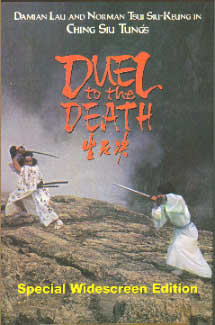
DUEL TO THE DEATH was Ching Siu-Tung's first directorial
effort. To be sure, there are some parts of this 1982 effort which
clearly point to its coming out -- probably even being part -- of the kungfu
movie tradition which still is often identified as characteristically Hong
Kong by many Western movie theatre goers (even though few, if any, kungfu
films have been made for a while now from that East Asian "dream factory").
Viewed positively, I mean that this debut work by the son of a director of
kungfu films contains multiple, extended, elaborate and technically correct
(even if wire-enhanced) martial arts sequences. Viewed negatively (in
the eyes of those who watch movies for more than just action, however good),
its plot is not all that imaginative and the standard of acting not all that
commendable (Flora Cheung, whose character has a not insignificant part in
(influencing) the proceedings, was the least charismatic of this movie's
cast).

Up until this (re)viewer watched DUEL TO THE DEATH, it had been years --
decades even -- since I had sat through and entirely viewed an "old" (by
Hong Kong standards) kungfu movie (I hardly think that the badly English
dubbed atrocity called "Drunken Fist Boxing" counts; a measure of how awful
it was is that the only part of its viewing experience that made me happy
was that I didn't have to pay anything to do so). Yet so much felt
familiar: Not least a tale of champion martial artists meeting to fight
on behalf, and for the honor of, their respective communities -- in this
case, China (and the Shaolin Temple) and Japan (plus a particular clan within
it) -- in a bonafide contest (at a location known as Sword Saint village!)
ending up being embroiled in a web of deception, betrayal, dishonor, death,
revenge and sacrifice; hence their having to not just duel to the death once
but also be involved in quite a few other skirmishes.

In action terms alone, the last fight -- which takes place at a scenic locale,
on top of not completely solid cliffs which are periodically sprayed by ocean
water and engulfed in mist -- is truly well done (and memorably seriously
violent). Even this non-expert viewer and practitioner of martial arts
could clearly discern the different fighting styles and stances of a Japanese
samurai and a Shaolin trained Chinese swordsman (Although it surely was unintentional,
but no doubt because Norman Chu was very convincing as a proud Japanese lord
while Damian Lau was weaker as a humanity-tinged individual trained by Buddhist
monks to kill, I found myself sympathizing more with the former
than the latter).
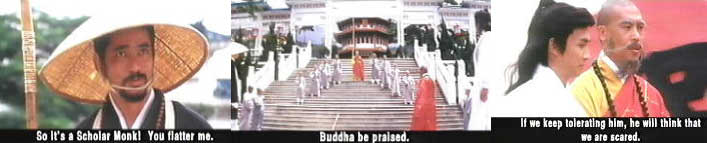
What really stands -- nay, leaps! -- out though are the amazing scenes involving
ninjas which are so incredibly imaginative as to be an Eastern aesthetic
equivalent of the unusual but fitting combination of extravagant rococo and
strange surrealism. Howard Hampton (whose writing on Brigitte Lin,
Tsui Hark and Ching Siu-Tung I admire so)has described Ching as possessing
"sheer visual flamboyance" and lauded DUEL TO THE DEATH as "quite terrific"
and being "at once detached and grandly unhinged". To my mind, these
words especially apply to the various encounters between sets of master illusionists
as well as stealth fighters and individual expert martial artists travelling
to Sword Saint Village to witness what they think will be an epic contest.

I sincerely hope it does not come across as patronizing when I write that
I honestly didn't think that Ching Siu-Tung's vision could be so well realized
a decade before the creation of such as "Swordsman II", "The East is Red"
(generally uneven but often outdoing even "Swordsman II" in its amount of
surprises and stunning moments), "Butterfly and Sword" and "Moon Warriors".
It surely represents a tribute to suggest that some of the magical
action scenes in "Duel to the Death" bear comparison
with as well as might be said to be precursors of those found in the above
mentioned fantasy swordplay dramas. Although it will not matter to
some viewers, I must admit though to preferring many of the later “wuxia"
works over this martial offering; in large part because they are so much
less decisively heroic and harshly macho
in tone along with benefiting from better actors -- albeit (often) less skilled
weapon handlers -- in key roles.

My rating for this film: 7.5.