Legend of the Mountain
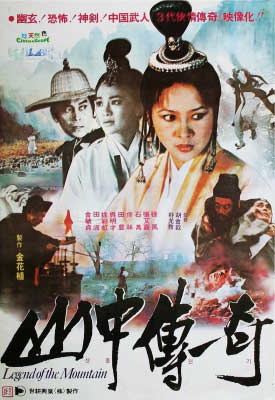
Director: King Hu
Year: 1979
Rating: 6.0
Though his output
over a thirty-year career was very small, there is little doubt that King
Hu was one of the greatest and most influential directors of our time. He
has unfortunately not gained the recognition that he deserves – due possibly
to his sporadic output, the difficulty today of seeing quality transfers
of his films and also possibly the subject matter and themes that he dealt
with. Hu was fascinated with Chinese history, culture and myth and his films
reflected this. In films such as Come Drink with Me, Dragon Inn, A Touch
of Zen and The Fate of Lee Khan, Hu reinvented the wuxia and the martial
arts genres. Hu also gave women very strong roles in his films – showing
them to be as fierce and courageous if not more so than any man is. Cheng
Pei Pei, Hsu Feng and Polly Shang Kwan all flowered under Hu’s tutelage.
The Legend of the Mountain was made a few
years after Hu’s classic films and he seems to be somewhat adrift in this
supernatural tale of ghosts. His painterly eye is still intact and there are
some beautiful shots of landscapes and authentic detailed looking sets, but
his usual dynamic narrative drive is very much missing in this film. Hu seems
much too willing to take his time, gets caught up with the cinematography
at times to the detriment of the story and the film almost takes on the rambling
pace of a shaggy dog story. It is well over an hour into this 115-minute
film before it finally starts coming together and something concrete begins
to happen. Until then Hu spends the time filling the screen with atmosphere
and hints of evil, but a good trimming was needed here.
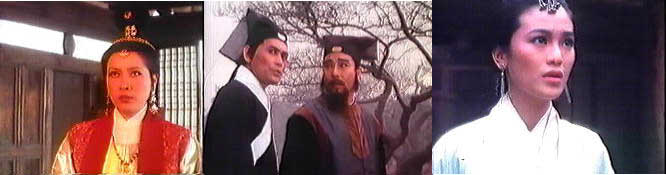
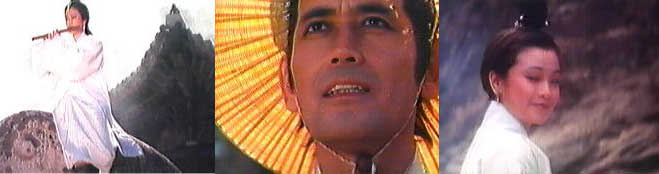
Ho is assigned by a Buddhist temple to transcribe some of the Sutras and
he goes off to a secluded part of the country where he will have peace and
quiet and be able to concentrate on his work. On his way, Ho starts seeing
strange visions of a girl playing a flute – but she always disappears before
his eyes. Is it a mirage or something more? Ho is greeted by his host Tsui
who tells him that the reason that so few people are about is that most of
the populace has died in various wars.
Ho is also introduced to Tsui’s daughter,
Hsu Feng, who initially appears to be a gentle and traditional woman – but
there is something behind her eyes that contradicts this image. The mute
servant keeps frantically trying to signal Ho that something is wrong and
a Taoist priest is constantly keeping watch on the family. One evening Ho
gets drunk and in the morning an abashed Hsu Feng hints to him that they
spent the night in bed. Ho then feels it is his duty to marry her. All seems
fine, but Ho has a sense of uneasiness that he simply can’t put his finger
on. Hsu quietly urges him to finish his work.
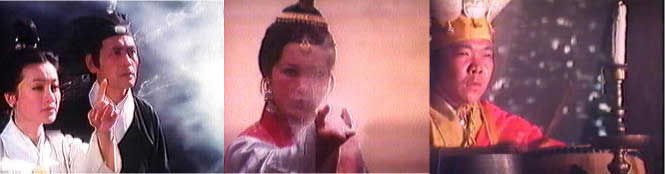
While walking one day Ho runs into Sylvia Chang and the two of them begin
a friendship – but she too has a mysterious aura around her. She tries to
warn him of something but is unable to. Hsu Feng becomes jealous of this friendship
and things finally start coming to a head. It soon becomes clear that Ho
has entered a land full of ghosts – some good – some evil and that his sutras
when completed will allow them to reincarnate.
One of the weaknesses of this film is the character of Ho. He simply seems
so lost and so naïve that you have to wonder if he was born yesterday.
The actor who portrays him gives him no sense of heroism, but instead he comes
off as a victim that only reacts to what goes on about him. As is often the
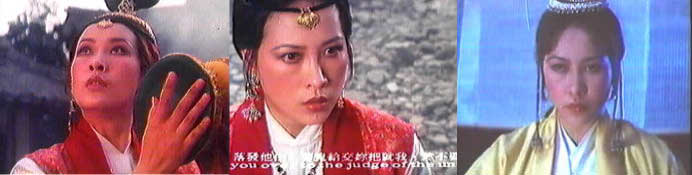
case, Hu gives the good roles to the two actresses. Hsu Feng in particular
is excellent as a ghost desperately needing to be reincarnated and willing
to do anything to accomplish this. A very young Sylvia Chang is quite lovely
and endearing in her role.
After this film Hu was only to make a few more films – none of them approaching
the genius of his earlier work – but his legendary status was already set
and his influence on the directors of the 1980’s such as Tsui Hark and Ching
Siu-Tung was soon to take place.