God of Cookery
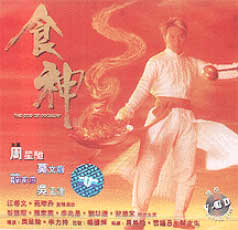
Reviewed by YTSL
In the Hong Kong movie world, Wong Kar Wai is
infamous for working without (much of) a script. However, it is the
industry's comedies -- notably those which feature Stephen Chow (as a director
as well as actor) -- that tend to feel to me like they were being made up
and cobbled together in the most impromptu of ways. This is in large
part because they sometimes do seek to bring together as well as draw upon
so many disparate elements (In the case of this particular film, they include:
Culinary practices, innovations and competitions; turf battles; street brawls;
Shaolin monks and kungfu; and divine interventions) in an apparent all-out,
frenetic bid to induce mirth on the part of their audience. One not
uncommon result of this is a definite unevenness of tone within a single
film. Another is the upping of the "hit" or "miss" quality, quotient
and effect (so that one either likes the product or just is too befuddled
-- not just frustrated or disappointed -- by it to generally appreciate it).
This is not to say that there's no detectable
basic plot line to be found. For example, GOD OF COOKERY's story could
be somewhat easily summed up in terms of: A master chef (played by
Stephen Chow) being too big for his boots; getting his comeuppance; finding
salvation in humble surroundings and with the help of a woman (Chow may be
its center of attention but Karen Mok is the emotional heart of this film);
and returning to reclaim his place in the culinary pantheon. Where
the surprises and delights lie though is in how he gets from point to point,
and what happens, on his effective journey of learning and discovery about
himself, other people, what (and who) ought to be cherished and eschewed in
life.
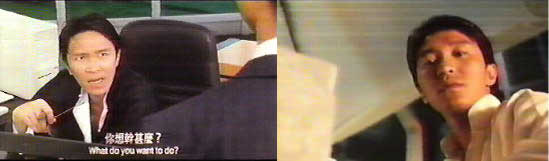
One of the more incredible achievements for me re GOD OF COOKERY is how much
topical ground it covers and range of emotions it encompasses without any
of it seeming to be too out of place. Though indisputably primarily
a comedy, this film (which has Ng Man Tat and Vincent Kok as the villains
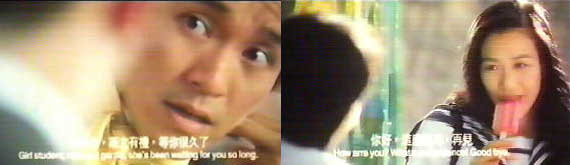
of the piece; and features a cameo appearance by Christy Chung) really does
contain certain rather instructive as well as touching moments (the latter
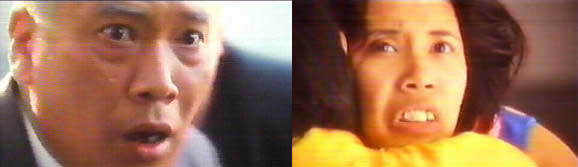
of which is largely provided by Karen Mok in her role as a disfigured street
vendor named -- I kid you not -- "Sister Turkey") and even a particular political
stance.
With regards to the last element: Perhaps one really is guilty of over-analyzing
a primarily comic movie when one finds significance in -- Mad Cow disease
notwithstanding -- British beef being the cause of a Hong Konger's downfall,
and a traditional Mainland Chinese institution as well as humbler members
of the local materialistic society being aids for his overall -- not just
spiritual -- rejuvenation. Alternatively, it will be argued that satire
and mockery of dominant institutions can be as great inducers of laughter
as -- or especially when combined with -- low brow physical humor and outright
farce (N.B. Even though the Shaolin temple is clearly established in this
film as a "good" place, the sequences that take place in it most definitely
include irreverent -- even lewd! -- as well as incredibly choice bits!).
Someone I know has criticized Hong Kong movies as -- among other things --
"preachy". I must admit that he may have a point here: In that
even in such as Jackie Chan actioneers, some of the most outlandish "wuxia"
fantasies and this "mo lei tau" showcase (Stephen Chow's trademark brand
of comedy has been described as "constrained by neither logic nor reality"
as well as translated as ""no-brain" or "non sequitur"" by Stefan Hammond
and Mike Wilkins in their ""Sex and Zen" & "A Bullet in the Head"" book),
certain moralistic elements are fairly prominent. The genius of a good
bulk of these works though is that they highly entertain and honestly enthrall
but also effectively socio-culturally comment and thought-provoke.
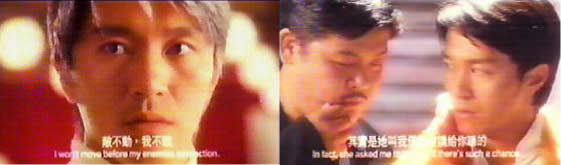
A large part of what makes Stephen Chow Hong Kong's box office king (in the
banner year that was 1992, three of his movies were in the top five of cinematic
money makers; seven years later, his "King of Comedy" -- rather than, say,
Jackie Chan's "Gorgeous" -- was Hong Kong's highest earning local film) may
well be his truly remarkable ability to look so winningly earnest and humble(d)
as well as appropriately mean and supercilious. Put another way:
He can make people care and laugh with as well as at the characters he brings
to life. Relatedly, IMHO, this star performer's better movies are filled
with dramatic and illuminating content as well as full of downright fun(ny)
moments. THE GOD OF COOKERY is one of these. How could it not
when it contains amazingly satisfying -- and truly creatively realized --
scenes involving the astounding effects of such featured dishes as the well-named
ecstacy-inducing "Pissing Beef and Shrimp Balls" and the love-inspired but
regret-inducing "Sorrowful Rice"?!
My rating for this film: 8.5.