Dreadnaught
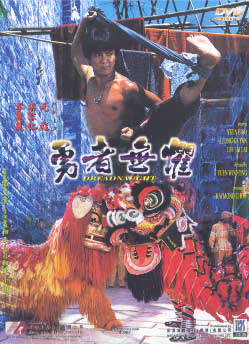
Reviewed by James Chang
Bravo! This production from Yuen Woo Ping
may well be thus far his best film and greatest masterpiece. The breathtaking
action scenes, the exceptional (nearly perfect) cast, the entertaining story
- every single element of a mainstream entertainment film is here under the
direction of Yuen. It is arguably much better than The Drunken Master (1978)
and The Magnificent Butcher (1979).
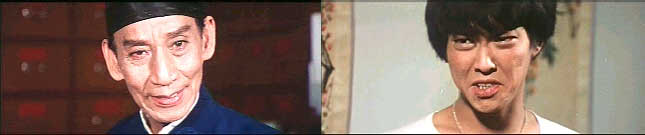
It is the story of Wong Fei Hung (1847-1924), a legendary martial artist
and militia leader of modern Canton, who participated in the Sino-French War
(1884-1885) and the Sino-Japanese War (1894-1895). In local Cantonese folklore,
Wong was depicted as a chivalrous hero and in real life he was a master,
a rightist, a man of honour and a man of integrity. This is why many local
film viewers consider the late Kwan Tak Hing as the perfect candidate for
such a role. Kwan, an elderly gentleman himself, was good-hearted, conservative
and righteous and some people have compared him to John Wayne.
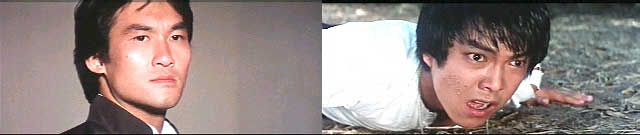
It is a simple story, about the adventures of Mousie (played impeccably
by Yuen Biao), who is chased after by a cruel, maniacal bandit (Yuen Shun-yi).
This bandit is being used by a local scoundrel (Philip Ko) to fight against
Wong Fei Hung, his top enemy. In order to save his own life, Mousie begs Leung
Foon, Wong ' s top pupil (played by Leung Kar Yan) to introduce him to Master
Wong and have him learn martial arts. In the end though it is up to Mousie
who knows nothing but washing clothes to protect the injured old master (Kwan
was 75 at the time) from being killed.
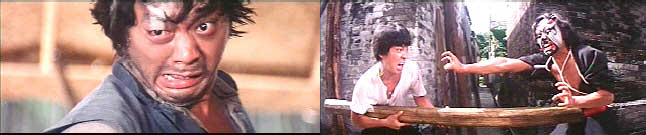
The action scenes are simply astonishing (I would even say flawless). Look
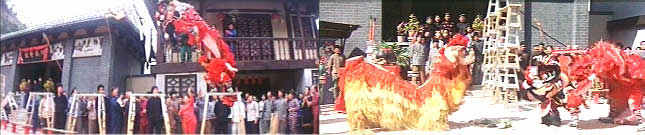
at the Lion Dance and how authentic it is! First we have the Southern Lion*
exquisitely dancing above loosely balanced storys of 'golden' and 'silver
benches', making use of the principle of lever, then we have the Northern
Lion* played by our equally tactful villains who use steel claws and fire
to assault their enemies. It is much better than the similar scenes in OUTIC
III that even showed Southern Lions being utilized in Beijing! The scene in
which Wong Fei Hung uses fire to heal his patient was also a treat to watch.
It will leave the viewers' mouths wide open by showing them how limber a
75 year-old man can be.
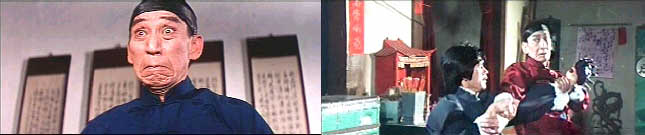
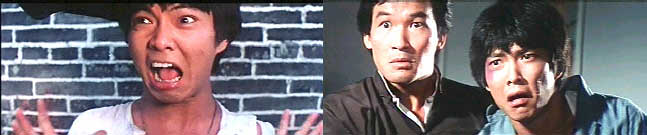
Yuen Biao and Leung Kar Yan, who are buddies, play the main characters.
Leung was surprisingly good in playing a rather comedic character who always
convinces Yuen to do stupid things --- such as telling him how to chase after
a girl by pretending to be Wong Fei Hung! Veteran actor Fan Mei Sheng is
also terrific in playing a rough version of Detective Clouseau in the Pink
Panther (look for Yuen Cheung-yan as one of his men). At the other end, the
serial killer whose name was White Tiger was extremely cruel and terrifying,
exuding a sense of unlimited strength.
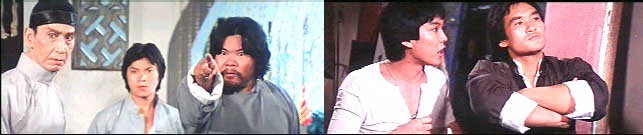
Though Kwan only has a few scenes, he is the spirit of the movie. Besides
the healing scene, his intricate and subtle fight with the ' Demon Tailor
' (Fung Hak On) was also exhilarating. He also shows a sense of kindness
and humour later on. Yuen Biao was also quite appealing as Mousie, a timid
young man who is afraid of everything. It seems that he knows nothing about
kung fu, however, the skills he uses to wash clothes for his sister (Lily
Li) were the essentials of the finger fight.
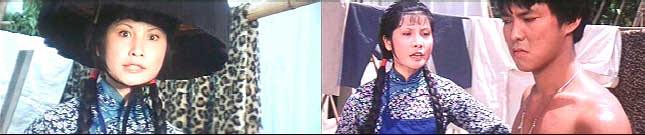
The image of the killer comes from traditional Chinese opera, however it
is also influenced by Western movies like Phantom of the Opera. The final
duel between Yuen and the masked maniac was also in a darkened theatre as
is the one between the masked maniac and Leung Kar Yan. In the final climax,
Yuen uses his cloth-washing technique to overcome the strange stances of flying
sleeves and the changing masks of the killer. The choreography is brilliant,
though many may consider the ending to be too violent and bloody. I personally
agree that this may spoil the comedic nature of this kung fu comedy.
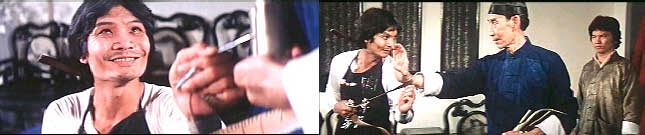
Kwan, Jackie and Jet as different Wong Fei Hungs
When there are different actors playing the
same character, people start to debate, arguing who's the best and who's
the worst candidate, etc. In our case, this is not necessary at all. The
Wong Fei Hung played by Kwan Tak Hing, Jackie Chan and Jet Li were not the
same person ---- they showed different personalities and this difference
in personalities represent the different attitude towards life of Hong Kongers
in the 50s, 70s and 90s.
First of all, let's look at Kwan Tak Hing
first. Kwan 's portrayal is most loyal to the character of the real Wong Fei
Hung. Both of them belonged to the landed upper class in China before the
Communist revolution. They were among the conservatives who were beneficiaries
of Qing and British rule. Middle-aged men at the zenith of their physical
and mental strength, they also represent the traditional Confucian values
which permeated every aspect of Chinese life half-a-century ago. Being the
symbols of the status quo of their day, they resisted all possible reforms
and revolutions, be it gender, economic, or political. Ironically, their philanthropic
acts, rendered possible by their economic status, allowed them to reinforce
their patriarchal image, thus boosting the public’s faith in the shattering
social order.”
Such a portrayal justly represents the social customs and common practice
of Hong Kong people in the 50s. Most of them came from China and had received
a traditional Confucian education that emphasized the importance of feudal
order. This is why Kwan Tak Hing exudes a NATURAL sense of DIGNITY. He is
the protector of traditional order, besides, being a member of the Chinese
gentry, he also practises calligraphy and ink painting.
What about Jackie Chan? His Wong Fei Hung
is definitely NOT a hero, but a boy, an ordinary boy. A REBELLIOUS youth in
nature. After all, every hero has to come across all sorts of difficulties
before becoming a hero. No one is perfect by nature and Jackie has to be
polished before becoming 'almighty' like Kwan's depiction of Wong. This stage
of training is important and Jackie Chan showed us how tough it can be. The
training shown in Drunken Master also reflects Jackie 's childhood --- a
childhood full of tears and sweat. In the 70s, when the economy of HK started
to bloom, movies which showed how hard one needed to work and its compensating
fruitful rewards was always endorsed by the crowds, as most of them were
facing similar strife.
Now, let's come to Jet Li. Is his Wong Fei Hung a hero? Well, he seems to
be, at least to many viewers, however to me he is an ANTI-HERO. From the beginning
to the end, he never enjoyed any real success. As he himself has stated in
OUTIC III, “ I 've won an imperial souvenir, when we have all lost our country.”
Neither had he won any real battle. The 'gweilos' were still in China, suppressing
local industries. The White Lotus sect’s (actually, Tsui Hark mistook the
Boxers as the White Lotus sect) leaders were killed by foreign armies in
1900 ****, not by Wong. The Manchus? Killing one officer is not enough (especially
when he belonged to the ' old army ' *****).
Besides, please take a note of Wong 's character.
Unlike Kwan's portrayal, he is not humorous at all, sometimes losing his
temper. Unlike Kwan's depiction, this Wong Fei Hung can get frustrated. He
was always under TENSION, lacking the suaveness and gentleness of the ideal
image of a traditional gentleman.
These are all signs of an anti-hero. But
why anti-hero? This reflects the psychology of pre-1997 Hong Kong population.
After the massacre in 1989, they were greatly shocked and terrified. They
were frustrated and did not know where the future was taking them. To them,
1997 was the end of days. Thus, Wong Fei Hung was portrayed as a man standing
at a crossroad. Besides, after 150 years of colonial education, Hong Kongers
had very complicated sentiments towards China and Britain and this was also
shown in the OUTIC series.
Finally, I would like to point out that Kwan
Tak Hing represents Canton culture while Jackie and Jet both represent mainland
culture.
My rating for this film: 8.5
*Southern Lions were huge puppets of
lions which are played during Chinese New Year in Canton, while Northern
Lions are played in the northern provinces of China, so it is impossible
for Wong to play southern lion in Beijing, as Cantonese culture was always
considered as a subculture 100 years ago.
**Wong was a Mandarin and Kwan was
awarded Member of the Order of the British Empire ( MBE ) in 1983.
***The real Wong Fei Hung in history
was an anti-revolutionist and helped the Ching Dynasty. Later he was expelled
by Dr. Sun in the 20s.
****In 1900, Russia, Britain, USA,
Japan, Germany, Italy, Austria-Hungary and France organized an expedition
force to invade China, to 'rescue Westerners who were under the threats of
the Boxers'. Actually, these civilized people slew approximately 3000 to
10000 Chinese civilians.
*****The officer played by Donnie Yen
in OUTIC II belonged to the old army --- an army that was not reorganized
in Western ways. From 1861 to 1911, 71% of the Chinese army was westernized
and 4 modern fleets were formed. However, there were still armies which were
not yet westernized, who kept on using primitive weaponry and were under
extremely poor discipline, these were known as old armies.