Pedicab Driver
Reviewed by James Chang
A long, long time ago, I watched a courtroom drama
called " Twelve Angry Men " and now I think it is very appropriate to regard
Sammo Hung as " one angry man ". He was obviously enraged by the hard time
he had to face in the late 80s and as a result he wrote, directed and produced
this multi-layered and well-structured melodrama. This is a film where you
can find the ROOTS of Sammo. Laughter and tears, anger and tenderness, romance
and vengeance, along with brilliant action sequences - all weaved into an
impeccable texture. It revived the tradition of humanity of the 1950s Cantonese
cinema and it has shown us how capable Sammo Hung can be as a director.
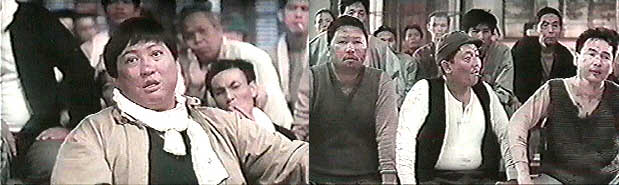
In the early 80’s Sammo's films were once down-to-earth, honest and righteous
(The Prodigal Son, for example). However, after they had garnered fame and
fortune in the world of cinema, Sammo and his friends were overwhelmed by
a sense of vanity. Their films started to become lowbrow and vulgar, look
at the Lucky Stars series and you know what I mean. Never mind, after the
poor box office results in 1987 *, we have our "original" Sammo, the hard-working
good man back on the screen. He had made a u-turn.
The film was set in the 50s and Sammo, along with
his buddies Max Mok, Lowell Lo and Meng Hoi, were pedicab drivers ** in the
tiny port of Macau, a dingy place ruled by corrupt Portuguese*** bureaucrats
and ruthless gangsters. Life was hard and they had to sweat blood for their
bread and butter. Nevertheless, they were easily satisfied - all they wanted
was a decent home for them to dwell in with their loved ones and enough food
for their offspring. It's just like the environment where Sammo was brought
up! He is so familiar with the lives of the poorest proletariat since
he WAS one of them. Now I can see why he felt most comfortable in kung fu
films set in the early 20th century --- it is a place where everyone had
to strive hard for what they deserve.
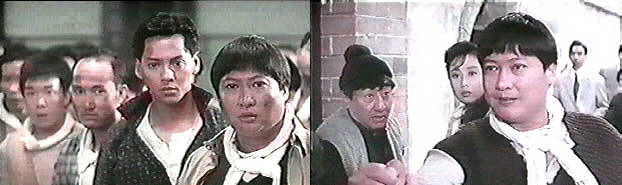
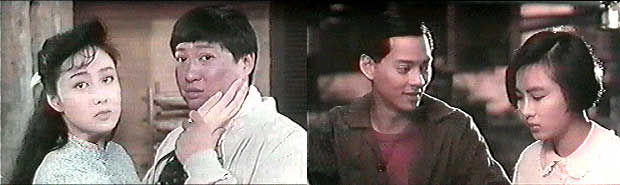
He meets Ping (Nina Li), an apprentice of an experienced old baker who grumbles
all day long (Sun Yueh). They fall for each other and the love triangle including
the poor old man (Sun ) is exhilarating. The subtle performance of Nina Li
exudes tenderness and love and her appearance, unlike in many other films,
was simple and plain.
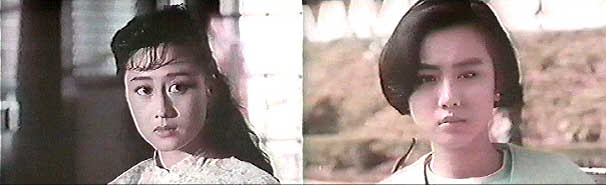
On the other hand, Max Mok, a rather romantic
labourer who loved classical literature, found himself in love with a delicate,
almost fragile Fennie Yuen. She was to him (to me as well) as pure as a lily.
After it was discovered that she was a prostitute, his heart was broken.
Their love story was not a plain one, and both of them had to go through
many agonies before they could stay together - for only one night.
The establishment and protection of FAMILY is the theme of this masterpiece.
Look at Meng Hoi, who always puts his wife and kids first, who never participates
in a single fight for most part of the movie. He (not Sammo) is the ideal
character in the entire story. In Chinese philosophy, family is the basic
unit of a society, of a civilization. Everything starts with the family,
so (according to Sammo, a traditional Chinese man) you've got to be married
first. The character of Sammo was young and vigorous, and he could risk his
life dueling with Lau Kar Leung (the most intricate pole fight in film history)
just to protect his loved one (Nina Li). After the disclosure of Fennie's
real identity, everyone including Sammo sneers at her. And Max was extremely
depressed till he heard the words of Nina Li and Lam Ching Ying, " No woman
wishes to sell their own flesh and soul, it is the lusts and desires of men
which make them prostitutes." The director condemned Lowell Lo, who
has no respect for any woman and has no intention to form a family. One can
clearly see the relations between family crisis and sexual discrimination.
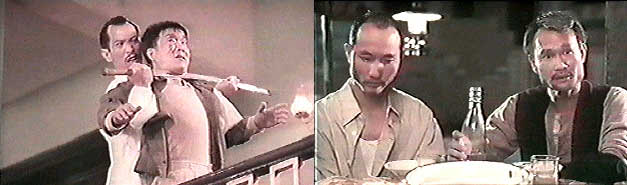
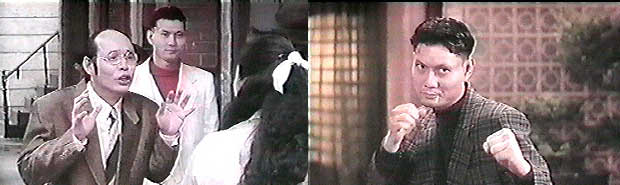
Finally, we have John Sham and Billy Chow as the demons. To me, the climax
was not the final duel between Sammo and Billy, it was the moment when Meng
Hoi's wife shouted ,"Go and seek revenge ! You need not worry about us!"
She was ready to sacrifice her own family to prevent hundreds of families
from being torn apart (John was a maniacal pimp.)
This is not merely a movie. This is life. It is only in life where we have
ups and downs. It is only in life where we have to face crossroads and obstacles.
Look at Sammo, he must face the evil side represented by John before he could
live with Nina happily ever after. In real life, he must make a U-turn from
the vulgar contemporary action flicks he used to make in the 80s.Even the
action scenes in this film were more "real" than those in his previous lesser
efforts ---- they were supported by a strong storyline and a sense of vengeance.
In this film, I found a sense of respect for human beings that was rarely
found in average Hong Kong films.
In conclusion, I advise all readers to watch this film, if you are a kung
fu fan, you shall definitely be impressed by the breathtaking choreography.
If you are not, take it as a well-structured, well-paced melodrama. (I don't
know why, but this film reminded me of On the Waterfront)
My rating for this film 8.5
* Eastern Condors. Sammo is definitely a fine
artist, however, I could not accept him to be cast as characters that should
be played by Sean Connery or Gregory Peck. I think the vast majority of Hong
Kong people agree with me.
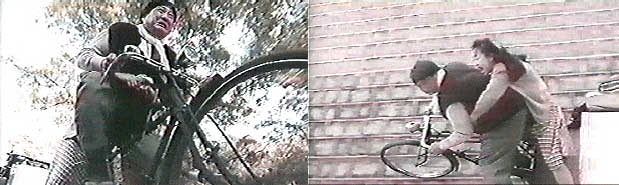
**Pedicabs were taxis pulled by human beings
--- you can see how tough is the job of a pedicab driver.
***Early Portuguese colonists obtained an imperial
decree granted by Emperor Shi T'sung (1507-1566), which allowed them to dwell
in and maintain the town of Macau --- through bribing local Chinese officials.
Originally, they wished to occupy Hong Kong by force, however, their fleet
was destroyed by the Chinese (Ming) navy in the early 16th century. As part
of the agreement, the Chinese continued to have sovereignty over Macau and
the Portuguese had to offer a large sum of money as "rent" to the Chinese
government in Canton. Thus, there are some difference between the status
of Hong Kong and Macau.
Reviewed by Brian
This was Sammo’s last great film. After
this, his long partnership with Golden Harvest was soon to come to an end
and though Sammo’s output in the 1990’s was often entertaining it was never
ground breaking or inspired. Pedicab Driver though is without a doubt one
of Sammo’s finest achievements. It does have a retrograde feeling to it –
one senses that Sammo is yearnfully returning to his kung fu heartfelt comedy
roots. This film had some success at the box office (15th) but it was overshadowed
that year by the Chow Yun Fat phenomenon (the Killer, God of Gamblers, A
Better Tomorrow III, All About Ah Long and Wild Search all did better at
the box office in 1989) that was sweeping Hong Kong. The failure of the film
to make a profit led to his separation from Golden Harvest.
In what feels like a last stand of Sammo’s old style, he pours everything
into this film and fills it with dazzling fight choreography and enjoyable
comedy – but it is primarily a dramatically sentimental tour de force. Sammo
holds his beating heart in his hand and challenges the audience to remain
unaffected. I suppose the emotion could be considered hokey – in fact it
is extremely clichéd in most respects – but it is carried so honestly
and passionately by the actors that it is impossible not to be touched by
the lives of these characters.
These characters will remain with you for
a long time. Sammo plays it perfectly as the simple and loyal pedicab driver,
Nina is as warm as the bread she bakes (watching Nina bake bread is a treat
in itself!), Meng Hoi as the loving family man who is torn between protecting
his family or fulfilling his obligations to his friends, Max Mok gives one
of his best performances as the young idealistic driver horrified to discover
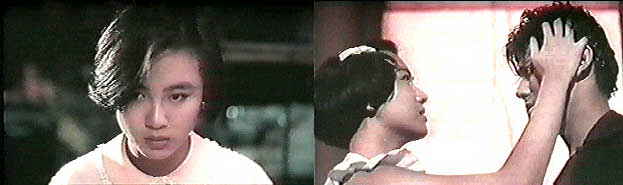
he has fallen in love with a prostitute and then there is Fennie. She gives
an emotionally riveting performance that takes her clichéd character
and smashes it into poignant pieces. If anyone can watch her sweet face crumble
into misery and despair and not feel something, they should be working for
the INS.
Though it really is the two love stories between Max and Fennie and then
between Sammo and Nina that drive the emotional core of this film – it does
of course have a fair amount of action within. And it is splendid action
– beginning with a humorous fight scene between the pedicab drivers and the
coolies. Among the coolies are Corey Yuen Kwai, Chan Lung and Billy Lau.
At one point a Star Wars parody breaks out with fluorescent lights rather
than light sabers! Eventually Sammo bumps up against the cretenous brothel
boss John Sham who wants to recruit Nina into his services. This leads to
a spectacular car/pedicab chase across Macau that has the pedicab shooting
across rooftops, swerving up narrow alleyways and driving sideways along
stonewalls. The friendly duel between casino owner Lau Kar-leung and Sammo
is pure delight – brilliantly done. There is really no reason for it plot
wise other than putting these two legends together and allowing them to perform
their unique kind of cinematic magic. Finally, there is of course the necessary
showdown between a Sammo at his angriest and the entire gang of Sham’s –
not without their own skilled fighters – Billy Chow, Chung Fat and Eddie
Maher (Yes Madam). It is brutal and powerful – only the lack of fighting
skills from Sham (and his overplayed slimy character) deprive this of being
on par with some of the more satisfying finales of Hong Kong film.
This is an enormously entertaining film – a stunning combination of action,
comedy and bullet in your heart melodrama. It is unfortunately not the easiest
film to find at this time – for whatever reason it has not been released
on either vcd or dvd but at least was once available on tape from the UK.
Hopefully this will be rectified at some point.
My rating for this film: 9.0