Flying Dragon, Leaping Tiger
Reviewed by YTSL
Saddled though it is with the sort of (English
language at least) title that led to initial rumors of it being a spoof of
“Crouching Tiger, Hidden Dragon”, that which looks to be a Hong Kong-Mainland
China -- and maybe also in small part Thai? -- co-production actually turned
out to be a serious – even if very heavily action packed -- period piece.
While the not unambitious effort -- whose choice of name plus (desert and
high country) settings seems to readily invite what would otherwise be an
undoubtedly unfair comparison between it and the winner of four Oscars along
with various other awards – surely is some ways away from being as awe-inspiringly
epic and all-round sophisticated in tone as the Ang Lee helmed wuxia work,
I nevertheless am inclined to look askance at the ethically dubious steps
taken by Harvey Weinstein to ensure that it would not get to see the light
of day in many parts of the world.
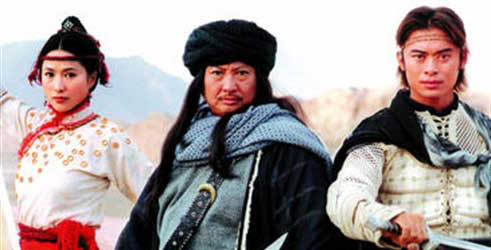
This is not least because FLYING DRAGON, LEAPING TIGER stars Hong Kong action
movie fan favorites Sammo Hung (as a legendary bandit named Luk Cheng Yeung),
Cheng Pei Pei (as his formidable estranged wife), Fan Siu Wong (who plays
an escaped detainee turned dedicated follower of Cheng Pei Pei’s Liu Ru Yuen
character) and Jade Leung (as the attractively spunky daughter of Luk and
Liu). Adding to the strong amount of promise plus interest that was
generated by the announced co-appearance of this pair of veteran and younger
talents is the happy realization that first time director Allan Lan knew
enough to provide the Golden Sun Film’s four principal cast members – and
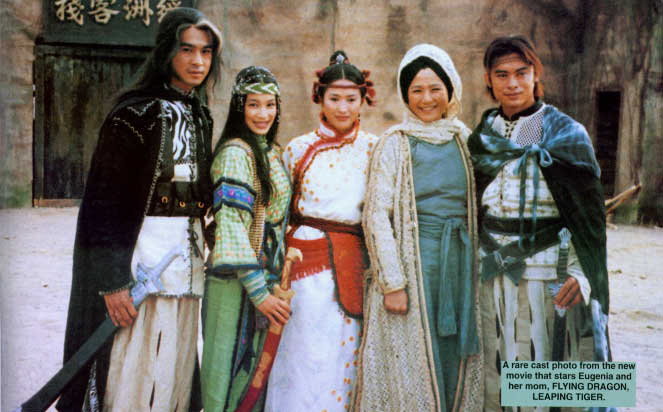
quite a few of the more capable supporting performers, among whom is this
effort’s near legendary lead actress’ real-life daughter, Eugenia Yuan –
with plenty of opportunity to impressively show off their martial artistic
moves (or, at least (especially in the case of Jade Leung), their ability
to give off the sort of fiery intensity and throw out the kind of stares
that are guaranteed to chill the bones of worshippers of feisty fighting
femmes).
FLYING DRAGON, LEAPING TIGER’s story is one that’s thematically simplistic
yet structurally convoluted. The first half hour or so of this clash
filled offering – one that gets off to a surprisingly quick start, and whose
unexpected feel was undoubtedly enhanced by my spending a few moments searching
in vain for English (never mind Chinese) subtitles to supplement the Bahasa
Malaysia ones on the 35 mm print version that I viewed (in a Malaysian cinema)
-- has Cheng Pei Pei taking center stage (as the kind of enigmatic character
who is a force to be reckoned with, even when badly wounded), then sharing
it with Fan Siu Wong (whose wide-eyed countenance helps to endow him with
an appropriate air of admirable idealism). Sammo Hung – whose assigned
hefty role is that of a man whose continued loyalty to a sworn blood brother
(Kiu Hung is essayed by Fong Ji Go), even after this individual betrays him
and seriously endangers his family by leading a troop of armed government
men to his hideout, results in his less forgiving wife deciding to separate
from him and elect to bring up their daughter on her own – doesn’t really
have to do much early on but turns out to be the pivotal personality around
whom others, and certain salient developments are revealed to, revolve around.
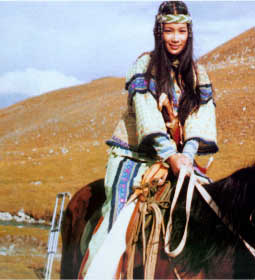
Although her character has strong links with those of Cheng Pei Pei as well
as – as it turns out -- FLYING DRAGON, LEAPING TIGER’s two main men, Jade
Leung doesn’t actually appear in the picture until well after the elder woman
permanently leaves the tragedy fraught scene. When she does so, it’s
in the wake of two equally assured young females (one of whom is portrayed
by Eugenua Yuan), who are part of what could be described as her commanding
character’s retinue. And it is a good deal prior to the proceedings
shifting to her part of the picturesque expanse of the (old) Silk Road --
that looks to have played host to the cast and crew of “Crouching Tiger,
Hidden Dragon” as well as this Lan Tien Hong production (whose Tiger and
Dragon look to be more hidden than the Columbia-Sony offering) – that the
often glowering villain of the piece (who, to the best of my knowledge, was
played by Tsiu Ke) makes his entrance and also shows his misguided revenge-seeking
hand.
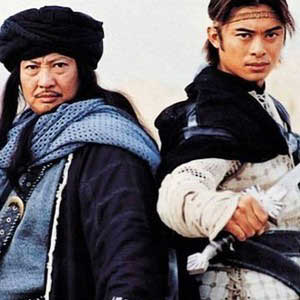
If I were to cast a critical eye over FLYING DRAGON, LEAPING TIGER, I’d have
to fault this recognizably budget-constrained production with particularly
coming up short in the editing, music, costuming and dramatic acting departments.
There also are those occasions when the film’s fight scenes – which, should
it not be already manifestly apparent, constitute the movie’s biggest plus
points – suffer from over-excessive under-cranking plus are let down by examples
of poor wire work and, more than anything else, distinctly El Cheapo looking
CGI effects. At the same time, this (re)viewer will vouchsafe that
it’s not at all like there’s nothing whatsoever in the turn of the Ming and
Qing Dynasties action work that can’t entertain, thrill and even elicit a
gasp or more from those viewers who have latterly felt starved of realistic
looking swordplay and the types of skilled martial artistic moves that fewer
and fewer contemporary Hong Kong – never mind Hollywood -- actors and actresses
appear capable of enacting.
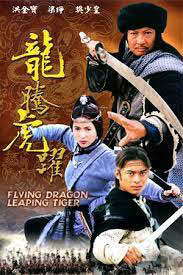
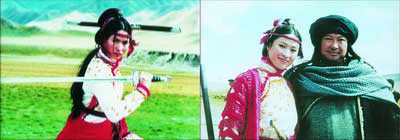
My rating for the film: 6.
(Pictures from various sources on the web + from
Femme Fatale article on Eugenia Yuan)
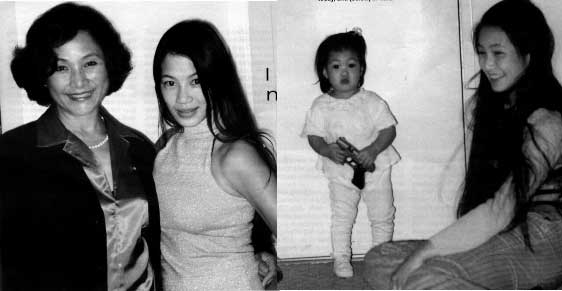
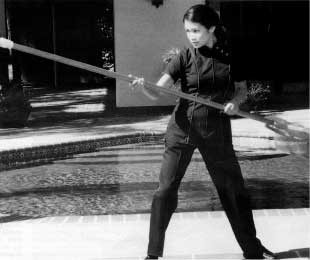
Cheng Pei Pei and Eugenia - 2002 and 1972