Painted Faces
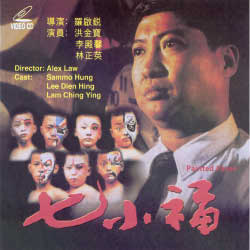
Reviewed by YTSL
For many Westerners, Jackie Chan Sing Lung (AKA
Yuen Lung Chan as well as Chan Kong Sang) was the first Hong Kong movie star
that they ever cast their eyes on and/or were impressed by. Perhaps
by way of such as “Dragons Forever”, they subsequently would have been introduced
to -- and also wowed by -- the Big Nosed One’s “Big Brother” Sammo Hung Kam
Bo (AKA Yuen Long Zhu), Yuen Biao and Yuen Wah. At some point in their
exploration of Hong Kong cinema, these fans surely would have noticed that
quite a few of that film industry’s luminaries -- some of whom (including
Corey Yuen Kwai, Yuen Tak and Yuen Bun) are better known for their behind
the scenes work than that which they have carried out in front of the camera
-- bear the surname of “Yuen”.
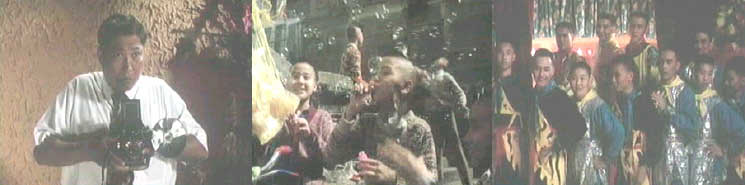
Not long afterwards, it would come to their attention that one particularly
prominent group of Yuens have been collectively known since their now far-off
days as youthful members of a Peking Opera Troupe as the Seven (Little) Fortunes.
Maybe by reading a copy of “I am Jackie Chan” (1998), it will be learnt that
this select septet came to perform together as a result of being students
under Master Yu Jim Yuen. Also, that none of them are -- despite their
tending to refer to one another as “brothers” -- really biologically related.
And ditto re their not actually having been born as Yuens but, instead, having
chosen to adopt that name as a way of paying tribute to their infamously
strict as well as redoubtable Sifu; a man who the eldest of those seven once
much put-upon Peking Opera pupils turned successful movie actors, action
choreographers, directors and producers, Sammo Hung, further honored by giving
a HKFA Best Actor caliber portrayal of in this absorbing1988 account of those
real lives (but bygone times).
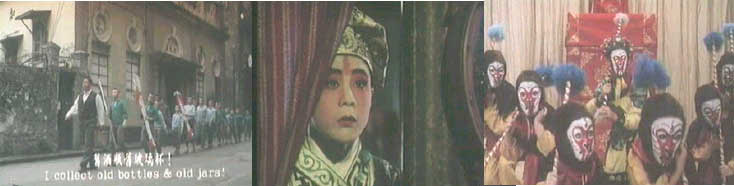
The often downright touching PAINTED FACES -- which derives its English title
from one of the four groups of characters that populate Chinese opera --
effectively begins with a dramatic re-enactment of Jackie Chan’s signing
up -- for a 10 year stint -- as a student of Master Yu(en). At that
point in his life, this now major international star was but an anonymous
pre-teen, whose antics were liable to get him and his fellow mischief makers
caned and sent to bed without any supper (rather than elicit cheers and laughs).
Slowly but surely though, he and his fellow Peking Opera trainees were taught
to take such maxims as “work hard and you’ll eat well” to heart -- while
being exhorted to “Remember not to look down on yourselves even if people
do” -- by someone who had studied Peking Opera for a decade in Peking itself
and practiced this traditional Chinese performing art form for another fifteen
years there before endeavoring to teach it to others for a further decade
and a half (in Hong Kong prior to emigrating to, and doing so in, the U.S.A.).
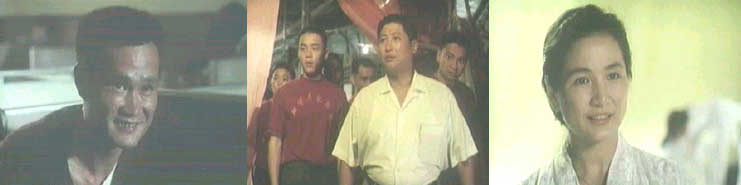
As can be discerned by way of such as the ages of the child actors who essayed
the Seven (Little) Fortunes (and their age-mates) in this Alex Law directed
and co-scripted -- along with executive producer Mabel Cheung -- offering,
the events and goings-on that are the subject of PAINTED FACES largely take
place in the 1960s and early 1970s. For some, those days came across
as being the twilight of Peking opera in a Hong Kong that at least one Chinese
Opera Sifu (Cheng Pei Pei plays an individual, addressed as Master as well
as Madam Cheng, who might be described as the gentler plus female equivalent
of Master Yu(en)) suggested was “now too Western”. Furthermore, not
only were trained Peking Opera performers having to find work as movie stuntmen
and extras -- whose jobs involve being beaten up on film by as well as doubling
for the likes of Kwan Shan (who may be better known these days as the father
of Rosamund) and Li Lihua (as was the lot of Uncle Hua, the good friend of
Master Yu(en) who gets played by Lam Ching Ying) -- but the few Chinese Opera
shows that continued to be staged in that then British Crown Colony were
increasingly likely to be performed in unglamorous surroundings plus play
to sparse crowds.
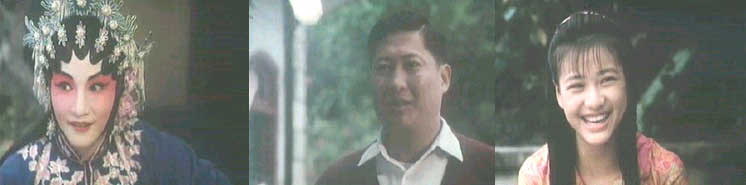
At one level, PAINTED FACES is focused on showing the passing on of Peking
Opera knowledge and skills from a no longer in his prime individual to a
group of boys who he probably despaired on occasion of ever managing to truly
train; and this particularly when all this was taking place at a phase of
his life when time seemed to be quickly passing him by and rendering much
of his accumulated abilities useless as well as unfashionable. As a
result of Yu(en) Sifu’s spartanly furnished and run academy also being a
de facto home as well as chief education facility plus practice space for
its pupils for the periods during which they had contracted to be his apprentices,
however, this martinet of a master and man effectively functioned -- as he
was shown announcing in this Shaw Brothers and Golden Harvest co-production
to one of his less than impressed neighbors -- as “their father and their
mother” as well as teacher, and consequently loomed large over much of their
lives.
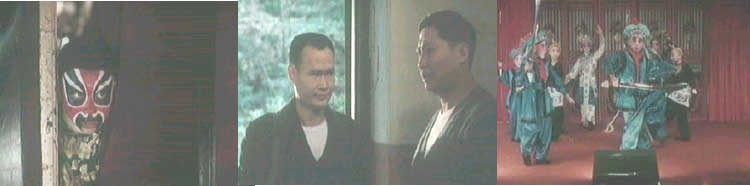
By a similar token, a whole host of operatic lines that Yu Jim Yuen would
declaim and make sure that his students would commit to memory by way of
repeating them ad nauseum -- including those maintaining that “You
think I’m reasonable. I think I’m reasonable. Reasonable or not.
Only Heaven knows” -- were liable to appear to be applicable to real world
figures rather than just fictionalized stage personalities. Although
many of Sifu Yu(en)’s methods may seem overly-harsh, not to mention questionable,
to those (of us) who have not known such a taxing task-master, the gratitude
that the high achieving graduates of his school have openly plus emotionally
exhibited -- including during this moving movie’s majorly star-studded post-script
-- ought to serve as ample proof of their feeling like they got a lot of
good out of the period in their lives when they trained and maybe aspired
to be no more than professional PAINTED FACES.
My rating for the film: 8.