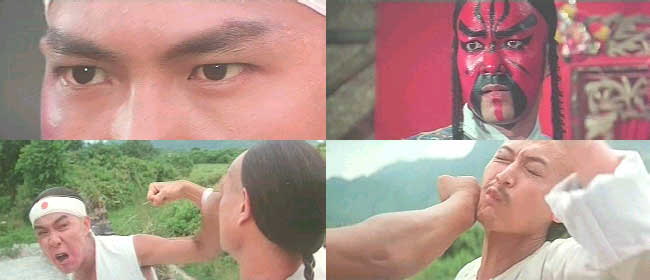
The Prodigal Son
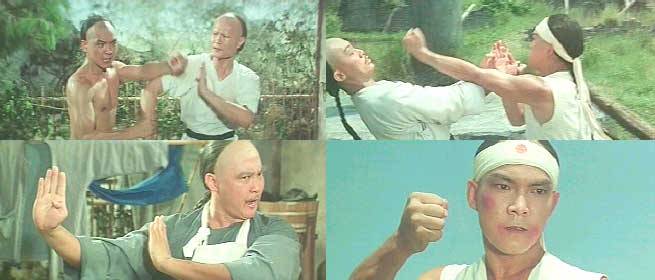
Reviewed by YTSL
When viewing this kung fu movie, the thought cannot
help but strike one that it clearly belongs to an era of Hong Kong cinema
that has come and gone. For one thing, Golden Harvest -- whose production
this is -- is no longer the industry powerhouse cum box office force that
it once was (even while not having completely closed down yet); and the same
could be said of this work’s director, co-action choreographer, co-scriptwriter
plus one of its four most significant on-screen presences, Sammo Hung (among
those luminaries for whom a position as action choreographer on the most
expensive Hong Kong film ever made -- the Jackie Chan starring “The Medallion”
-- can’t be counted as a career high). For another, at least three
individuals who looked to have had a big hand in ensuring that this 1981
effort really can be considered an “all time martial arts classic” like is
touted on its DVD cover -- i.e., the legendary Lam Ching Ying along with
talented scriptwriter Barry Wong and influential producer Leonard Ho -- no
longer belong to this world.
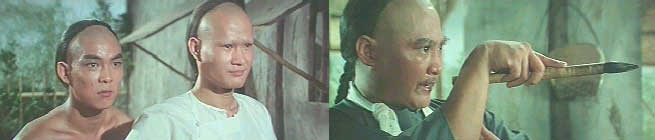
For a third, THE PRODIGAL SON is one of those now seemingly as extinct as
the dodo action offerings that doesn’t contain many wire assisted fight sequences,
let alone CGI effects filled ones (but, instead, the kind of actors fully
in possession of physical abilities which can seem, if not superhuman, then
at least near impossible for most others to emulate as well as had in its
crew a specialist Wing Chun Fist consultant (in Guy Lai) along with four
other martial arts instructors (three of whom happen to be Sammo Hung, Yuen
Biao and Lam Ching Ying)). Fourthly -- and by no means least as well
as lastly -- is the fact of its story being one of those that has the movie’s
courageous but not necessarily all that clever protagonist electing to go
along the well worn path followed by young men who yearn to acquire martial
artistic prowess in order to do such as make a name for themselves and/or
revenge their master(s).
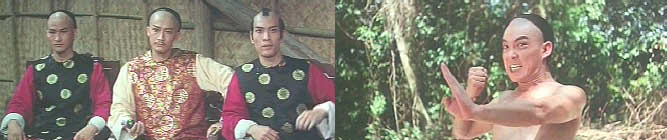
For all this though, there is little question that THE PRODIGAL SON -- whose
Chinese title translates into English as the quite different “Spendthrift”
-- is one of those cinematic gems that has stood the test of time.
Among its attributes that I wish to call attention to and praise is its fights;
all of which may be “old school” in style but were enacted at a pace and
precision that few will find labored or overly artificial looking.
And although this film’s plot appears utterly cliche ridden at a glance,
this Sammo Hung and Barry Wong co-scripted effort turned out to be full of
unexpected twists and welcome innovative touches (including those which made
room for the incorporation of actually not all that effeminate cross-dressing
“sissy” and a hardly thin damsel named Twiggy into this otherwise very male
tale). Consequently, I can imagine that, post viewing this vastly entertaining
offering, many will find themselves mourning its being so that they don’t
make movies like this anymore.
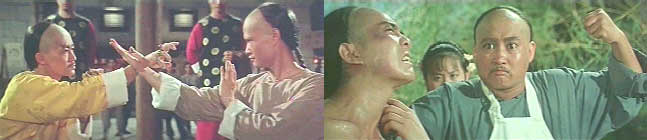
Something else that surely will be looked upon as a genuine tragedy after
one has viewed THE PRODIGAL SON is that its titular star, Yuen Biao, never
did rise to the heights of fame, and hasn’t been endowed with half the staying
as well as star power, that his fellow member of the Seven Little Fortunes,
Jackie Chan, did. For even while it is arguably so that Lam Ching Ying
(as the masterful Chinese opera diva cum Wing Chun expert, Leung Yee Tai)
is this HKFA Action Direction winner’s biggest unsung hero, the then physically
in his prime Yuen Biao (as Leung Chang, the rich businessman’s son who wanted
so much to be a true martial artist) it is who endowed this incredibly endearing
plus often downright eye-catching effort with much of its live-wire feel
and daring.
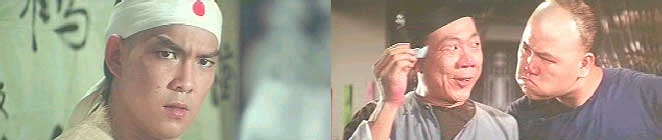
To be sure, Frankie Chan -- the director and lead actor of such as “Burning
Ambition”, whose musical achievements (together with Roel Garcia, he is the
composer of the original soundtracks of “Ashes of Time”, “Chungking Express”,
“Fallen Angels” and “Full Throttle”) actually may be better known than his
martial artistic prowess -- also greatly impresses in THE PRODIGAL SON (as
Ngai Fai, the proud Manchu personage who roams the country seeking worthy
opponents to have “friendly” matches with). And although Sammo Hung’s
part (as Wong Wa Po, the barb-trading “yang” to Leung Yee Tai’s relatively
restrained “yin” in terms of personality as well as Wing Chun mastery) in
the picture initially looked to be largely light-hearted in nature, he soon
revealed that there was -- as with the movie as a whole -- a commendable
strength, depth and breadth to his character.
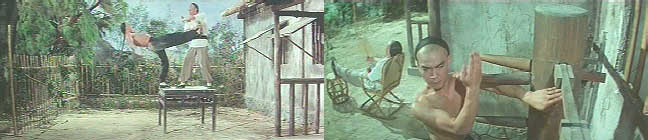
It’s not every day that I agree with what’s written on a Hong Kong movie’s
DVD cover. However, in this case, I wholly concur that “THE PRODIGAL
SON is filled with humor, drama, fantastic training sequences and realistic,
classic Wing Chun fights”. Additionally, while it may seem to the less
initiated to lack major star power (on account of its not being graced by
bigger names like Ti Lung, David Chiang, Bruce Lee or Jet Li as well as Jackie
Chan), suffice to say that it’s not exactly a minor deal for a work to be
able to star no less than four very capable individuals plus have supporting
roles for Chung Faat (as one of Ngai Fai’s two main men), Dick Wei (as the
other) and James Tien (as one of Ngai Fai’s revenge-seeking opponents) along
with comic parts for Wu Ma (as a purported Iron Palm specialist) and Peter
Chan Lung (as the red nosed Yee Tong Choi).
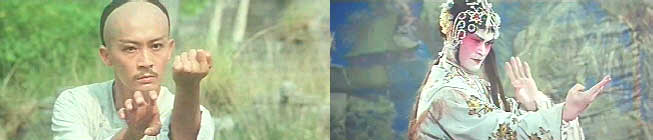
My rating for this film: 9.