Two Wonderous Tigers
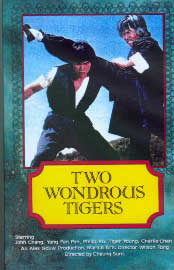
Reviewed by Yves Gendron
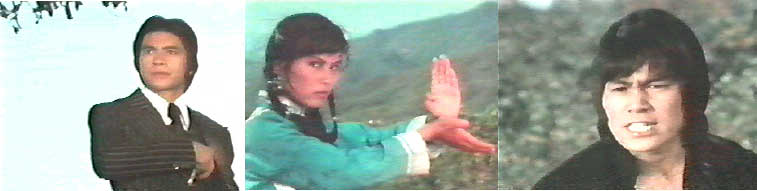
Old school k-f comedy from the seventies cannot be exactly described as fighting
woman friendly, or even friendly towards the whole gender for that matter.
If you would put together the length of all the female fight scenes found
in the kung-fu comedies of Sammo Hung, Jackie Chan and Yuen Woo-ping
(the major contributors of this sub-genre) the total amount of time would
be less than fifteen minutes. There are thankfully a couple of exceptions
here and there; martial comedies that do indeed feature woman fighters in
a major way. One of them would be LEG-FIGHTERS (80) starring the impish,
leggy Hsia Kwan-li paired with boot-master Tang Tao Liang. Another would
be this following film TWO WONDEROUS TIGERS (1979) whose two lead stars are
male: John Chang and Phillip Ko-fei but which showcase two fighting women
in a major way and one in peculiar: Sharon Yeung Pan Pan nicknamed the female
Jackie Chan for her handful of contributions into this sub-genre.
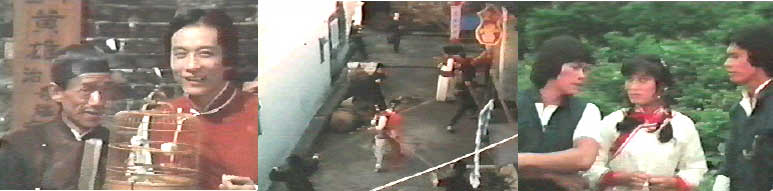
Dapper-suited American Chinese Robert Ko (Phillip Ko Fei) pays a visit to
his native land. While on the road he crosses the path of a mischievous hobo
nicknamed “Tiger” (John Chang) who’s hot-temper quickly leads the both of
them into a friendly rivalry where each tries to best the other with his
k-f skills. They come to a truce however when they see the two cute feisty
fighting Yeung sisters (Kitty Meng, Sharon Yeung) being harassed by the lecherous
spoiled son of a powerful boss (Gam Saan). Not having learned his lesson,
the spoiled son tries his luck again a couple of days later coming to the
Yeung household with a cartload of gifts and an irrefutable proposal of marriage
(or so he thinks) for the youngest of the girls, Ah Mei (Sharon). The Yeung
brother (Charlie Chan) replies however that he will consent to any marriage
only if one is successful in beating all three of the Yeung siblings in a
fight. The spoiled son can’t manage it of course, so he sets an award to
whoever will accomplish the deed instead. Soon enough a score of candidates
show up in front of the Yeung’s door and joining the fray are none other
than Robert Ko and Tiger themselves who have taken a liking to Ah Mei too.
What both they and the Yeung’s don’t know however is that the spoiled son’s
father (Tiger Yeung) is waiting in the wings to claim Ah Mei as his own and
he has more than the fighting skills necessary to rise-up to any challenge.
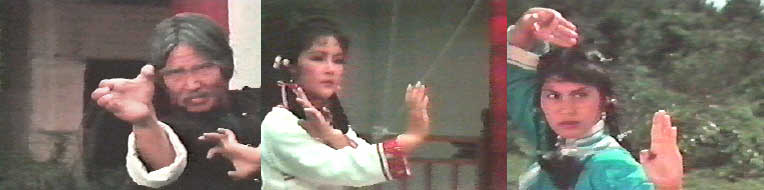
A k-f movie can’t get any spottier than this, as instead of a firm plot TWO
WONDEROUS TIGERS narrative rests on a couple of gimmicks which are played
out mostly as burlesque-oriented jousts. It’s as if two ten minute sketches
had been patched together and stretched out to make a 90-minute film. Somehow
despite it’s sketchy nature the film does manage to sustain itself pretty
well thanks to the genial performers and some colourful choreography. Chang
and Ko have great chemistry together and the verbal banter as well as their
acrobatic k-f jousts over a bun or pieces of silver money are quite amusing.
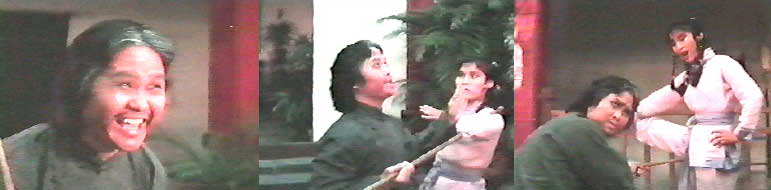
The fighting girls Sharon and Kitty are as cute as buttons and in their own
fights confront quite a quirky bunch (including Sammo Hung’s porky regular
player Lung Chan as the blindman). Especially note-worthy in the film are
the extended and imaginative use of props in the choreography: besides the
already mentioned use of a bun and money there is also use made of a drum,
cane, spear, a carrying chair and even the ever favourite bench.
Other aspects of the film also help make it feel especially fresh when compared
to other k-f comedies. There is of course the aforementioned showcase of
a couple of women fighters, usually a rarity in k-f comedies. Also there
is no revenge oriented plot twist rearing its ugly head at the end, and although
the film does indeed feature a naughty kid there is no loony sifu and so
for once a k-f comedy doesn’t turn to one of it’s more prevalent, familiar
and redundant formulas
TWO WONDEROUS TIGERS original Chinese title is
THE TIGER THAT GETS OUT FROM THE LOCKED GATE a likely reference to the predatory
like lead villain. The English title feels more satisfactory although it’s
still a bit inaccurate and should have had added something like “and the
Pretty/fierce Feisty Tigress.
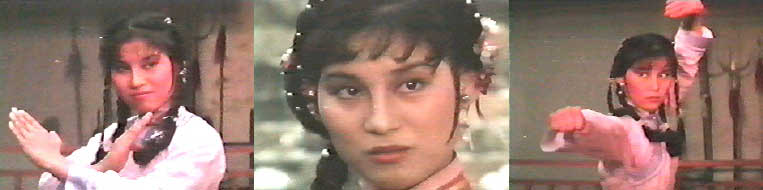
By the time, Sharon Yeung started her movie career in the late seventies
the era for the cinematic woman warrior had been long gone, (well in H-K
made martial art cinema anyway) so she never became as famous as the likes
of Cheng Pei Pei or Angela Mao although the continual development in fight
choreography did mean that she often performed moves more outlandish than
her predecessors. In time, she established herself as one of the rare certified
H-K stunt- women and acquired some level of fame for her regular appearance
at an annual telethon TV special performing daring acrobatic stunts.
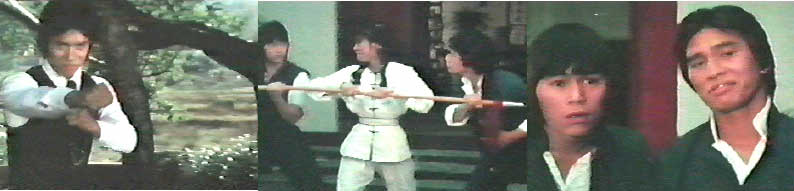
Of the two titular players Philip Ko-Fei, is the best known. In the nineties
he became especially notorious as hack producer/ director for a string of
cheap, cheesy actioners many of them starring fierce fighting female favourite
Yukari Oshima (they were married briefly). Back in the old-school days, however
he was one of the best screen fighting heavies around making usually a brief
but thundering showcase. In time, though he did find more substantial roles
such as Wong Fei Hung’s evil kung-fu rival in Yuen Woo-ping’s DREADNOUGHT
(1981), the stern k-f patriarch in LEGEND OF A FIGHTER (1983) still by Yuen
and the pole fighting abbot in grand-master martial filmmaker Lau Kar Leung’s
EIGHT DIAGRAM POLE FIGHTER (1984).
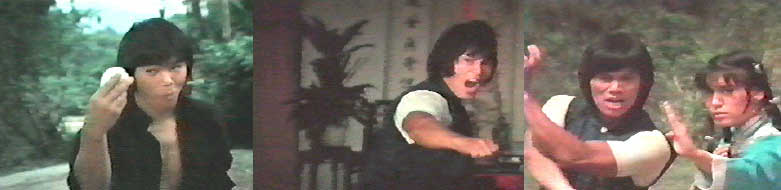
In sharp contrast to Ko-fei, the other tiger John Chang (or Cheung in Cantonese)
is little known. Like Ko-fei he has come from an opera trainee turned stuntman
background, part of Lau Kar-leung’s fighting stunt men stable. He along with
fellow Lau crew’s stunt-mate Wilson Tong joined for a time in the late seventies
a small film company named Goldlit. In the handful of movies they made there
Chang played the lead while Tong acted as the villain and handled the fight
choreography. TWO WONDEROUS TIGERS was their third Goldlit film.
Shortly afterward Chang would leave while Tong stayed on, graduated to fully
fledged director; making a handful of uneven, but quirky k-f movies.
In TWO WONDEROUS TIGERS Tong played only a henchman
leaving the lead villainy to a fellow named Tiger Yeung. A towering figure
with great kicking abilities Tiger Yeung looked formidable indeed so it’s
quite surprising to learn that he made only a handful of k-f movies. Playing
the second Yeung sister is Kitty Meng, who was taught at the same H-K Peking
Opera academy as Sharon Yeung, along with her own brother the elfin Sammo
Hung regular player Meng Hoi. A minor k-f starlet she played in less than
ten movies and TIGERS was her next to last film.
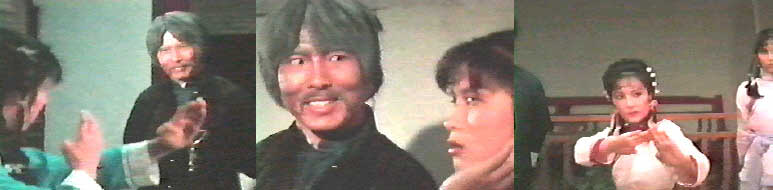
Except for Tiger Yeung, all of the WONDEROUS TIGERS action players; Chang,
Ko-Fei, Tong, Sharon Yeung, and Charlie Chin (who played the Yeung brother)
had an evident Peking Opera background. Peking Opera male performer-turned-stuntman
have always played an essential role in martial art cinema - stunt man, stunt-double,
fight choreographer and screen-fighting heavy. Yet in the first dozen years
or so of the genre’s classic modern era (from the mid-sixties to mid seventies),
they were never given any starring role. These went to more screen savvy
trained actors (like Ti Lung and Fu Sheng) or genuine martial artists (like
Bruce Lee or Chen Kwan Tai). All the sweat, blood and guts, none of
the glory. Things were different with female Peking Opera performers but
that’s another story.
Things changed rapidly however in the second half
of the seventies and the door opened for them not only for stardom but for
fully fledged filmmaking as well. Sammo Hung, Yuen Woo Ping and Jackie Chan
became the leading figures of this new generation, while martial art cinema
master filmmaker Chang Cheh began making films showcasing a new team of acrobatic
fighters extraordinaire: the Venoms, three of which had opera backgrounds.
Even Lau Kar Leung (who was the first k-f choreographer to rise to directing),
promoted an acrobatic stuntman named Hsiao Hou both in front and behind the
camera (as fight choreographer) giving to his films an acrobatic dimension
they had never seen before. In the wake of these major figures, many other
minor players found their way to shine. John Chang, Ko Fei, and Wilson Tong,
were among them. They never became big stars but still found occasional leading
parts in minor k-f films entries, like TWO WONDEROUS TIGERS.
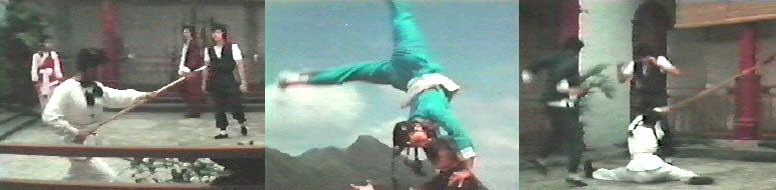
This new generation pushed physical virtuosity and fight choreography to
a new exiting level. Acrobatic outlandishness isn’t the only thing these
newcomers took from Peking Opera, they also drew upon it’s burlesque theatre
tradition which gave k-f comedy it’s fanciful slapstick routines, archetypical
comic characters and farcical irreverent spirit all of whom are wonderfully
represented in WONDEROUS TIGERS.
TWO WONDEROUS TIGERS is not quite up there with
the major k-f comedy fare from Sammo or Yuen Woo Ping, and remains a fairly
lightweight piece of work. Also perhaps it does disappoint a bit when one
of the tigers is actually dropped from the film’s last act (to say who would
not be very sporting). Still WONDEROUS TIGERS feels wonderfully fresh,
sparkly and inviting, good enough for any who have a taste for K-F comedy
and female fighters.
My rating for this film: 7.0