Temple of the Red Lotus
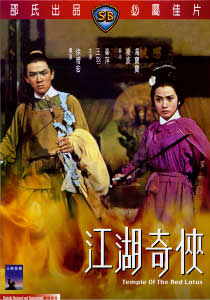
Reviewed by Simon Booth
Well, a while ago I made the claim in my review
for COME DRINK WITH ME that "this is where it all started". It turns out I
have to take that back, 'cause 1 year before COME DRINK WITH ME was TEMPLE
OF THE RED LOTUS... and "it" all seems pretty well in place here.
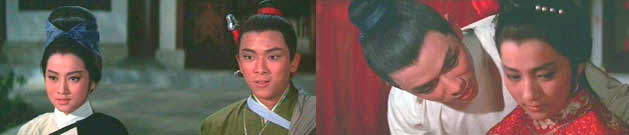
Jimmy Wang Yu has the starring role, as a young kid who heads off to Dragon
Valley to meet the childhood friend who was promised as his bride. When he
gets there, he finds that the family of the bride might not be an entirely
honest bunch of people though. What is the story behind their feud with the
monks at the Temple Of The Red Lotus, for a start?
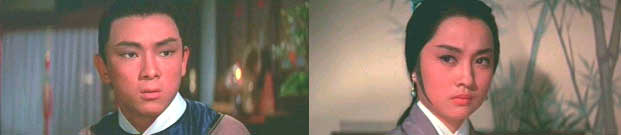
The movie is a luscious period drama featuring a strong story and excellent
performances from the entire cast, especially young Wang Yu in his star-making
role, and the gorgeous Ching Ping as his bride. The sets and costumes are
as sumptuous as any Shaw Brothers period piece, and it’s all beautifully
filmed. TEMPLE OF THE RED LOTUS has a truly compelling plot, full of drama
and emotion, and a nicely developed intrigue. Unlike many other swordplay
movies, there is never any trouble following the plot and the cast of characters
are all easy to keep track of. The script is very tight, and more solid and
professional than most HK movies.
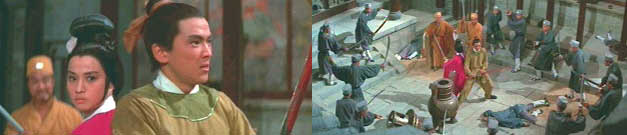
Most surprising to me though are the action sequences, featuring exciting
and dynamic swordplay choreography that's filmed just as well as anything
in COME DRINK WITH ME. In fact, though King Hu definitely introduced some
dramatic style of his own, I'd go so far as to say that TEMPLE OF THE RED
LOTUS actually has better action than his seminal work... or indeed any other
60's film I've seen so far. So, is this where "it" started. Apparently, it
is. I don't even know who was responsible for the action direction here,
though Tong Gaai and Lau Kar Leung are all listed as extras at HKMDB, so
it would seem quite possible that this is some very early work from those
legendary choreographers. If that's the case though, I don't know why it's
so much better than their work a year later in THE JADE BOW. Yuen Wo Ping
is also listed as an extra, but surely he was much too young to be action
director at that point.
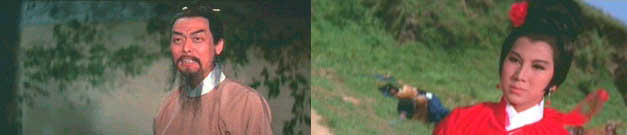
Looking at the movie it's hard to believe it was made in 1965, as it stands
up easily to pretty much any swordplay of the 60's or 70's (or any time).
I've never even heard of director Chui Chang Wang before, and HKMDB only
lists 15-20 movies for him. I hope that this beautifully remastered Celestial
DVD will help to make his name as well known amongst the fans in the west
as equally visionary peers King Hu and Chang Cheh. I am especially looking
forward to the two sequels to RED LOTUS, THE TWIN SWORDS and THE SWORD AND
THE LUTE.
Highly recommended (9/10).
Reviewed by Brian
I have to confess to being fairly disappointed
by this offering overall though it certainly has a number of plusses in its
favor. From a historical perspective it is considered a very important film
in the development of period martial arts films that came to dominate Hong
Kong over the next few decades. In his book Hong Kong The Extra Dimensions,
Stephen Teo credits it with being perhaps the first film in the evolvement
from the cinematic male romantic hero to the wuxia hero. Most male characters
in films up to this time were portrayed as rather limpid sensitive fellows
and the martial art films in the 60’s (in particular those from Chang Cheh)
were to radically change that image to one of masculine hunks.
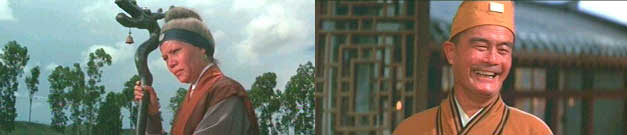
The thing is though that while watching this I found myself being amazed
at what a wimp Jimmy Wang Yu’s character is. Wang Yu looks astonishingly
young and slender in this film – his scenes of self-imposed massed carnage
still off in the future – and he gets beaten up by just about everyone in
the film! His character is suppose to have had ten year’s sword training,
but his swordplay struck me as very awkward looking and Wang Yu had clearly
not developed his slashing powerful sword style yet. Not only does Wang Yu
constantly get defeated and is saved primarily by his pout – but his opponents
are mainly all women in this very female driven film that has a household
of women from different generations that one suspects could take on an army
of men and make quick ends to them.
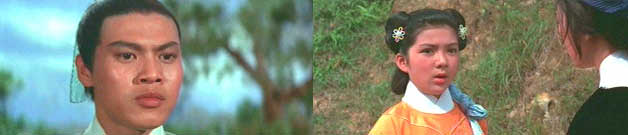
The film does have a lovely look to it and an intriguing plot that I am eager
to see continued in the sequels. There is also a fabulous cast - many
who were to become quite famous over the next few years from Wang Yu, the
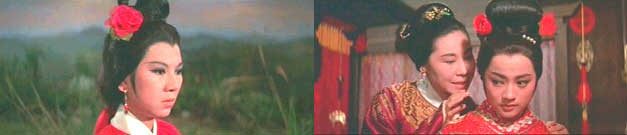
lovely Ching Ping, Lo Lieh, Tien Feng as the father, Petrina Fung Bo Bo who
was already famous as a child actress, Wu Ma as one of the bad guys, Ivy
Ling Po as the mysterious woman in red and many extras who were to grace
martial arts films for years to come. My main complaints were that the action
looked very so-so to me and that the film was poorly paced and didn’t flow
particularly well.
My rating for this film: 6.0
Reviewed by Yves Gendron
THE TEMPLE OF THE RED LOTUS is part of a string
of pioneering movies from the mid-sixties which brought a vibrant new style
for H-K swordplay movies, made them into a hugely popular genre and started
a new era for Chinese martial art cinema that would last twenty years. So
to look at TEMPLE is to look at the very dawn of modern martial art cinema.
Made by the Shaw Brothers Studio TEMPLE also saw the film debut of the studio’s
two newest acting recruits who would go on to have a tremendous careers:
the already brooding, sour-faced Lo Lieh and martial art cinema’s would-be
first male superstar: Wang Yu.
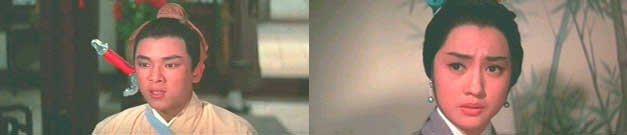
Shaw had dabbled in martial art films before, as with the 1961 film THE SWALLOW
starring the studio lead female super star Linda Lin Dai, but only occasionally
as the genre was considered too low-brow for their would-be glamorous and
sophisticated studio. Things changed however when Shaw’s chairman Run Run
saw the local success met by Japanese samurai movies such as the Akira Kurosawa
productions YOJIMBO (61) and SANJURO (62) as well as the film series ZATOICHI
which began in 1963. Wanting to capture a whole new audience, Run Run therefore
shifted some of his studio resources to make a home grown swordplay film
and commissioned his directors and screen-writers to view and study Japanese
martial productions so as to copy their film techniques and borrow plot ideas.
He also started hiring Japanese directors and cinematographers to upgrade
technical quality of Shaw’s movies. At one point he even sent some of the
studio’s own technical staff to Japan to learn local techniques.
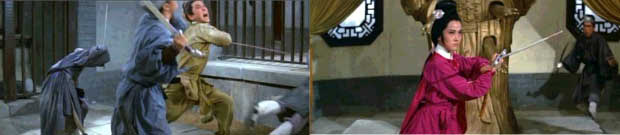
While not the first martial art movie made under Shaw’s new guidelines, TEMPLE
nonetheless would appear to have been the studio’s most ambitious and accomplished
early martial art effort; as the film was Shaw’s first attempt at a lavish,
colour, scope two-parter martial art production, (the second instalment being
THE TWIN SWORDS). The film also cast the studio’s latest stars Wang Yu, Lo
Lieh and the pretty Chin Ping as well as the already established veteran
Ivy Ling Po and child star Fung Bo Bo.
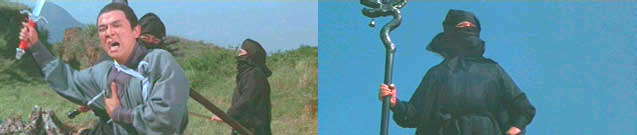
Wandering young swordsman Gui Wu(Wang Yu) unexpectedly comes upon an ambush
in which black-hooded bandits are plundering what appears to be an official
escort. Wounded in his attempt to help out, Wu quickly recovers thanks
to the providential help of the “Scarlet Maid” (Ivy Ling Po) a famed swordswoman
who was nearby. Wu then arrives soon afterwards in the territory of the Jin
Clan, in order to learn their famed dart throwing technique but also to rekindle
his romance with the clan master's daughter Lianzu (Chin Ping) to whom
he was betrothed in childhood. Once the wedding takes place however, Wu begins
to notice some strange things going on with his new in-laws, most notably
that their household keeps being attacked by the henchmen of the mysterious
Red Lotus Clan. Wu eventually concludes that his in-laws are actually the
bandits who wounded him and he is unwilling to remain in an outlaws’ s den.
He wants to leave with his lovely wife, but in order to do so the couple
will have to pass through the gauntlet of the clan’s female members, each
one a formidable fighter. And while all of this is occurring, the Red Lotus
henchmen are still lurking in the shadows.
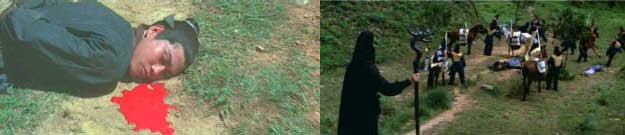
TEMPLE OF THE RED LOTUS actually opens with the sight of a small pool of
blood having come out of the mouth of what appear to be a corpse. At the
time of the movie’s release this was a strong sign that the film would differ
from H-K martial art cinema’s normal depiction of violence in which there
was never any blood shown even if two duellists fought for an extended time.
The Japanese samurai films appeal greatly stemmed in their realistic and
edgy brand of action in which the swordplay was fast and the fighters really
seemed to cut each other in bloody fashion. Thus TEMPLE followed suit with
its own depictions of sword slashing, limb chopping and lethal dart throwing.
It may seem rather stagy and tame by today’s standard but was considered
quite exiting and gruesome at the time. A large bulk of H-K made martial
movies were fantasy oriented with the heavy use of special effects to depict
such abilities as the palm power or weapons like the flying sword. Therefore,
TEMPLE’s edgier more realistic brand of action along with the film’s lavish
production values, polished film techniques and the use of colour and of
the scope format made the movie a whole new martial cinema experience for
a Chinese audience. It was as exiting as the Japanese samurai films but with
a distinct Chinese flavour to it.
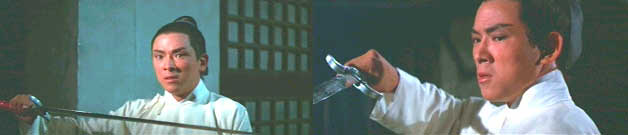
If TEMPLE displayed some radical changes from the way martial art movies
had been made previously, it still kept some typical features as well. Thus,
despite some of its polished film techniques the movie still remains dominated
by stagy Peking Opera aesthetics especially in its sets, use of music and
theatrical action. Strong female characters also dominated Hong Kong cinema
at the time with lead males usually depicted as weaker than their female
counterparts; so likewise in TEMPLE. Wang Yu’s Gui Wu is a shy, awkward kind
of a guy who’s only barely adequate with a sword and who has often to rely
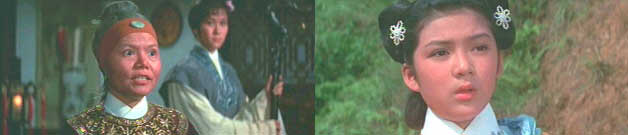
on his wife to make it through a fight. TEMPLE has actually not one, not
two, but a full bevy of strong female characters which include a wife, an
aunt, a sister-in-law, a cute kid, a granny and lets not forget the Scarlet
Maid - all strong willed, martial experts and any of them more than a match
for Wang’s skills. No doubt, in TEMPLE we are a far cry from Wang Yu’s later
cool, gloomy and angst-filled screen persona as well as the male-centred
bloody martial universe of Chang Cheh.
Another characteristic often found in old martial movies was that because
of the dearth within the film industry of action choreography experts (whose
position had yet to be firmly defined and established) the emphasis in these
productions was not so much on action proper but on melodramatic and convoluted
plotting. Now while TEMPLE did have indeed half a dozen martial fights full
of sound and fury, there was still some difficulty in making the film’s action
and drama fully blend together seamlessly and with an edge. This peculiar
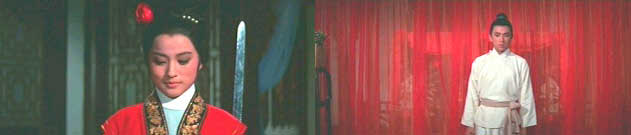
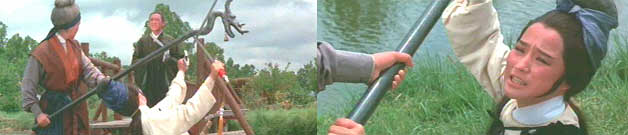
failing is best exemplified by the dramatically key series of sequences where
the young heroic couple have to escape the family household by going through,
one at a time, four female guardians with the clan’s stick wielding matriarch
actually the most powerful of the lot. But it’s more by begging than actually
fighting that the young couple manage to succeed in a rather anti-climatic
and tedious resolution from a potentially promising action scene. TEMPLE
does eventually deliver an impressively edgy and dynamic fight scene when
the evil henchman of the Red Lotus gang surrounds the heroic couple. In it
Wang Yu finally sheds, if only momentary, his clumsy fighting skills and
gets to unleash a dashing display. This is a scene though that comes at the
very end of the film, a nice way, probably to hook the viewer for the film’s
next instalment.
In any case, viewing TEMPLE actually gives a greater appreciation to the
tremendous groundbreaking accomplishment achieved by King Hu in his seminal
swordplay COME DRINK WITH ME; another Shaw new wave swordplay production
released eight months after TEMPLE in July 1966. King Hu understood that
in cinema the less plot there is the better the stylish action delivery could
be; so with his own inspired action vision in mind and through his own successful
cinematic synthesis of both Japanese style action and Peking Opera aesthetic
he pushed H-K swordplay beyond its stagy and literary boundaries right into
true, pure cinema. Still, despite it’s drawbacks and limitations TEMPLE must
be given it’s due for having been one of the films that started the “new
style” process that would be extended by COME DRINK WITH ME.
TEMPLE OF THE RED LOTUS was made by Chui Chang-wang (Xu Zeng-hung in Mandarin)
a then young director with a background in cinematography, who had been one
of the Shaw staff sent to Japan to learn their film techniques. It was future
martial art film master Chang Cheh who wrote the film’s script, as at the
time he was Shaw’s script supervisor and he also served as special advisor
to Chui who had been the cinematographer for Chang's own "new style" martial
debut TIGER BOY. Released in February 1966, three months after TEMPLE, TIGER
had much of the same cast; Wang Yu, Lo Lieh and Chin Ping, but it was a black
and white production that it seems had been made nearly three years earlier
back in 1963 but was not released until after TEMPLE. Chui also directed
TEMPLE’s two follow-up movies - TWIN SWORDS (released in December 1965)
and THE SWORD AND THE LUTE (April 1967). This series of works give him consideration
as one of the key figures in the establishment of Shaw’s new style martial
art “wave”, but he was much more a film technician than a real martial film
author in the way both Chang Cheh and King Hu were. Although he produced
and directed more than a dozen martial movies well into the seventies none
of his works appear to have gained much of a classic status.
In an interview, Chui actually credited Lau Kar-leung and Tong Gai (Mandarin
name Tang Chia) as TEMPLE’s action choreographers. This is a problematic
statement as it’s well known that Tang and Lau were discovered and immediately
hired by Shaw on the basis of their ground-breaking action choreography work
in THE JADE BOW which the HKMDB web site cites a release date in January
1966, three months after TEMPLE’s own release. Chang Cheh’ s MAGNIFICENT
TRIO, released in November 1966, is the Tang/Lau team’s first official Shaw
piece of work. So Chui would appear to have made a mistake, which is quite
possible, as memory is known to be tricky. The other explications could be
that either the HKMDB has a date wrong or that the Shaw bosses managed somehow
to view JADE BOW well before its release and promptly hired the pair to work
on TEMPLE, which was started, completed and released before JADE BOW, but
this is hypothetical. Unfortunately, the HKMDB does not give TEMPLE’s action
choreography credit so the issue remains clouded.
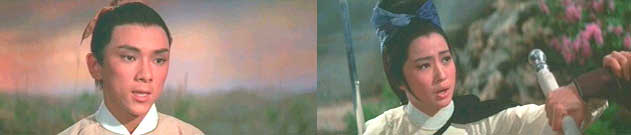
Wang Yu, Lo Lieh along with COME DRINK WITH ME co-star Yueh Hua were Shaw’s
first generation of male martial art stars, having come to a Shaw advertised
recruitment call along with hundred of others and became the sole chosen
candidates following an arduous selection process. After an acting and martial
art course both Wang and Lo Lieh were launched into the limelight with TEMPLE.
While Wang Yu received a matinee idol type of role, Lo Lieh was the brooding
“other guy”, the male star's rival which was to be his stock screen role
for a couple of year before coming in to his own toward the end of the sixties
as both a heroic lead and arch-villainous foil.
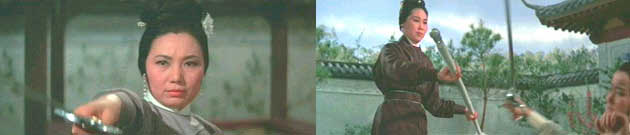
Wang Yu’s female co-star Chin Ping was also a newcomer but with already one
movie under her belt, CRIMSON PALM (64) a previous martial hit by Shaw. Cutie
pie and bashful looking, Chin hardly looked like fierce sword woman material
in this film. Very cute yes but she was most definitively not Cheng Pei-Pei
in terms of screen presence and it’s pretty obvious her action capabilities
were quite limited. Hard to believe now but Chin Ping (along with Pei Pei)
was one of Shaw’s top sixties female martial stars as she did at least a
dozen martial films in her eighteen-film career. A bit more convincing in
her swordswoman role was special guest star Ivy Ling Po as the Scarlet Maid.
Although she makes only very brief, occasional appearances and doesn’t draw
a sword at all, she does have the requisite screen presence to pull off her
role. TEMPLE’s other big special guest star was H-K cinemas own Shirley Temple,
Fung Bo Bo as Chin Ping character’s adorable spunky niece. The daughter of
crooked mouth character actor Fung Fung as well as the sister of future notorious
toad faced screen villain Fung Hark-onn (to whom even as an adorable kid she
shares a family resemblance), little Bo Bo even at a mere ten years of age
was actually one of TEMPLE’s veterans having been cast in nearly eighty film
productions since the age of six.
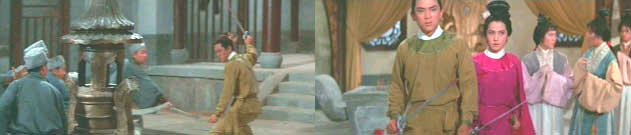
TEMPLE also had an early appearance by future famed character Wu Ma as a
Red Lotus henchman. He was in his mid-twenties at the time and had just begun
his film career. Other Shaw Brother regular players include; Tien Feng and
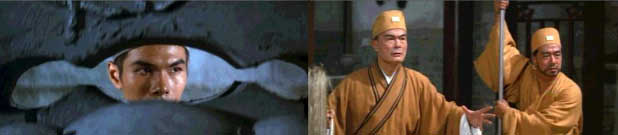
Ku Feng as elder male members of the Jin Clan, the Japanese born Feng Yi
as a slimy evil abbot and of course the ubiquitous character actor Kok Lee-yan
as a magistrate. Another supporting player worth notice would be actress
Go Bo-shu (also known as Kao Pao-shu) as Chin Ping’s sword expert aunt, who
would become in the seventies one of the extremely rare martial art female
directors.
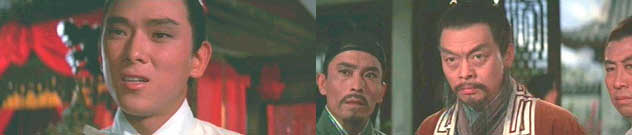
TEMPLE OF THE RED LOTUS is the screen adaptation of an extremely popular
“wuxia” novel dating back from 1928; Legend of the Strange Hero by
a writer named Xiang Kain (wuxia=martial art fiction as the Chinese called
it themselves). It had been immediately adapted for the screen as THE BURNING
OF THE RED LOTUS MONASTERY, one of the first martial art movies ever made
and proved so popular that eighteen subsequent episodes were filmed thus
initiating the earliest golden age of fantasy martial art movies. Sadly,
just like TIGER BOY no print of the serial is known to have survived to this
day. The novel was adapted on at last two other subsequent occasions, both
in H-K. First in 1956 with STRANGE HERO, then once more in 1963 under the
BURNING OF THE RED LOTUS MONASTERY appellation starring in the male lead
role Cho Tat-wah and choreographed by Simon Yuen Siu-tien, the future Drunken
Master himself. Consisting of more than one hundred chapters, most of Legend
of the Strange Hero’ s film adaptations have tended to focus on certain
significant episodes, probably the most important of which was Gui Wu and
Lianzhu’s escape from the latter’s evil family.
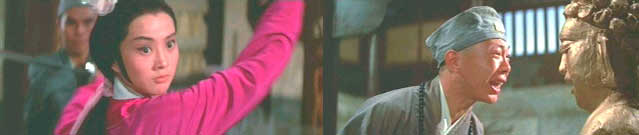
As filial piety is a virtually sacrosanct virtue in traditional China, the
very idea of children seeking to leave the clan was considered a revolutionary
idea when first written in the 1928 novel and was used in all the subsequent
film adaptations. Shaw’s version of the story differed radically from
the other films however as the in-laws clan turned out not to be villainous
after all; only mistaken as such. Another major difference was in the
way the story was presented; in a realistic gritty fashion in TEMPLE while
all of the others had been quite fantasy oriented. BURNING 1963’s bizarre
and fantastic imagery has even been described as “almost Daliesque”. Both
the 1957 and the 1963 version were shot in black and white with Cantonese
dialogue as it was H-K Cantonese cinema which had specialized in martial
art movie making before the advent of Mandarin cinema's New Style swordplays.
Interestingly, TEMPLE was actually one of the earliest movie productions
done in post-production synch-sound, which would soon become the established
practice for decades to come. In the end, what the three latest versions
have in common was that all of them were conceived as two-parters. The
Legend of the Strange Hero’s novel may have been adapted once more at
a much later late as a Taiwanese movie bearing the title BURNING OF THE RED
LOTUS MONASTERY that was released in 1982, starring martial art actress Pearl
Cheung Ling. Strange Hero’s idea of the young couple seeking to escape
their evil family was so compelling that it was used in a couple of other
unrelated movies including most notably Lau Kar-leung’s 1978 martial art
production; SHAOLIN MANTIS.
Unlike COME DRINK WITH ME, which remains to this day a superb timeless classic,
TEMPLE OF THE RED LOTUS could be more aptly described as something of a haphazard
antique prototype. It is overall a sound, polished, visually colourful and
good-looking film, but a bit on the plain and awkward side in regard to its
fight scenes, drama and character appeal. Still TEMPLE has a great old-fashion
charm going for it and remains an entertaining piece, especially worthy of
a good chuckle or two for Wang Yu’s dopey matinee idol hero character and
Chen Ping’s bashful swordswoman. It’s also quite interesting and instructive
to see a Shaw swordplay before it started to get all gloomy and angst-filled
as it later became.
As stated before, TEMPLE OF THE RED LOTUS was meant to basically establish
both the characters and the situations that were to be resolved with more
drama and action in the second part. This accounts for much of TEMPLE’s dramatic
and action drawbacks. The second part, THE TWIN SWORDS, was released six
weeks after TEMPLE on December 22nd, 1965. For now though, Celestial has
not made any plans to release this film this year, leaving the viewer on
a ledge as to what is going to happen next.
Overall merit: 6.5 but with quaint charm and chuckle
comedy: 7
Sources: A Study of Hong Kong Swordplay
film (1925-1980) , Hong Kong Urban Concil
ABOUT TIGER BOY.
Released in February 1966 three months after TEMPLE,
TIGER had actually been produced up to two or three years earlier and is
considered as Shaw's first modern martial art movie. It had much of the same
cast as TEMPLE, Wang Yu, Lo Lieh and Chin Ping, but was a black and white
production. TIGER was meant as a prototype to see if the Shaw Studios were
able to make a convincing Chinese swordplay and to judge whether a Chinese
audience would accept it. Despite it limited distribution; it appears to
have been successful enough to convince Shaw to go ahead in their martial
art initiative. Preserved on a friable brand of celluloid, none of the TIGER
BOY prints appear to have survived to this day and it is nowadays considered
as a lost movie.