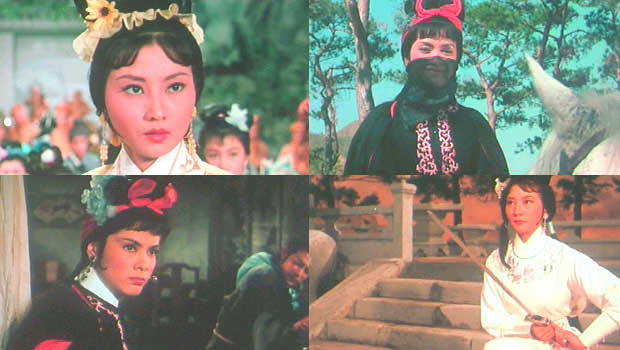
The Jade Bow
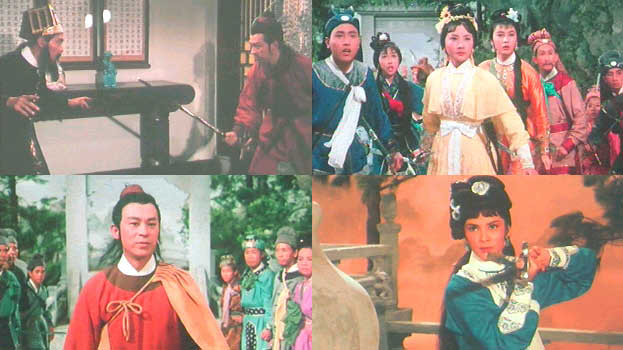
Director: Fu Chi/ Cheung Sing-yim
Year: 1966
Rating: 8.0
There are a few films
that are generally credited with being the jump-start to the modern day
Wuxia film – The Temple of the Red Lotus, Come Drink with Me (both produced
by the Shaw Brothers) and the 1966 film, The Jade Bow. The Jade Bow was produced
by The Great Wall – generally considered a left wing film company that
was formed in the 1950’s by refugees from the Mainland and whose films alternated
between ones with a political or social message and others that were more
commercially oriented. The Jade Bow clearly falls into the latter category
– a terrifically entertaining story of martial arts chivalry, romance and
adventure. Though certainly not made on a large budget, it still has a lush
look to it (even with some very fake looking sets), a surprisingly energetic
score that has both classically Western and Chinese sections and some very
appealing characters. These characters (and of course the actors who play
them) make what might seem like a clichéd plot line quite effective.
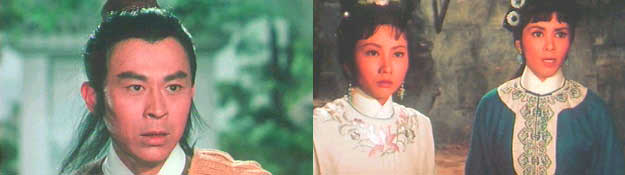
Of course, what the film is now most famous for is the action and the choreographers
who created it. Until this film and the others mentioned above came out in
the mid-60’s Wuxia films tended to have fairly tame action sequences that
were as much Chinese Opera as action choreography. The new style of action
that was usually choreographed by true martial artists was more imaginative,
faster in nature and contained more graphic violence. Though initially many
of the actors in these early films had no real martial arts background, the
action was filmed and edited in such a way to enhance their on screen abilities.
This was the second film to be choreographed by the team of Lau Kar Leung
and Tong Gai (South Dragon, North Phoenix was their first) and they brought
a fresh clean style to their action scenes and nicely utilized wires to give
the characters great martial arts skills. After this film was released, the
Shaw Brothers were so impressed that they persuaded Lau and Tong to join their
company and they were to go on to choreograph or direct many of the great
martial arts classics of the 60’s and 70’s.
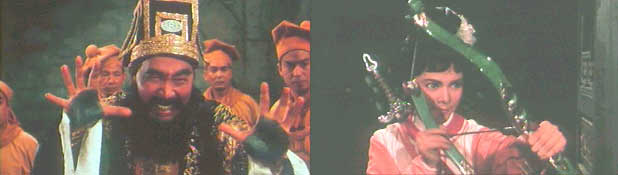
Even with this reputation though one has to realize that the action will
look very quaint by today’s standards and even by the standards that Lau and
Tong were to soon set in the Chang Che films over the next few years. The
three main actors clearly are not martial artists – but were instead popular
dramatic actors of the day – and no manner of editing or camera angles can
make them seem particularly accomplished. There is also still a lingering
operatic feel to the action sequences as the characters often do as much talking
as fighting. At least from my perspective what I really enjoyed was the story
itself - the theme of revenge across generations, the love triangle
that had to end sadly for someone and the poignancy of a father and daughter
who are natural enemies but who yearn for the other’s love.
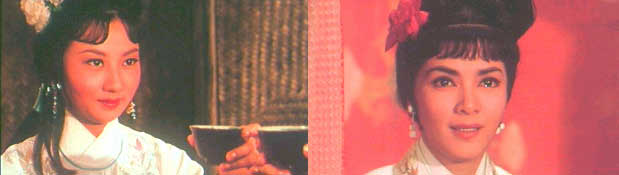
The film begins in somewhat confusing fashion as the viewer is introduced
to a number of characters over a short period of time – but here goes a quick
summary. Shi-yi (Fu Qi, who also co-directed) is told by his dying sifu that
Shi-yi needs to rectify a terrible mistake that the sifu made twenty years
previously. In a flashback the sifu relates that he once wanted to steal two
books on martial arts that would have made him the number 1 hero on the hit
parade. While he is looking over the scene, another thief – Meng Sheng-tung
(Wong Biu Chan) breaks in and steals one of the books. During the theft though
his wife who is carrying their baby daughter is killed – and Meng kills the
husband and wife who possessed the book. Meng escapes with the one book –
but leaves his daughter behind and a member of the Min Shan family adopts
her and brings her up. The dead Li’s also had a baby girl and she is brought
up by her uncle to hate and someday revenge the death of her parents.
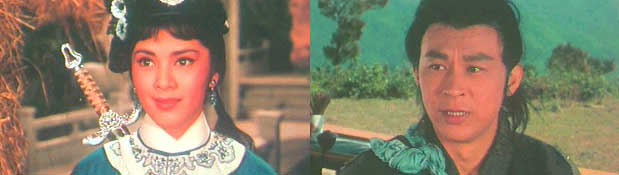
Shi-yi’s sifu feels terrible guilt at having done nothing because Meng has
now become a feared tyrant and a strong supporter of the Ching Emperor. The
book he stole has given him special palm powers such as being able to turn
liquids into ice – a very neat party trick in pre-freezer days. So Shi-yi
is asked by his sifu to find the Min Shan group and help them in their fight
against the Chings. Dressed as a beggar, he soon comes across two cuties who
can fight as well as they flirt – the first is Chi-hua (Ping Fan) who is
a member of the Min Shan’s and of course unknown to her the daughter of the
hated Meng. Soon she is to learn who her real father is. The other beauty
(Shen-nan – played by Chen Sisi) turns up as a mysterious femme fatale behind
a veil who is doing her best to get close to Meng so that she can kill him
– she is of course the other daughter. Among her weapons are an array of smoke
bombs and a deadly jade bow that shoots poison tipped arrows. The three of
them initially form a bond of friendship, but once Shen-nan learns whom Chi-hua
really is she is forced by a blood oath and pressure from her now crippled
bitter uncle (and no wonder as he has lived in a tree trunk all these years!)
to attempt to exact revenge on all members of the Meng family – even on her
friend.