Warriors of Heaven and Earth
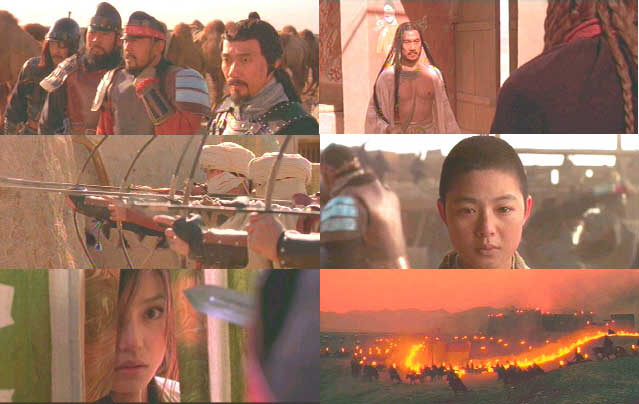
Director: He Ping
Year: 2003
Rating: 8.0
I have not reviewed
many Mainland Chinese films on this site previously, but I wanted to include
this one for a couple of reasons. First, I really enjoyed it and think most
Hong Kong film fans will as well, secondly there are some people involved
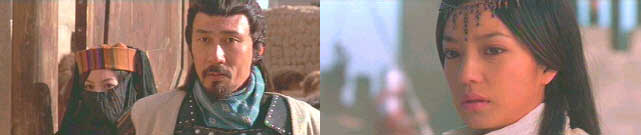
that are often associated with the Hong Kong film industry – actress Vicky
Zhao and action choreographer Stephen Tung Wai, the score was written by
one of Bollywood’s greatest composers – A.R. Rahman – and Mainland Chinese
films are finally becoming much more commercially entertaining and deserve
to be shown outside of the art houses in the West.
Not that those morose and downbeat tragedies weren’t wonderful films, but
there are only so many times that you can watch Gong Li – as beautiful as
she is - being persecuted. The introduction of capitalism into China has
found a welcome mat in the film industry and the huge success of “Crouching
Tiger, Hidden Dragon” from Taiwan sent a message to Chinese filmmakers –
epic action period films sell at home and abroad. Oddly, Hong Kong with its
vast experience in sword fighting films was unable to take advantage of the
Crouching Tiger phenomenon, but the Mainland has stepped in with first “Hero”
and now this film. “Hero” was nominated for Best Foreign Film at the academy
awards in 2002 and Warriors of Heaven and Earth was China’s submission to
the Academy Awards for 2003, but didn’t make the final cut.
Directed by He Ping (Swordsman of Double Flag Town, Red Firecracker, Green
Firecracker), this is a tale of adventure that is a fast paced mix of heroic
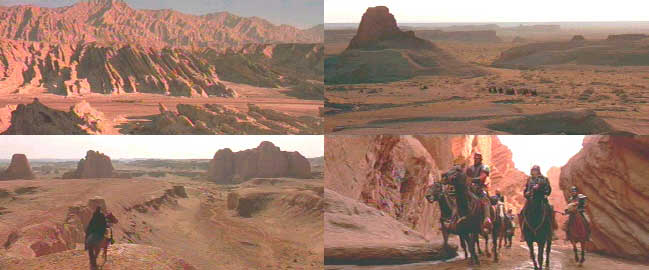
wuxia and a John Ford western. It takes place during the time of the Tang
dynasty (618 A.D – 907 A.D.) and is set in the majestic stark beauty of the
Gobi desert. The production values of this film are absolutely top notch,
the story thrilling, the characters distinctly defined, the panoramas at
times are breathtaking and the action scenes are plentiful. The only real
note of dissent comes because of its very similar story line to the Korean
film, Musa. In fact, it follows Musa to such a degree – though clearly a
very different story – that it is hard to imagine it is co-incidental. To
my mind it doesn’t quite match up to Musa – the action scenes lack the spectacle
and over the top frenzy of Musa – but at the same time the characters in
this film are better etched and more appealing than those in Musa.
Out in the barren western parts of China, there is only a small modicum of
Imperial presence and bandits, warlords and Turks vie for power. The Emperor
has sent one of his agents there in order to bring some justice and to capture
wanted bandits. Lai Xi (Nakai Kiichi) is Japanese but has been working for
the throne since he was a young man. After many years in the West doing the
Emperor’s work he has finally received permission to go home to Japan – after
one more assignment – to capture an ex-Imperial soldier who mutinied and
escaped with some of his men many years previously. Word has come to the
attention of the Emperor that Lieutenant Li (Jiang Wen) has returned to this
part of the world and the Emperor wants him dead.
The reason Li mutinied was that he refused under order to massacre innocent
civilian prisoners and had to kill several soldiers to escape from being
executed. He parted from his men, but after many years in exile he wants
to come home. Lai Xi sets off for Beijing with an eye open for Li, but also
to escort Wen Zhu (Vicky Zhao), the daughter of a dead general back to the
capital. In the open desert an Imperial caravan has been destroyed by a gigantic
sandstorm and only one guard and a young monk have survived. The guard comes
across Li caught in the same storm near death and saves his life. In return,
Li promises the guard to help him bring the caravan safely to Beijing.
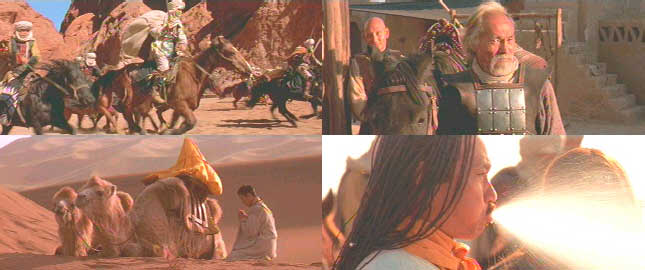
This turns into a treacherous journey as it soon becomes evident that the
Turks and their hired killers led by the vicious Master An (Wang Xueqi) are
after something very valuable among the contents of the caravan. Soon Li
and Lai Xi come face to face to test each other’s mettle – and after a draw
– Li promises to continue this duel in Beijing if Lai Xi allows him to keep
his promise to lead the caravan. Lai Xi assents and is soon in a position
where he has to help keep Li alive so that he can kill him in Beijing. It
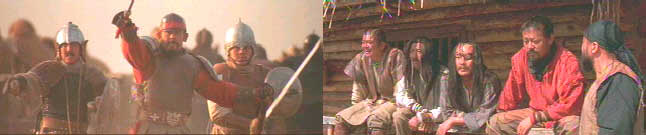
is the stuff of pure male heroic bonding. Li also picks up some support –
a tough old man, a young boy and in the nick of time his four old friends
show up – and with this small band of heroes, he fights for his honor, for
his pride and for God against a steely-eyed and determined enemy that come
at them in waves.
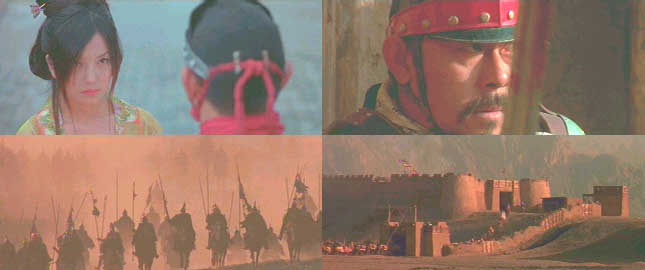
The first few minutes of this film are a bit confusing until you figure out
who all the characters are – and it takes some fifteen minutes or so until
the adventure begins, but once it does it is a near non-stop rush filled
with heady action, valiant men, stunning vistas, charges across the desert,
the clash of steel swords, sacrifice and the letting of much blood. Both
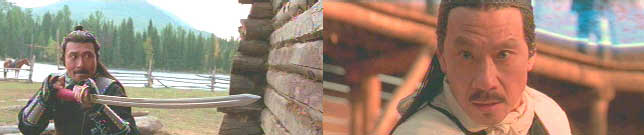
Jiang Wen (Devils on the Doorstep, The Emperor’s Shadow, Green Tea) as Li
and Nakai Kiichi (When the Last Sword is Drawn, Owls Castle) as Lai are absolutely
terrific as the two honorable and capable men who come to respect each other
and fight back to back. Also, very interesting is Wang Xueqi (Yellow Earth)
who gives a villainous turn that is worthy of Francis Ng. I wish I could
say that Vicky was made good use of, but in truth though she is the narrator
of the story, she does very little but tag along until near the end of the
film when she gets involved in the fighting.