Once Upon a Time in China
IV
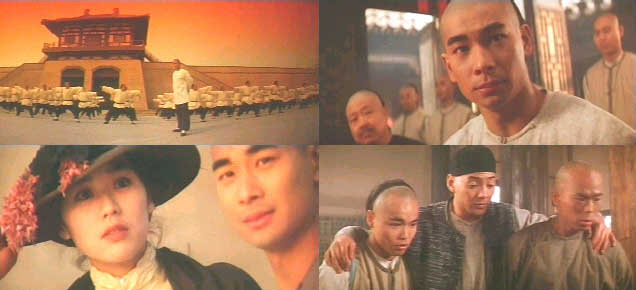
Reviewed by YTSL
At some point during one’s acquaintance with Hong
Kong cinema, the observation cannot help but be made that those associated
with it appear to have a distinct fondness for the number 3. After all,
it’s not just “The Heroic Trio” (and its sequel, “Executioners”) which features
a starry threesome but also such disparate movies as “The Soong Sisters”,
“Peking Opera Blues”, “A Better Tomorrow”, “Once a Thief”, “The Private Eyes”
and “Wu Yen”. Then there are all those three-part series out there
like the “A Chinese Ghost Story”, “Swordsman” and “Infernal Affairs” sagas.
And funnily enough, I’d also be willing to wager that there are quite a few
fans out there who have been moved to conclude that many, if not all, of
the series which stretched beyond Part 3 probably would have been better
served if they have had come to a close at the end of their third installment.
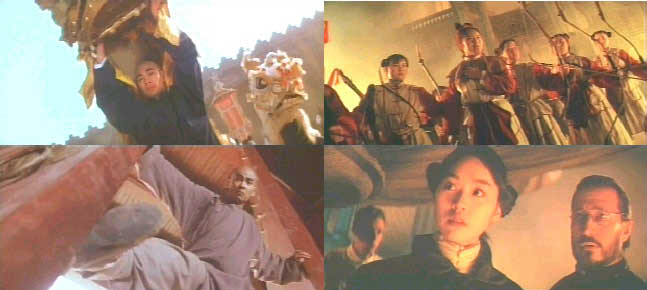
With regards to the “Once Upon a Time in China” series: It certainly doesn’t
help that its fourth installment has a different director and main star along
with lead actress from the previous three OUATICs. And although Tsui
Hark did at least remain on board to co-script (along with Elsa Tang) and
- produce (with Ng See Yuen) ONCE UPON A TIME IN CHINA IV, gone is so much
of what made the first three “Once Upon a Time in China”s so much more than
the out-and-out wire-work action spectacle that the main individuals behind
this 1993 Golden Harvest cum Film Workshop production appeared content for
it to be.
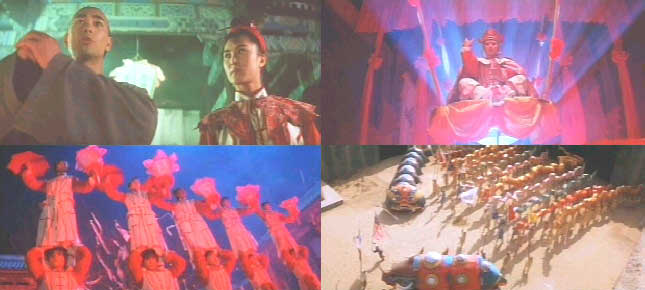
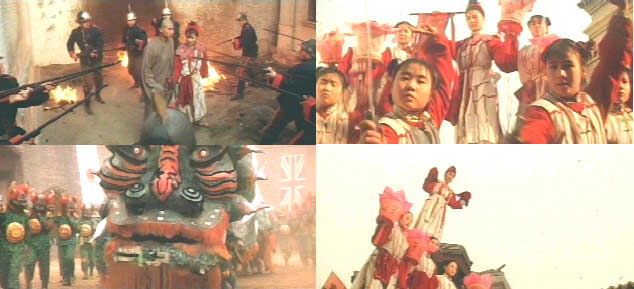
To be sure though, ONCE UPON A TIME IN IV is once again not without a multi-stranded
plot that ensures that Wong Fei Hung (essayed in this movie by Chiu Man Cheuk)
will have to battle against more than one formidable enemy (two of whom are
played by Chin Kar Lok and Billy Chow). Some semblance of continuity
is provided too by this particular installment purporting to begin immediately
after the events of “Once Upon a Time in China III”: with a senior Ching
court official meeting with Wong Sifu to successfully persuade him to accept
the gold medal he refused at the end of the earlier film, as well as agree
to take part in another ultra-competitive Lion King competition, albeit one
with the twist of being an international contest organized by the eight foreign
powers (including Britain, Japan and the U.S.A., but with the Germans marked
out here as being the most nefarious of the enemies) which China feels most
obliged to not lose face to.
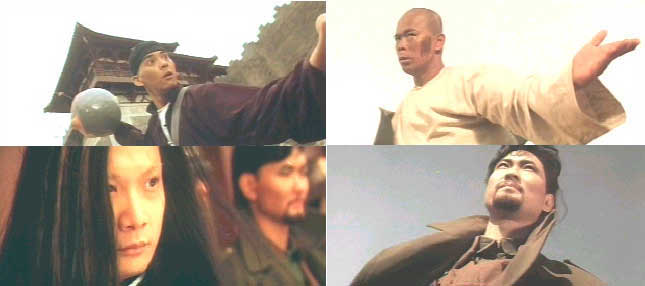
As Lisa Morton noted in “The Cinema of Tsui Hark”, ONCE UPON A TIME IN CHINA
IV also has a plot which “borrows heavily from the first three entries in
the series” (2001:195). More specifically, this Yuen Bun-helmed as
well as action-directed offering takes “the element of the sympathetic white
priest from “Once Upon a Time in China [I]”, the dangerous anti-foreign-intervention
cult from II, and the Lion King Competition from III” (Lisa Morton, 2001:196).
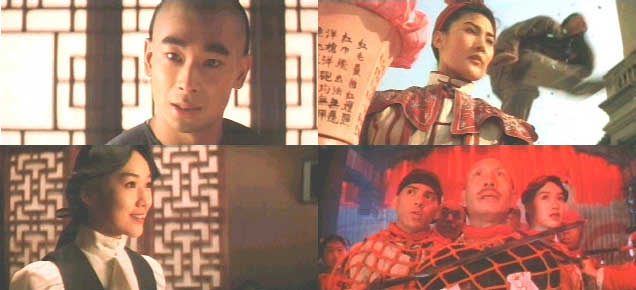
Present in the picture too are the likes of the mischievous Leung Fu (portrayed
once more by Max Mok), enemy-turned-student Club Foot (essayed for a third
time by Xiong Xin Xin) and Wong Kei Yin (Film Workshop favorite, Lau Shun,
reprises the role of the elder Master Wong). Additionally, while Rosamund
Kwan’s Sap Saam Ee (trans., 13th Aunt; AKA Auntie Yee) is nowhere to be seen,
Wong Fei Hung has similar support -- along with distractions -- in the form
of Sap Seh Ee (trans., 14th Aunt; AKA Auntie May), Sap Saam Ee’s equally
Westernized sister (played by Jean Wong).
Small wonder then that so much of ONCE UPON A TIME IN CHINA IV comes across
as recycled rather than original (...though, it has to be admitted, moments
of inventiveness are apparent, like in the case of the fight on blocks of
wood which were liable to fall like dominoes). At the same time, where
I feel that the film most suffers -- and loses out in comparison to the earlier
OUATICs (and, especially, the first two) -- is with regards to its reduced
ideological scale. As an example, while Wong Fei Hung continues to
ostensibly act as a Chinese patriot plus function as the archetype of the
physically able Chinese man, his primary motivation for those of his actions
which propel the latter part of this movie appears to be the seeking of vengeance
for the death of a good man who just happened to have been a Chinese court
official (rather than something larger as well as more abstract in nature).
Furthermore, even while ONCE UPON A TIME IN CHINA IV has its moments of melodrama
together with comedy, it feels devoid as well of genuine emotion plus emotional
heft. To my mind, some of this emotional disconnect is a function of
it feeling like this fourth OUATIC really was made just to capitalize on
the commercial success of the earlier OUATICs. At a more observable
level, it also may stem from the serial good guys somehow not having been
particularly affected by being subject to torture while being held prisoner
by the Germans or even shot by them. Then there’s the Jet Li factor.
Suffice to state here that the actor’s absence from this work was felt, and
most regretted, by this (re)viewer.
My rating for the film: 5.5