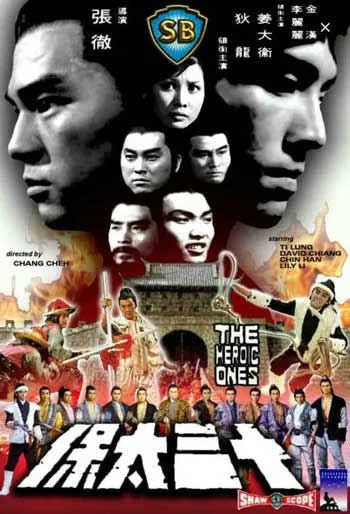
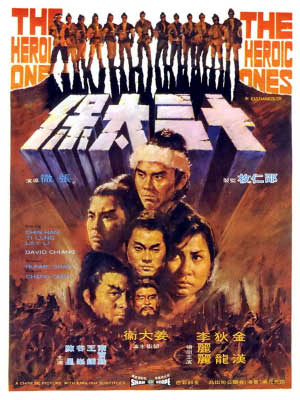
The Heroic Ones
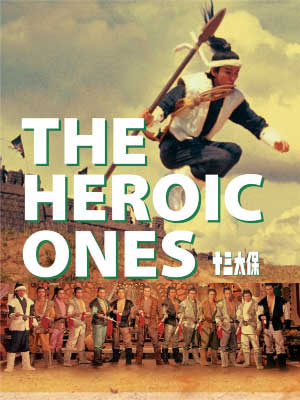
Reviewed by Yves Gendron
HEROIC ONES was the very first film from master
filmmaker Chang Cheh to be released on DVD by Celestial Pictures. It’s
a fitting choice as the movie is a spectacular swordplay yarn, dating back
from 1970 and starring Old School icons David Chiang and Ti Lung. The film
is part of Chang Cheh’s “Blood Brother” cycle of grim, bloody and angst-filled
martial potboilers featuring the pair of actors who were the martial genre’s
biggest sensation at the very dawn of the seventies. Actually HEROIC ONES
could be aptly described as the more topsy-turvy entry of the cycle as it
has our heroic stars playing a bunch of boastful, ruffian Mongol-like barbarians,
the types who usually are the fiendish villains against which the noble Chinese
patriotic heroes are fighting.
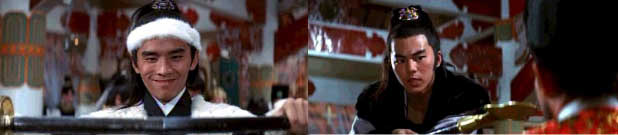
The "Heroic Ones" are the thirteen fierce fighting sons of barbarian chieftain
Li Ke Yung (Ku Feng) who in the last years of the Tang Dynasty (around 900AD)
has been requested by the Chinese Emperor to recapture his capital city held
in the hands of a rebel leader. Chief among this band of heroes are Shih
Szu (Ti Lung) and Li Chun-xsiao (David Chiang) who is the youngest and most
able son as well as his father’s favourite. The Heroic Ones will have to
do more than just deal with a rebel and his large army however, but also
be faced with the treacherous action of a crafty Chinese court official (Chan
Sing), as well as the bitter jealousy of some of the brothers toward their
more favoured siblings - that in the end will lead to tragic consequences.
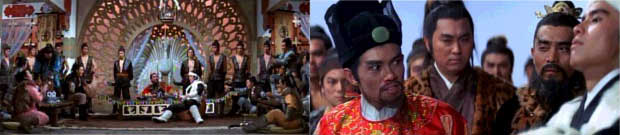
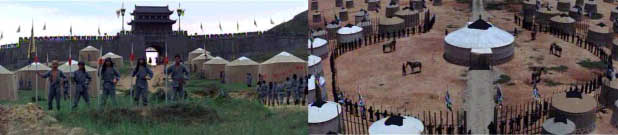
Undeniably, THE HEROIC ONES is a spectacular epic swordplay with superb scenery,
action scenes and swiftly moving armies. It also has a splendid twist on
the usual ingredients of the genre by having the Mongols as heroes thus allowing
for the films’ stars a more wily and wild behaviour instead of being the
typical noble and dignified Chinese heroes. Unfortunately, the film
does suffer from some shortcomings. Let’s just go past the fact that we have
to buy into the urbane and fair looking David Chiang as a Mongol warrior
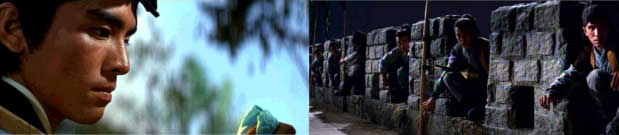
as well as some plot inconsistencies (in one scene the heroes need a grappling
hook to scale a wall, in another they just jump), the film’s main drawback
would be that at least in its first hour, it feels somewhat lumbering. Usually
a Hong Kong film lasts around 95 minutes, but here it is 120 minutes and
one can only wish the film had stuck to the more typical duration.
Yes, there might be plenty of action as Chiang and company goes from one
fight to another but it is sorely missing any real juice and compelling angst-filled
drama. Furthermore, during part of the movie HEROIC ONES is marred by some
sloppily executed techniques with some very poorly done day for night shots.
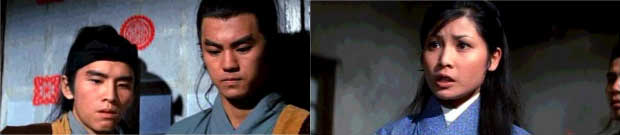
Thankfully, HEROIC ONES pretty much redeems itself at the 75-minute mark
when Ti Lung and a couple of others engage in one of those “one against hundred”
battles which are very typical of the work of Chang Cheh and is the highlight
of the film. Finally, the action (as well as buckets of blood) is flowing.
Bare-chested and wielding a spear, Ti Lung looks superb as he always does
in these types of sequences – although it usually means that his part in
the film is about to come to a end. What follows afterwards, as two resentful
brothers plot against favourite son David Chiang, is somewhat laborious making
the movie’s final third a bit anti-climactic but nonetheless leading to one
of the more spectacularly gruesome and memorable scenes of cinematic killing
ever witnessed in a martial art movie.
HEROIC ONES’s original Chinese title is “THE THIRTEEN SONS OF THE KING”.
Interestingly enough, not all of the sons are the chieftain’s blood-children
as some of them are actually adopted including David Chiang and Ti Lung’s
characters. Besides these two and the two bad seed brothers who cause all
the trouble, the only other one of the thirteen sons to really be distinct
is the burly looking eldest brother, played by character actor Chin Han,
who always advises his father. The rest of the bunch is a pretty undistinguished
lot who for the most part just follow David Chiang around and fight on cue
without displaying much of a personality. Heck, most of them don’t even have
a single line of dialogue in the movie. One of those silent brothers is played
by Lau Kar-wing, younger brother of Lau Kar-leung, one of the film’s
co-action choreographers (the other being his regular partner Tong Gaai).
Lau Kar-wing’s presence among the brothers indicates that quite likely most
of the subordinate siblings were actually screen-savvy stuntmen rather than
regular actors.
One of the film’s great highlights is actually
the king who is played, in a scene-stealing performance, by Shaw Brother’s
superb character actor Ku Feng. Here he finds one of his best early roles
as the boastful, battle scarred, chieftain patriarch who likes nothing more
than to celebrate or bury his grief under gallons of wine. On the other hand,
while getting top billing Shaw female star Lily Li has only a flower vase
type of part to contend with. She appears forty-five minutes into the movie
and is gone within five minutes. Her appearance, however brief, does bring
a nice feminine touch in this otherwise quite male centred movie as a Chang
Cheh’s production usually was.
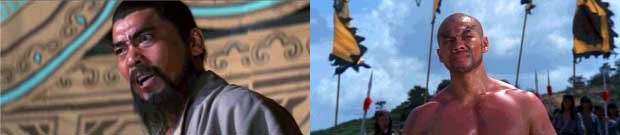
Other regular martial art players cast in the film include the Charles Bronson
of Asia, karate tough guy Chan Sing in a quite atypical role for him. If
David Chiang and Ti Lung are brash Mongols, he plays a crafty courtier who
doesn’t fight. Hong Kong muscle man Yang Sze (better known in the West as
Bolo Yeung) actually makes his screen debut in HEROIC ONES. He was hired
by Shaw after making a name for himself first by escaping the Mainland to
reach HK by swimming and then shortly afterwards by winning a body building
competition. Typically in the film he plays a hulking warrior who Chiang
challenges in a David and Goliath martial style duel. Future minor
kung fu star Clift Lock also appears briefly as a Chinese general and from
time to time there is a sighting of some of the Yuen Brothers, who worked
as stunt-men/fighting extras for Shaw at the time.
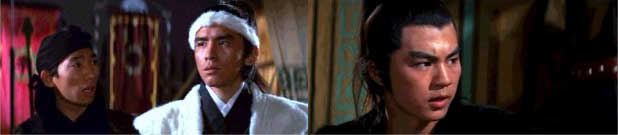
HEROIC ONE was a great box-office success as it ranked fourth and was the
top Chang Cheh movie of the year. Although crucial, Ti Lung’s role was quite
subordinate to David Chiang who was the film’s real star; so the film cannot
be quite properly described as a real pairing of the two. The Blood Brothers
cycle of film was still in its early stage and as the cycle evolved Ti Lung
would receive more prominent role and become Chiang’s real screen partner
instead of just his foil or a plot device - although Chiang still usually
remained the pivotal character. The Blood Brother cycle reach its full throttle
in 1971 with four films being in the box-office top five. Unquestionably,
Chiang and Ti Lung would have been the great martial sensation of 1971 if
it’s hadn’t being for the late and impromptu arrival from America of a former
H-K child star turned martial artist; Bruce Lee. But that’s another story.
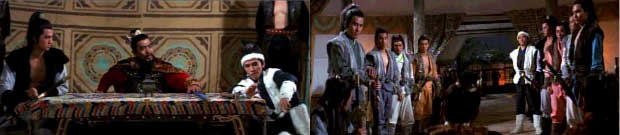
HEROIC ONES like most of Chang Cheh’s huge stellar cast swordplay yarns is
hardly one of his best works. Chang was actually better in more focused,
intimate and haunting efforts like VENGEANCE (70), NEW ONE-ARMED SWORDSMAN
(71) or BOXER FROM SHANTUNG (72). Despite his reservation however,
this reviewer recognises the film as quite an adequate action period piece,
entertaining enough and a pretty good way to get an introduction into the
early, manly, bloody and chivalrous universe of Chang Cheh, pre-Venom time.
Rating: 6.5