The New One Armed Swordsman
Reviewed by Yves Gendron
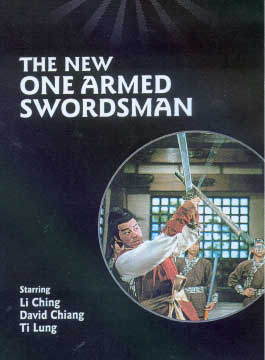
THE NEW ONE-ARMED SWORDSMAN is an early seventies
swordplay directed by martial-cinema master Chang Cheh, part of his "blood
brother" series of violent and gloomy martial films pairing David Chiang and
Ti Lung. Just before the impromptu coming of Bruce Lee, they were the biggest
things in Hong Kong martial cinema. Of the dozen “blood brother” films
made, NEW ONE-ARMED SWORDSMAN is actually one of the most reputed titles
among them.
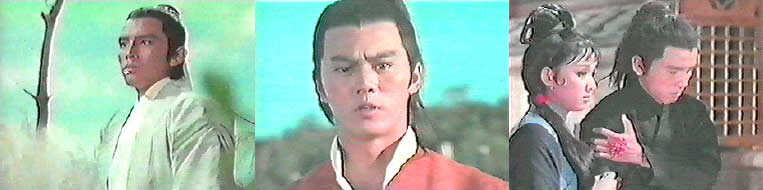
In classic period China, seemingly righteous but actually devious martial
master Lung (Ku Feng) seeks to get rid of the highly talented knight-errant
Lei Li (David Chiang) and so he frames him for a plunder attack, challenges
him in a duel, beats him and has Chiang cut off his own arm by using his
pride against him. One year later, Lei has become a despondent cripple hostel
waiter brooding endlessly despite the tender attention of Pao Chin the daughter
of the local blacksmith. Only the friendship of a follow knight-errant named
Feng (Ti Lung) and the admiring attention he gives Li finally succeeds in
making him come out of his shell. However, Feng happens to be the next victim
of Master Lung’s devious scheming. Feng falls into his trap, is killed and
when Li hears of this all hell breaks loose, as he once again has to pick
up his sword and thus becomes the New One Armed Swordsman.
Dating back from 1971 (predating The BIG BOSS Bruce Lee’s Hong Kong martial
art debut by a matter of weeks) NEW ONE-ARMED SWORDSMAN, might be considered
as fairly dated and cheesy looking by today’s standards (as well as further
damaged by bad dubbing and a full screen video format that most viewers are
forced to see it in). This is the brand of movie that earned Chinese swordplay
their derisive pun "chop-sokky" back in the old days, although in the case
of NEW this is a most literate description. Still, despite some slow
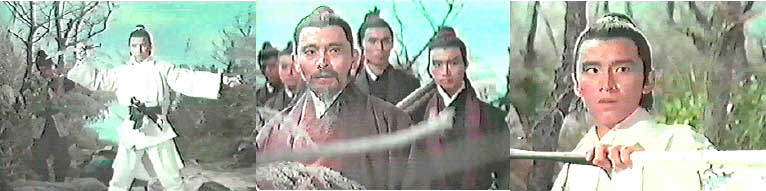
parts, the movie can be considered as having a sound drama. Some of the action
is of the swinging sword-dozen fall dead variety, but other parts - especially
the one on one duels are exciting and intense. Ti Lung as Feng is his usual
majestic self, while character actor Ku Feng (better known by today’s audience
for his role as the malignant police chief officer in PEKING OPERA BLUES),
creates a deliciously devious villain who fakes being a honourable master
and handles the three-handle staff pretty well.
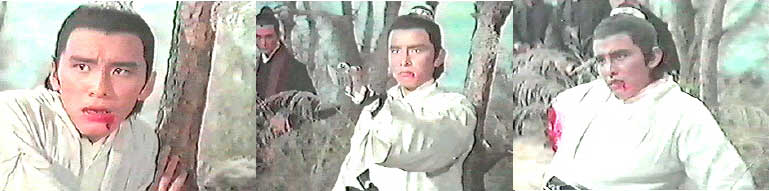
Actually, what many might consider as the movies main liability would be
its hero star player, David Chiang. In the old days he was Ti Lung’s starring
equal, as he was physically capable and gave a haunting quality to the wily
or brooding characters he played. Nowadays though, while Ti Lung’s reputation
has become legendary, David Chiang has become one of the most under-appreciated
players from that period. To a contemporary audience, he looks rather unconvincing
as an action star with his sleight build (even though he was a stuntman in
the industry after his child star period), and his screen persona can come
across as annoying. In this particular movie he is called upon to sulk for
half of the movie and then slaughters about a hundred guys in two minutes,
which is a bit much. Also, he has something of a modern urbane look to him
that make him look somewhat out of place in a period movie. He fits better
in either contemporary or early Republican martial movies. Still, if one
can ignore that, then the viewing should be rewarding. The spectacle of Chiang’s
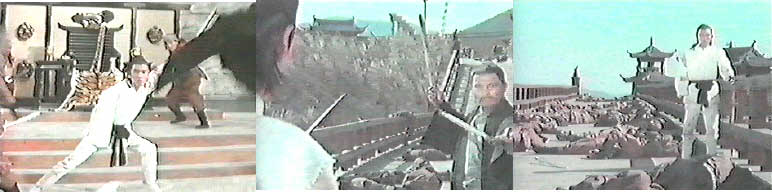
mass slaying has to be seen to be believed and the finale between Chiang
and Ku Feng, while perhaps overusing the trampoline, is dramatic and excellent.
Incidentally, it is because of the villain’s use of the three-section-staff
that NEW ONE ARMED is also known as TRIPLE-IRON, another name for that sort
of weapon.
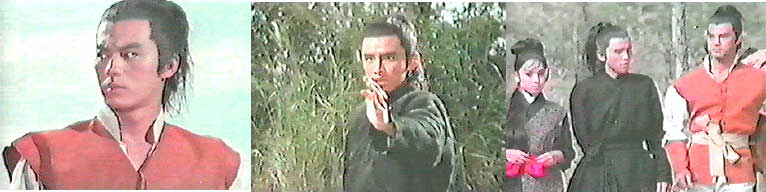
The film is called the NEW ONE ARMED SWORDSMAN not because a one-armed guy
replaced another in the movie but for more complicated reasons. The original
cripple knight was (Jimmy) Wang Yu who created the part for the classic
titular movie back in 1967 and its sequel was made in 1969. But then in 1970
Wang left Shaw Brothers, the movie studio that had made the one armed movies,
carrying with him the character for another picture. Needless to say the
Shaw Brothers bosses were none too happy about this situation and so they
commissioned Chang Cheh, who made the original pair of One-Armed movies,
to recreate the franchise with another actor - in this case David Chiang.
There are some interesting differences and similarities between the two heroes.
First of all they are both initially proficient swordsman until they are
both similarly crippled - both physically but also psychologically as well
and change into brooding loners. On the other hand, while one-armed swordsman
2 was a confident and wily fellow, the first was already a born brooder to
begin with, feeling ill at ease and out of place in his master's school.
Unexpected events lead both swordsmen back into action but while the first
one acted to defend his master against an old rival, the second one acts
out of pure revenge becoming almost an enraged psychopath coming to the enemy
and killing everyone in his path; an hundred strong army of men in this case.
This is an interesting distinction that says a lot about how within four
years Chang Cheh’s themes evolved, how the socio-cultural background within
the martial genre changed (from empowering fantasy to revenge one) and how
Chang envisioned his actors differently. Quite ironically after Chiang left
Shaw later on he would team-up with Wang-Yu in a movie putting their respective
cripple knights together in ONE-ARMED SWORDSMAN, which he also directed in
1976.
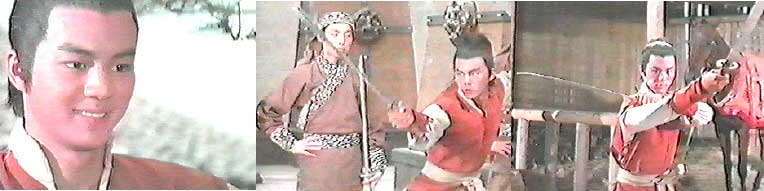
Overall while NEW ONE ARMED SWORDSMAN could be considered as having a somewhat
dated look, it still remains an eminently watchable swordplay yarn, especially
for those who have gone through all the wire-fu stuff of the nineties. It
might be cruder by comparison but it has solid qualities and it sure delivers
quite a wallop in an over the top brand of action that is mostly lacking
in the more special effects driven martial art fare of recent years. For
those who want a change of pace, this is really most recommended.
Rating: 7.0