Duel of Iron Fist
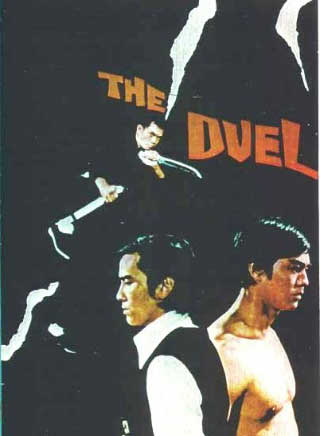
Reviewed by Yves Gendron
Try to imagine owing your life to the man who
killed your beloved (god)father. This is the predicament that poor Ti Lung
finds himself in DUEL OF IRON FIST (also know more simply as THE DUEL). This
1971 kung fu pot-boiler is from the martial art master filmmaker Chang Cheh
and is part of his "Blood Brother" movies that he directed back in the early
seventies which showcased the deadly duo of Ti Lung and David Chiang.
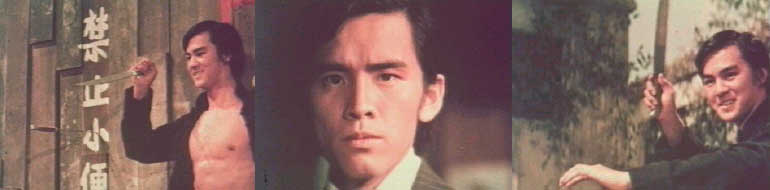
Set in the Republican era of China, Ti Lung plays
Chan Cheh the (god)son? (the dubbing isn't clear on that), of an ageing underworld
godfather on the verge of retirement. The latter is killed in a surprise
attack during a celebratory party however, forcing Chan into exile for the
good of the gang. A year later after various attempts against his life, Chan
Cheh discovers that the one who took over his (god)father’s group, the book-keeper
Kang, not only wants to kill him but had also arranged his (god)father’s
murder in the first place. A guest at the party, the “Rover” (David Chiang)
– a dapper suited mysterious mercenary - carried out this assassination.
Naturally, Chan Cheh sets out for revenge with the help of his drunkard elder
brother (Ku Feng), his best buddy, but along the way the Rover saves Chang
on a couple of occasions for his own mysterious reasons.
It's rather hard to make a fair assessment of DUEL OF IRON FIST nowadays
as most current versions suffer from the triple outrages of so many kung
fu films from this period - weak English dubbing, extensive cutting and a
terrible video transfer. It’s more than enough to wreck any viewing experience
and of making any griping pot-boiler into shoddy looking chop socky silliness.
Under such treatment even a classic like John Woo's THE KILLER, would end
up looking pretty bad. Small wonder then that DUEL recently ended up
being used as an example of a "bad" kung fu movie in an episode of the TV
series BUFFY THE VAMPIRE SLAYER.
Yet despite being reduced to a shadow of it's
original self, some juice still comes out of this movie and it still remains
a tense, compact action drama with an adequately gloomy atmosphere and frequent
one against many thundering battles scenes. Not of the intricate and ballet
like kung fu variety seen in later martial pictures, but far more raw and
bloody with whirlwind-like ample use of knives, daggers and hatchets. Another
strong asset going for the film is the showcasing of Ti Lung in the prime
of his mid-twenties. He plays an impetuous young fighter, earnest enough
to tattoo a red butterfly on his chest in honour of his beloved sweetheart
and yet he is a furiously kicking two blade carrying human tornado in battle.
This said, DUEL is far from being a masterpiece. Plot-wise it lacks focus
and meanders a bit. It's most grievous lapse is an odd subplot which feels
as if it has been put there only so as to avoid Ti Lung and Chiang ending
up slaying each other at the picture’s close. It involves a crooked senator
and makes the Chiang character some sort of secret agent. Not only does this
needlessly complicate the plot, but it also diminishes the dramatic "You
saved my life yet you killed my (god)father" twist. Fortunately this shortcoming
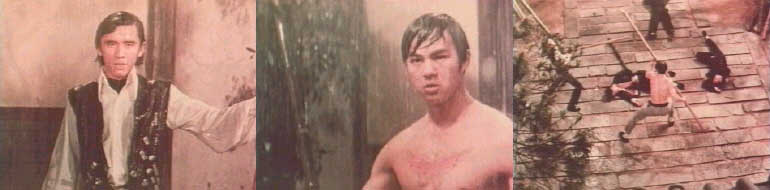
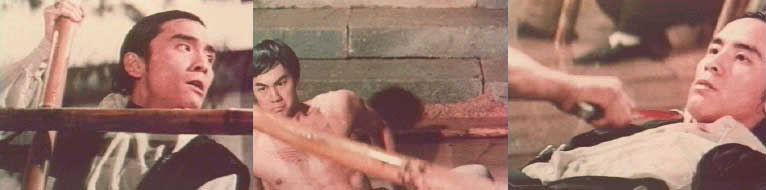
does not detract too much from the riveting final third with three huge fights
coming one after the other - the one in the middle being a bamboo pole duel
between Ti and Chiang. It's done in a setting of rain, mud and blood and
allows Chang Cheh to create some superb homoerotic heroic blood-shed imagery.
Seen in a straightforward way, DUEL is fair enough.
It's possible however to see the movie from a quite potentially interesting
angle: as a prototype of John Woo's late eighties heroic bloodshed movies
(the reference earlier of the THE KILLER was not gratuitous). It's widely
acknowledged that Chang Cheh was John Woo’s mentor to whom he worked as assistant
director in the early seventies and to which he patterned his themes of tragic
heroism, male bonding, chivalrous like code of honour and bloody, balletic
battle scenes after. As a kung fu gangster mix-up DUEL OF IRON HAND’s affiliation
with the later gangster epics by John Woo is even more clear than most of
Chang Cheh’s “Blood Brother” movies.
It's just that it's 1930 Republican China instead of contemporary Hong Kong
- knives instead of guns, and David Chiang rather than Chow Yun Fat. Indeed,
Chiang may not have the all consuming charisma of Chow and looks rather like
Tony Leung Chi wai (aka Little Tony), but his dapper suited, smirking, secretive
cool dude character is much like the characters of Mak Gor and John/Jeff
played by Chow in A BETTER TOMMOROW and THE KILLER respectively. As an aside
- ten years later Chang Cheh recycled the DUEL plot for another movie, the
Venom gang martial art movie FLAG OF IRON aka: SPEARMEN OF DEATH in 1980.
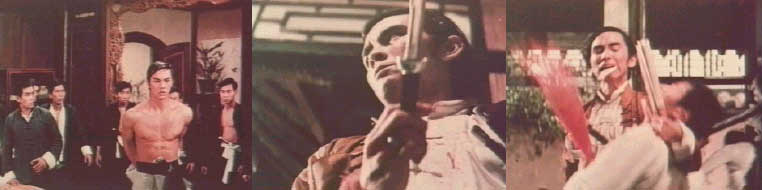
DUEL OF IRON FIST exists in two different versions, both far from being satisfactory.
One is 100mn long, dubbed, in full screen format and seemingly cut around
the edge to some unknown extent. The other is letterbox, which greatly improves
the viewing of the fight scenes, but is even more extensively cut, ends in
the middle of the final fight and wears the title DUEL OF SHAOLIN FIST which
is a sheer travesty as the film has nothing to do in either plot or fighting
style to the Shaolin mythos. As it now exists, DUEL OF IRON FIST is recommended
mostly for Ti Lung and old school dedicated fans, as well as fans of Heroic
bloodshed movies who might be interested in seeing an "ancestor" of their
beloved genre. However once it is restored - if ever - DUEL might be possibly
considered quite worthwhile for a far wider range of Hong Kong cinema fans.
Rating: 6.0