The House of Love
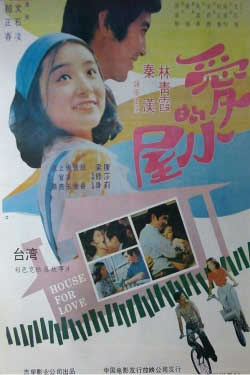
Reviewed by YTSL
Looking at the statistics supplied on one of
the “Absolutely Trivial”(!) pages of a former brigittelin.com (now gone)
site, it becomes very apparent that, while Brigitte Lin Ching-Hsia’s Hong
Kong and Taiwanese movie careers were of the same, approximately ten year,
length (N.B. I’m not counting the two instances -- in 1998 and 2001 -- in
which she lent her voice to Yonfan’s films; consequently, as far as I’m concerned,
the aptly nicknamed -- by the Chinese media -- “Wondrous (or Major) Beauty”
retired in 1994), the cinematic goddess was far more active in her homeland
than the so-called Eastern Hollywood. When viewing offerings like this
disappointingly lame 1974 romantic effort, I find myself hugely ruing it
being so that she appeared in 10 movies in what was only her second year
as an actress (and another 20 in the two years following it) rather than
in, say, 1986 (when she appeared in only three works, two of which were “Peking
Opera Blues” and “Dream Lovers”), 1990 (when she appeared in only one --
the multiple Golden Horse award winning “Red Dust”) or 1992 (the year of
release of the understandably career rejuvenating “Swordsman II”, “Dragon
Inn” and just two others in which she had a significant role).

To be fair, THE HOUSE OF LOVE (AKA “Little House of Love” and “The House
for Love”) does offer up ample opportunities to revel in seeing its heart-clutchingly
young, wonderfully fresh-faced and very leggy female lead flit around on plus
own the screen. Although this pointedly pro-marriage -- but only for
those who have adhered to such adages as “Better bitter now, sweet in the
future” and “The more frugal we are, the closer we get to marriage”, as opposed
to those who hope to be able to wing it with the aid of hopeful prayers and
romantic declarations like “Using our passion, we [shall] create a new life”...
-- production has three other pairs of characters with messages to relay
beside those portrayed by its headlined stars, it is clear enough that the
main spotlight is meant to fall for the most part on Brigitte Lin (whose
Shiao Yu character spends a lot of time alone in her family’s mansion of
a home due to the only child’s wealthy parents frequently being out of the
country on business) and Chin Han (whose equally sibling-less character, a
college-mate of Shiao Yu as well as her boyfriend, is the one who puts the
thought into her pretty head that “If you are married, you can have company”).

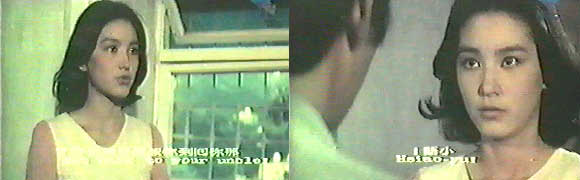
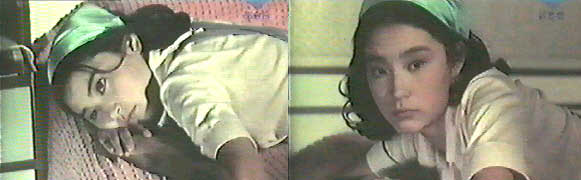
Furthermore, THE HOUSE OF LOVE’s cinematographer really did appear loathe
to deny himself the opportunity to zoom in, capture and provide the movie’s
audience with full-frontal close-up shots of Brigitte Lin’s ever so cute countenances
and visage. Unfortunately, it is quite obvious that the veritable legend
that was obviously in the making -- who (already) was able to recite lines
in this offering like “I’m afraid to be alone in the dark” and “I don’t get
real love” (from the parental units) with a straight, even winningly mournful,
face -- hadn’t quite mastered “the gaze” straight into the camera and viewers’
hearts just yet. Instead, one ended up with the kind of way less electrifying
attempts to look in the direction of the camera(man) from the then under
21 year old actress that, while still better than most efforts by the likes
of Kelly Chen (whose looks -- but surely not acting abilities -- some people
have compared to Brigitte Lin’s. No way, IMNSHO!), can seem disconcertingly
off the mark.
That I had found myself pondering over such things and making these types
of judgments while viewing this film is, actually, less a commentary on this
(re)viewer’s openly admitted Brigittephilia and more re the large amounts
of THE HOUSE OF LOVE that get spent on that which really didn’t do much to
directly further the work’s main story (involving Brigitte Lin and Chin Han’s
love-struck characters and their impulsively seeking to wed even before they
take their final academic exams) or two subsidiary ones (through which marital
themes also run). So much is this the case, in fact, that this effort
might well be the movie to test one’s genuine willingness to sit through and
enjoy watching my (together with many other people’s) favorite actress do
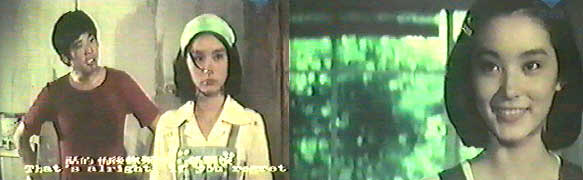
such as: even if not actually read a phone book, spend lots of time talking
on the phone with Chin Han’s character; go on shopping expeditions for home
decorations with him; do a bit of painting of what appear in the English subtitles
as a “love cabin” and “cottage of love” as well as (little) house of and/or
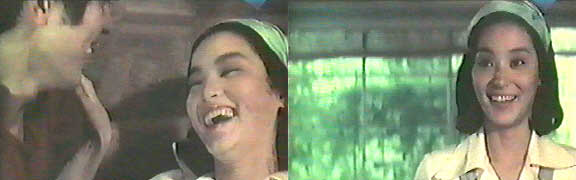
for love; participate in the kind of “dodging through and around trees” romantic
scenes that are more stereotypically Bollywood than Taiwanese; and, more
than once, get happily twirled around in the air by the man who was, for
a time, the love of her real as well as reel life.
In a poll conducted over at <www.brigittelin.com>, at least one respondent
actually registered his or her opinion of THE HOUSE OF LOVE being an excellent
film while the other of its evaluators adjudged it to have been very good.
My post-viewing reaction is to suggest that those two fans of she who then
was solely credited as Lin Ching-Hsia most definitely passed the test that
I think that this at times this often too silly to be taken seriously movie
demandingly poses for Brigittephiles. The possibility also exists that
they (who might be reading this review!) disproportionately enjoyed the respite
that this never intense -- in large part because it never was truly involving
-- work provided from their being put through the emotional wringer in a way
that seemed to have been the norm for Brigitte Lin’s 1970s era efforts.
To be sure, there were people who objected to The Great One’s Shiao Yu and
Chin Han’s Lo Wen characters wanting to get married at such a young age and
at a period in their lives when they weren’t sufficiently prepared to enter
into a union knowingly described by a more experienced as well as conservative
individual as “a very important matter” and “a matter of a life time”.
However, one of them (i.e., the parentless Lo Wen’s bachelor uncle) turns
out to have other pressing matters on his mind while about the most that the
chief protester against THE HOUSE OF LOVE’s youthful protagonists’ romantic(ized)
marital plans -- the lass’ wealthy mother, rather than her father, has the
part of the nominal “heavy” in this piece -- does to register her disapproval
is to huff and puff but still not blow down the idealistic lovebirds’ ramshackle
house of love (which she took to negatively calling a “love dog house”).
And should anyone wonder: This being some eighteen years before Asia the Invincible
would memorably burst onto the Chinese cinematic scene, about all that this
Brigitte Lin character did in response was to pull a long face, let out a
few indignant “hmmph” sounds and beguilingly sulk... ;S
This “Brigitte-attack” prone -- and this is what
she got for it! -- reviewer’s rating for the film: 4.5