The Private Eyes
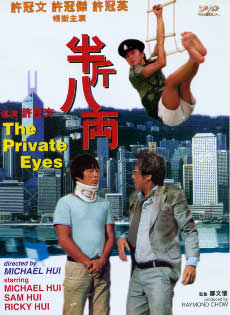
Director: Michael Hui
Year: 1976
Rating: 8.5
This is a classic
film from the opening shots of the camera silently panning the skyscrapers
of Hong Kong and then gravitating down to the street level and suddenly picking
up the noise and rhythm of the people – crowds of people going about their
lives – and then Sam Hui’s catchy guitar riff suddenly breaking in with “We
the poor working people” giving recognition to those who just manage their
lives from day to day. It seems to be saying this is where life goes on –
far away from the grandeur of mighty buildings – this is the real Hong Kong
– people bumping, pushing, eating – trying to get ahead a step at a time.
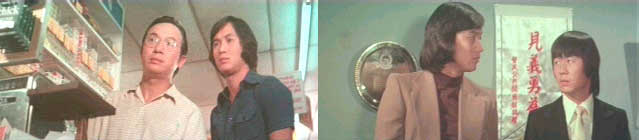
By the mid-70’s Hong Kong itself was going through the beginning of a transformation
that would take it from a somewhat sleepy colonial city that produced and
exported inexpensive consumer goods to being one of the major financial hubs
in the world. This was a city on the move – finding newfound energy and a
sense of identity and purpose and this change was beginning to be reflected
in the Hong Kong cinema outside of the martial arts films. Michael Hui who
got his start in television (which tended to be more experimental then film
at the time) was one of the first to bring this hip, contemporary and irreverent
attitude to film.
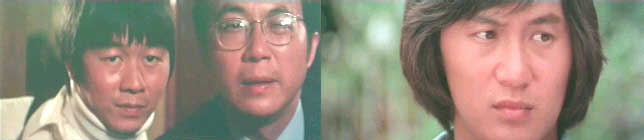
His comedies dealt with the common man – but by no means the virtuous man.
His characters were in a tough rat race and often resorted to whatever means
needed to get ahead of the guy next to him. Gone was much of the communal
feeling of earlier Cantonese films as it was replaced by a sense of individualism
and get ahead capitalism that in fact reflected what Hong Kong itself was
migrating to. Michael himself often portrayed the most cynical character
though generally by the end he has learned some moral lesson about helping
out his fellow man.
By this film, Private Eyes, Hui had worked out some of the rough edges of
his earlier films (Games Gamblers Play and The Last Message) and the brothers
produced a nearly seamless film that is one of Hong Kong’s greatest comedies.
In polls both from critics and from movie fans, this is usually considered
one of the most popular films ever made in Hong Kong. It is also an important
film (along with Hui’s others) for the contribution it made to revitalize
the Cantonese film industry. The Cantonese film industry (films produced
in Hong Kong utilizing the local Cantonese dialect) had fallen on hard times
and nearly all the films at the time were being produced with Mandarin as
the spoken language. The reasons for this were largely economic, as there
was a much larger market outside of Hong Kong for Mandarin films than there
was within Hong Kong for Cantonese films. The Hui brothers though captured
the mentality of Hong Kong in their films and Cantonese was an essential
element of that. The films became so popular (both inside and outside of
Hong Kong) that within a remarkably short time (along of course with the
New Wave, Golden Harvest and Cinema City films) Cantonese films were soon
dominant and HK Mandarin films went the way of the dinosaur (though the films
were still dubbed for Mandarin speakers). Hui incorporated many influences
from the West, but he still maintained (but modernized) many of the Chinese
comedy traditions such as the buddy film.
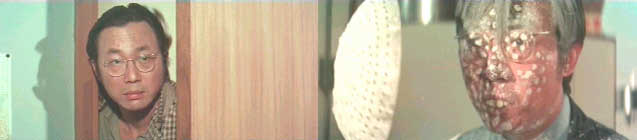
By today’s post Stephen Chow/Wong Jing standards, Hui’s comedy may feel a
bit tame and perhaps too restrained, but it has a wonderful dry humor, human
warmth, constant sly cleverness and such a sense of good nature that it is
difficult not to enjoy it. Hui never overdoes it in a scene – there are times
you think he could have gone longer with a routine – milked it for a few
more laughs – but he prefers ending it to overstaying its welcome. This film
has a number of images/routines that have become part of the fabric of Hong
Kong film – the image of Michael battling in buck teeth and armed with sausage
nunchakas, his face covered with spotted flour, falling back into the pool
as he tries to check out a beautiful girl, the chicken/cooking/exercise routine
– but the film has other excellent ones as well – from something as small
as getting toothpaste out of a tube to Sam completely wrecking a car bit
by bit in a chase.
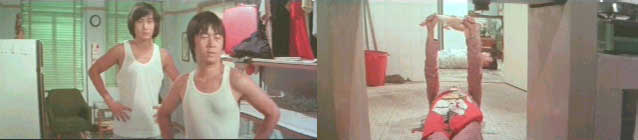
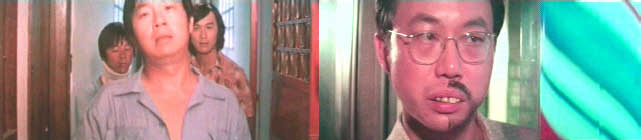
The film is basically made up of a series of cases and misadventures by a
private eye (Mannix Detectives) and his two assistants – Sam Hui and Ricky
Hui. All three take on very distinct personalities that they were to maintain
to some extent throughout their film careers – Michael the fast talking,
fast thinking cynical manipulator, Sam the good hearted open one that the
women liked with kung fu skills to boot and Ricky the woeful not very bright
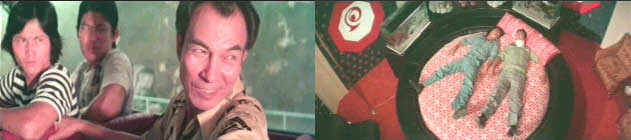
one. The cases are all small - retrieving a TV set, catching a shop
lifter, getting evidence on cheating husbands/wives and a group of movie
theater robbers (headed by Shek Kin), but within this framework the Hui brothers
are able to create some lovely comical moments. Much of the pleasure of the
film is simply in the low-key chemistry between the three brothers - a stare,
a look, a slow burn.
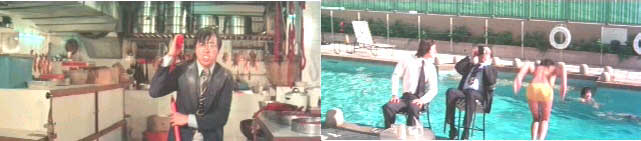
How well this film has weathered the past quarter of a century is difficult
to determine for others. Since it was made in 1976, the style of comedy has
become rougher, faster and more obvious in many ways and often provides more
immediate gratification. Hui’s comedy is subtler and gentler – full of lovely
still or quiet moments - and at least for me this film and the Hui humor
has well stood the test of time.
We the poor working people
Getting ulcers running around
Chicken feed is our reward
Rough deal is what we get
The boss is ever ready to explode
His barks are long, his face longer
When we ask for a raise
Brother you’re in for a treat
(chorus)
Working like a dog
Things keep going wrong
Why don’t we grab a gun and hold em up
At least making our efforts worthwhile
We the poor working people
Slaves to money for life
Our misery it’s unspeakable
But we don’t take it for granted
Happiness is not ours to share
Suffering is ours to bear
A little more is a little more
We care at least to make our effort worthwhile
It’s tit for tat
Tit for tat
(chorus)