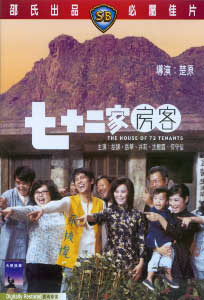
The House of the 72 Tenants
Reviewed by YTSL
I’m not sure about other people but this Hong
Kong film fan had been feeling some trepidation as well as excitement with
regards to the Shaw Brothers movies that Celestial Pictures has been and will
be re-releasing. Apart from techie type concerns and those that stem
from the sheer size of the collection whose contents many folks will be seeing
for the first time in decades, if not ever, I also found myself wondering
whether these near mythical offerings that have finally been freed from their
place in the Shaw Brothers vault would seem too dated. Furthermore,
I have worried re whether they would appear overly foreign, even for someone
who now feels comfortably familiar with the output of the more recent decades
of Hong Kong cinema.
In bidding to minimize this possibility, I made sure that my first two introductory
Celestial Pictures releases starred Cheng Pei Pei -- a former dancer turned
actress who may have started her career as a Shaw Brothers contract worker
but has continued to ply her trade up until the present day. Emboldened
by how much enjoyment I got out of viewing a 1960s musical (in “Hong Kong
Nocturne”) as well as a classic wuxia work that I had previously only managed
to see in faded, “pan and scan” form (i.e., “Come Drink with Me”), I next
elected to check out a legendary comedy that: has been majorly credited with
helping to revive Cantonese-dialect/language cinema (The mind almost boggles
upon learning via David Bordwell’s “Planet Hong Kong” that, in 1972, the
year before THE HOUSE OF 72 TENANTS’s initial theatrical release, “no Cantonese
films were made” (See 2000:66)); plus looked to have been warmly referenced
two decades later in “He Ain’t Heavy, He’s My Father” (a nostalgia drenched
U.F.O. work that featured an appearance by this box office champ’s director-scriptwriter,
Chor Yuen, as well as a main character -- played by Tony Leung Chiu Wai --
who was named after him).
THE HOUSE OF 72 TENANTS is a generally affectionate as well as often comic
portrait of Hong Kong at the peak of an economic depression, and during a
time of high inflation -- when a bar of soap or sack of flour could just
one day later cost as much as two of the exact same stock did the day before.
Although its context plus subject matter -- which, broadly speaking, include
human nature, social problems and communal goings on -- are not innately
humorous ones, the movie apparently succeeded in generating a bundle of laughs
along with some fortunately not long-lasting tears during its climb to the
top of the 1973 box office list. Re the matter of its out-grossing
even the Bruce Lee starring “Enter the Dragon”: This probably stemmed in
large part from this collective spirited product of what might have been
labeled at the time as a “right wing studio” turning out to be -- as Bey
Logan opined in an interview that’s part of the film’s DVD package -- a “celebration
of the common man in Hong Kong”. At the same time, the eventful offering
undoubtedly appealed as well to 1970s era “Fragrant Harbour” cinema-goers
by way of possessing a cast that has been described as “a virtual who’s who
of the local entertainment scene” (whose names -- and that of the characters
they play -- actually get flashed on the screen when they make their first
appearance in the film).

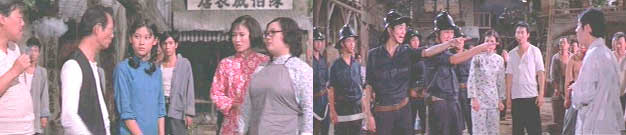
As might be gathered from its (English language) title, THE HOUSE OF 72 TENANTS
centers around certain colorful personalities who live in the same large
building -- that’s actually multiply divided up into separate units -- and
are liable to frequently cross swords as well as paths with their fellow
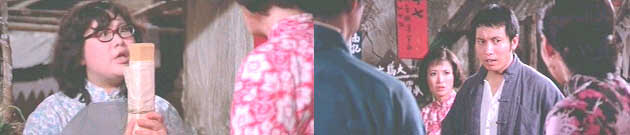
tenement residents. These include: the good looking -- but frequently
bad behaving -- landlady (Hu Chin plays the woman identified as Pat Koo in
the English subtitles); her arrogant husband (Ah Bing is essayed by Tien
Ching); her put upon adopted daughter (Ah Heung is portrayed by Cheng Li);
a honest and handsome cobbler (Fat Choi comes in the form of Yueh Hua, one
of whose earlier roles had been that of the drunken hero of “Come Drink with
Me”); an activist olive vendor named Ah Fook (played by Hoh Sau San) together
with his quieter wife (who is essayed by Nam Hung, the real life wife of
Chor Yuen); and a lively laundress referred to as Shanghai Po (who Lydia
Shum plays with quite a bit of relish).
Among the supporting characters in THE HOUSE OF 72 TENANTS who, nonetheless,
also manage to get embroiled in such as an argument about water rights, disputes
over a pair of burnt trousers or a piece of stolen cloth, a bid to stop the
planned eviction of a tenant and the foiling of an attempt to marry off a
nineteen year old female to an old man who already had five concubines as
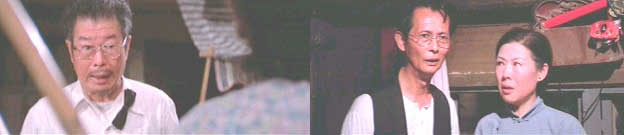
well as a (senior) wife are: an elderly tailor and his gentle wife (Uncle
and Auntie Chan are respectively portrayed by Wong Hon and Ouyang Shafei);
a doctor who has just migrated to Hong Kong from Shantung (played by Cheng
Miao - real life father of Cheng Li); plus a seemingly particularly impoverished
cigarette vendor (Wong Ching Ho’s character still gets respectfully addressed
as Uncle Yeung though by most of the other tenants). A few others whose
presence adds flavor plus socio-cultural variety to this packed effort are:
Shanghai Man (Cheng Hong Yip character is the husband of Shanghai Po); a
crooked cop (Police Constable 369 is played by Liu I-Fan); a consumptive
as well as jobless university graduate (Han Yi Shi is essayed by Leung Tin)
and his double job holding -- to compensate for her spouse’s unemployed plus
sickly state -- wife (The elegant but understandably often tired looking Mrs.
Han is portrayed by Karen Yip Leng Chi).
Despite the still entertaining after all these years -- without being “side-splitting
laughter” inducing, like had been promised in its original trailer -- offering
having the title it does, not all of the 72 stars (or characters) who populate
THE HOUSE OF 72 TENANTS are residents of the crowded living quarters whose
address gets given as No. 96 Chan Yuen. Additionally, even while this
surprisingly unclaustrophic feeling work looks to have been entirely shot
inside the Shaw Brothers Studio, other settings inside of which events occur
include a market, an underground casino, a brothel and assorted streets and
alleyways. For the most part, it is these supplemental locations where
Hong Kong filmophiles can get further amusement by way of spotting certain
individuals who only have minor roles in this effort but would achieve greater
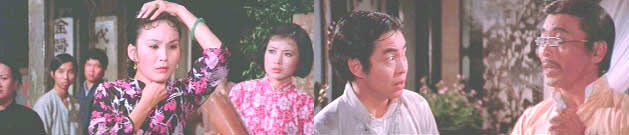
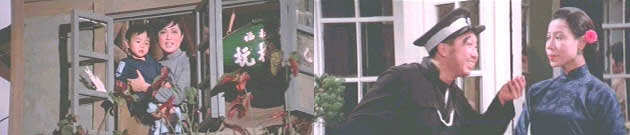
prominence in years and decades to come (like Helena Law Lan and Danny Lee;
though Adam Cheng and Ricky Hui did end up at the movie’s main locale as
members of a crew of firefighters who went there in response to what turned
out to be a false fire alarm).
My rating for the film: 7.5
For another review of The House
of 72 Tenants plus a Gallery of the Actors/Charcters, click here.