Magic Kitchen

Reviewed by YTSL
Wong Kar Wai. Tsui Hark. Ann Hui.
Johnnie To. Wong Jing. Love them or hate ’em, it’s undeniably
so that these are auteurs who are familiar to a large percentage of Hong Kong
filmophiles. Additionally, there are a sprinkling of others -- e.g.,
Alan Mak, Riley Yip, Wilson Yip and Barbara Wong Chun Chun -- who have latterly
gained a following and reputation on the basis of a handful of, sometimes
less than that even, offerings. However, while many fans of Hong Kong
cinema have viewed at least one movie in which erstwhile United Filmmakers
Organization (U.F.O.) partner, Lee Chi Ngai, had a hand (be it as director,
scriptwriter, producer or art director), his is a name that does not seem
to be readily recognizable to quite a few folks.
Maybe this is the result of Lee Chi Ngai’s not
having worked for a while; what with his having decided against being involved
with “The Touch” and “The Sleepless Town” (1998) consequently being his last
directorial effort before he finally returned to the Hong Kong film-making
scene in 2004 with MAGIC KITCHEN (which he scripted as well as helmed).
Perhaps it’s due to his versatility (It can be hard to believe that the man
who made his directorial debut with a rape revenge work entitled “Vengeance
is Mine” could go on to helm such U.F.O. works as the feel good “He Ain’t
Heavy, He’s My Father” and the thoughtful as well as magical “Lost and Found”).
In any case, his name being attached to this Chinese New Year offering --
rather than it having a star-filled cast headed by Sammi Cheng, Jerry Yan
(of F4) and Andy Lau -- is what got this admittedly not always in the majority
(re)viewer all interested in checking out the movie that has been described
as a comedy but turned out to be too preachy to strictly qualify as such.
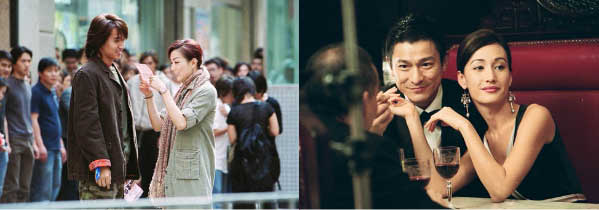
MAGIC KITCHEN centers on a sweet, even if insecure, woman named Yau (essayed
by Sammi Cheng) who is a successful restaurant owner and does much of the
cooking that takes place in the establishment’s kitchen. Unbeknownst
to almost all bar for her faithful assistant, Siu-Ho (who’s played by a broody
as well as dubbed -- in the Cantonese version of the film -- Jerry Yan),
though, the recipes that she follows to cook up a whole host of culinary
delights were actually thought up by her food lover mother -- an individual
who would conjure up a feast in honor of even an accidental slip by President
Reagan! -- rather than herself. Furthermore, Yau doesn’t seem to possess
much of a love of food, never mind food preparation, and thus considers herself
a fraud who’s in major danger of being found out should she ever do such
as accept a tendered invitation to appear on a popular Japanese TV cooking
show.
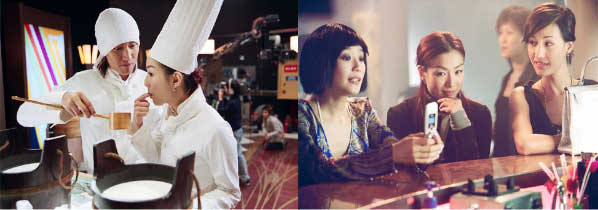
Nonetheless, Yau allows herself to be talked by Siu-Ho to visit Japan and
check out the rules, regulations and conditions which she would have to adhere
to if she were to take part in that “King Chef” TV program cum cooking contest.
While in the Land of the Rising Sun, she bumps into an old flame (Tsuen Yau
is attractively portrayed by the guest-starring Andy Lau). Although
she tries -- albeit in neither the most efficient nor ideal way possible
-- to get him re-interested in her, they return to Hong Kong without truly
reconnecting. While this was bad enough, worse was to come: as in Tsuen
Yau turning out to be going out with one of Yau’s two best gal pals (i.e.,
the sophisticated May who is played by a badly dubbed Maggie Q, as opposed
to the other guy-magnet essayed by Nicola Cheung). As a result of this
state of affairs, Yau finds herself with more than her suspect culinary abilities,
never mind a cooking contest, preying pretty heavily on her mind...

...Although certain connections are made between Yau’s loveless, for the
most part, culinary activities and her (in)ability to come by true love with
a man, they generally seem rather forced. Additionally, if I were asked
whether MAGIC KITCHEN is more a film about food (and/or cooking) or love,
I would immediately answer that it’s primarily a romance -- and one that
neither needed nor gained all that much from its main character being a cook
(or, more accurately, restaurant owner). Therein lies one fairly substantial
problem that I have with this uncommon Lee Chi Ngai movie whose surroundings
didn’t jive with as well as was far away from effectively functioning as
an additional character for its main story.
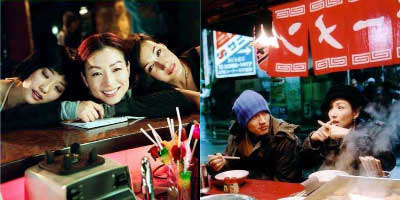
Another is the lack of chemistry that Sammi Cheng has with the veritable
parade of men -- bar, as one might expect, for Andy Lau -- who appeared as
her character’s possible love interests. In all fairness to them, Stephen
Fung seemed to really only be there to be comic relief as well as was in
just a few scenes, and Daniel Wu is in MAGIC KITCHEN for even less time than
his fellow Chinese-American actor (As an aside: what with its also having
Michael Wong in its cast, this effort appears to have an unusually high Asian-American
quotient). However, it is a damning indictment on the offering as well
as the individuals involved that its leading lady and main man (Jerry Yan,
unfortunately) fail to generate sufficient sparks and sparkle to cast light
as to why anyone would think that this duo would make for a real winning
combination at the box office or anywhere else. Indeed, on the face
of their interactions in this work, it would seem that Ms. Cheng might do
much worse than consider having Anthony Wong (who has a small role here as
a writer neighbor of Yau’s -- and seemingly can do no wrong these days) play
a romantic partner of hers in a future dramatic offering instead.
My rating for the film: 6.